You can mop up standing water, run a few fans, and convince yourself the problem is solved. But the IICRC standards are clear: visual and touch tests consistently miss residual moisture and mold risks that only calibrated tools can detect. In the northwest suburbs of Chicago, where basements flood during spring storms and pipes freeze every winter, that gap between what you can see and what’s actually there can cost you tens of thousands of dollars. This article walks you through exactly how restoration professionals assess water damage, what tools they use, and why that process protects your home, your health, and your insurance claim.
Table of Contents
- Why professional assessments beat DIY and guesswork
- The professional water damage assessment process explained
- Key tools and technology for finding hidden damage
- Common findings and what they mean for your home
- What most homeowners miss and what really matters after water damage
- Connect with trusted water damage assessment and restoration experts
- Frequently asked questions
Key Takeaways
| Point | Details |
|---|---|
| Professional tools matter | Restoration experts use advanced equipment that finds moisture and mold missed by DIY checks. |
| Fast assessment is critical | Getting pros on-site quickly prevents further damage, health hazards, and insurance delays. |
| Certified reports aid insurance | Insurance companies prefer reports from certified professionals for valid claims. |
| Hidden damage is common | Most serious water issues aren’t visible; only experts can properly scope the full extent. |
| Trust local certified teams | Choose IICRC-certified, local response teams for safer, faster restoration in NW Chicago. |
Why professional assessments beat DIY and guesswork
Most homeowners approach water damage the same way: they look at it, touch the wall, and decide whether it feels wet. That’s understandable. It’s instinct. But it’s also one of the most expensive mistakes you can make after a flood or a burst pipe.
The risks of hidden water damage go well beyond what’s visible on the surface. Water travels. It seeps into wall cavities, soaks into subfloor layers, and pools inside insulation where no amount of looking will find it. By the time you can smell mold or see discoloration, the damage has already been spreading for days or weeks.
Here’s what a DIY check typically misses:
- Moisture trapped inside walls and floors that feels dry to the touch but reads dangerously high on a moisture meter
- Mold colonies forming in dark, damp cavities where air circulation is poor
- Structural softening in drywall, floor joists, and wooden supports that isn’t obvious until something gives way
- Elevated humidity levels that keep materials from drying even after the water source is gone
- Contamination from gray or black water (water from drains or sewage) that requires specialized cleanup, not just drying
On the insurance side, the difference is just as significant. IICRC-certified professionals produce documentation that insurance adjusters recognize and accept. A DIY assessment, no matter how thorough you think it is, doesn’t carry that weight. Insurers want standardized reports with moisture readings, damage maps, and photo documentation. Without them, claims get disputed, delayed, or denied.
“An underscoped assessment is not a partial solution. It’s a setup for a larger problem down the road.”
Pro Tip: If you’ve had any water intrusion, even what looks like a small leak, call a certified restoration company before filing your insurance claim. The documentation they produce from day one will protect you throughout the entire claims process.
The professional water damage assessment process explained
Knowing why you need a professional is one thing. Understanding exactly what they do when they arrive gives you realistic expectations and helps you ask the right questions. Here’s how a thorough assessment actually unfolds.
-
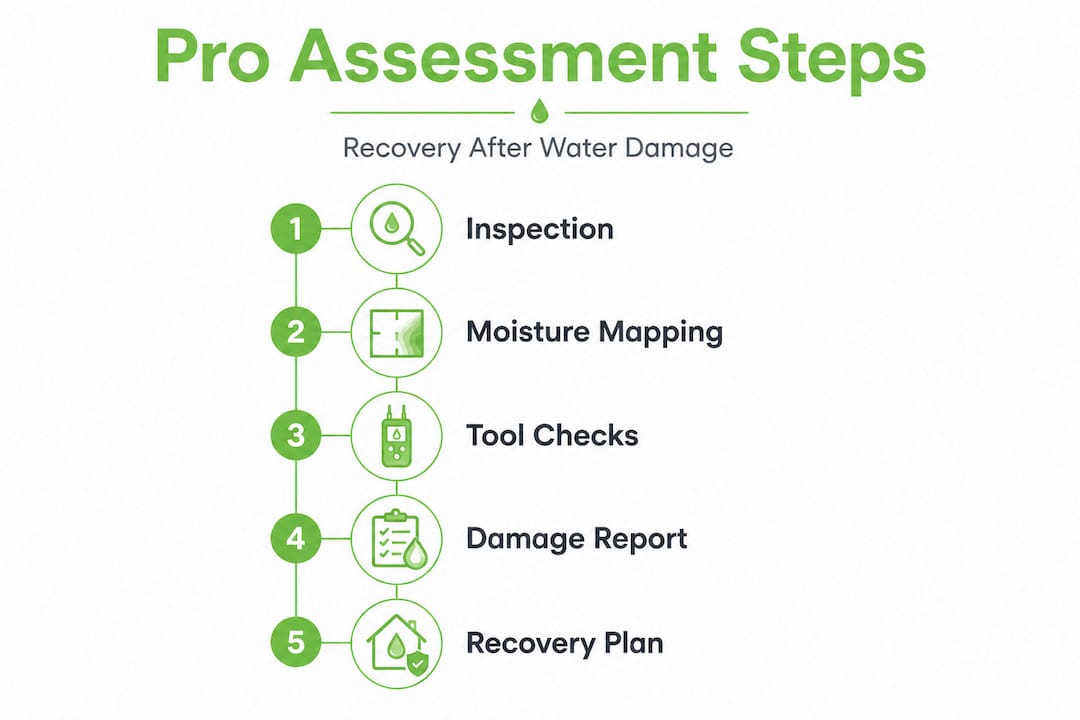
Safety and source control first. Before any measurement or documentation begins, the technician confirms the water source has been shut off and checks for electrical hazards. No assessment is worth starting in an unsafe environment.
-
Initial walkthrough and visual survey. The tech does a full visual sweep of affected and adjacent areas, noting obvious damage, water staining, and any signs of mold or odor. This is the starting point, not the conclusion.
-
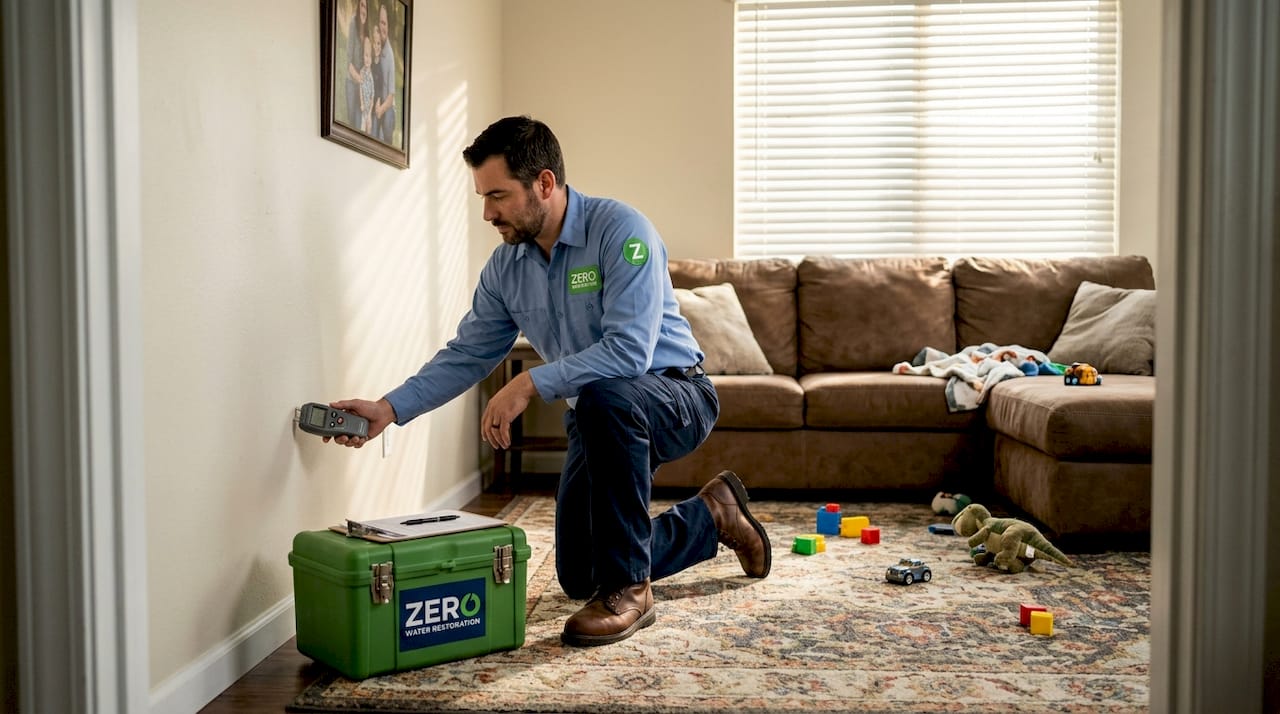
Moisture meter readings throughout the affected zone. Calibrated moisture meters are used on walls, floors, ceilings, and structural elements. Readings are taken in a grid pattern to map exactly where moisture is elevated and how far it has spread.
-
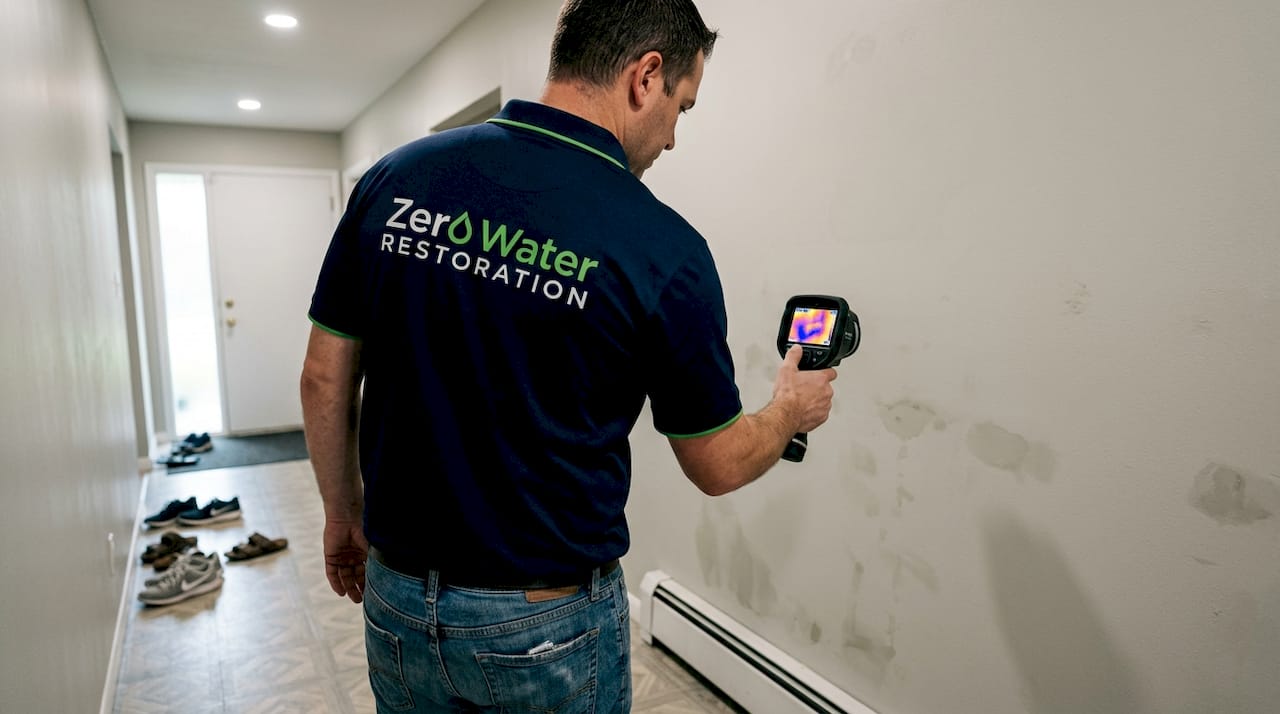
Thermal imaging scan. An infrared camera reveals temperature differences in surfaces, which indicate moisture hiding behind drywall, under flooring, or inside ceilings. This step catches what meters alone might miss.
-
Humidity and air quality measurement. Hydrometers (also called hygrometers) measure the relative humidity in the air. High ambient humidity slows drying and signals that moisture is still evaporating from hidden sources.
-
Damage classification and categorization. According to industry inspection standards, professionals classify water damage by water category (clean, gray, or black water) and by damage class (how much moisture has been absorbed and how difficult drying will be). This directly affects the restoration plan and timeline.
-
Full documentation and reporting. Every reading, photo, and observation is compiled into a report that serves as the foundation for both the restoration plan and the insurance claim.
| Assessment step | Tool used | What it finds |
|---|---|---|
| Moisture mapping | Pin and pinless meters | Moisture levels in walls, floors, ceilings |
| Thermal scan | Infrared camera | Hidden seepage behind surfaces |
| Humidity check | Hygrometer | Ambient moisture slowing drying |
| Water categorization | Visual + lab testing | Clean, gray, or black water classification |
| Damage class grading | Combined readings | Severity and drying difficulty |
For homeowners in Palatine, Barrington, or Schaumburg, response time matters enormously. Mold can begin developing within 24 to 48 hours of water exposure. A team that’s available around the clock and arrives quickly can compress the assessment timeline and get mitigation started before conditions worsen. These local water damage tips reinforce why speed and certification go hand in hand.
Key stat: Water damage that is addressed within the first 24 hours typically results in significantly lower restoration costs compared to damage that sits for 48 to 72 hours. Every hour matters.
Key tools and technology for finding hidden damage
With the process mapped out, it’s worth getting specific about the technology that makes professional assessments so much more reliable than anything you can do on your own.
Moisture meters come in two main types. Pin meters drive small probes into a material to measure electrical resistance, which correlates with moisture content. Pinless meters use radio frequency signals to scan below the surface without penetrating the material. Pros often use both. Pin meters give precise depth readings; pinless meters let technicians scan large areas quickly to identify where to focus.
Thermal imaging cameras are game-changers for hidden water detection. Water retains heat differently than dry building materials, so wet areas show up as distinct temperature zones on an infrared display. A technician can scan an entire wall in seconds and immediately see if moisture is trapped behind the drywall without cutting into anything. This saves time, reduces unnecessary demolition, and gives a clear picture of the damage scope.
Hygrometers measure relative humidity in the air. This matters because a room can have dry-feeling surfaces but still be saturated with airborne moisture from evaporation. Without measuring humidity, you might think drying is complete when materials are still releasing moisture into the air and reabsorbing it into adjacent surfaces.
The IICRC standards are explicit: calibrated tools are not optional. Visual and touch assessments are starting points at best. Relying on them exclusively leads to underscoped work, missed moisture, and eventual mold.
| Tool | DIY accessible? | What pros do with it |
|---|---|---|
| Pin moisture meter | Sometimes, but uncalibrated | Grid readings across all surfaces |
| Pinless moisture meter | Rarely | Fast surface scanning before deep testing |
| Thermal imaging camera | No | Full wall/ceiling/floor scans for hidden moisture |
| Hygrometer | Basic versions, yes | Ambient humidity tracking during drying phase |
| Borescope camera | No | Visual inspection inside wall cavities |
Pro Tip: Don’t assume that because your floors feel dry, the subfloor underneath is fine. Subfloor moisture is one of the most common things homeowners miss, and it’s one of the most expensive to fix when caught late. Protecting your home starts with knowing what you can’t see.
Common findings and what they mean for your home
After examining how pros detect problems, let’s talk about what they actually find and what those findings mean for your safety, your home’s structure, and your insurance outcome.
Hidden moisture behind walls and under floors is the most common finding. In a typical northwest Chicago suburb home, water from a burst pipe or a basement flood will wick into drywall, travel along floor joists, and pool in areas you’d never think to check. Left alone, that moisture becomes a mold problem within two days.
Structural weakening is more serious and more common than most homeowners expect. Drywall softens and crumbles. Wooden floor joists absorb moisture and begin to warp or rot. In severe cases, load-bearing elements can be compromised. This isn’t just a cosmetic issue. It’s a safety issue that affects the integrity of the building.
Air quality hazards follow moisture problems closely. Mold spores become airborne and circulate through HVAC systems. Dust mites thrive in humid conditions. For anyone with asthma, allergies, or respiratory conditions, this is a direct health threat. Professional restoration in Lake Zurich and throughout the northwest suburbs regularly uncovers air quality issues that homeowners had no idea existed.
Insurance claim outcomes are directly tied to the quality of the assessment. Insurers look for standardized documentation that proves the scope of damage and connects it to the covered event. When an IICRC-certified team documents everything from day one, claims move faster and disputes are rare. When documentation is missing or incomplete, adjusters push back.
“The homes where we find the worst long-term damage are almost always the ones where someone tried to handle it themselves first. By the time we get called, the moisture has had days to spread.”
Here’s a quick breakdown of what common findings mean for you:
- Elevated moisture in walls: Requires controlled drying with commercial dehumidifiers, not just fans
- Mold colonies: Requires professional remediation, not bleach spray
- Warped subfloor: Requires removal and replacement, not just surface drying
- High ambient humidity: Requires dehumidification and air movement equipment running for days
- Category 2 or 3 water (gray or black): Requires sanitization and protective equipment, not standard cleanup
What most homeowners miss and what really matters after water damage
Here’s a perspective built from years of responding to water damage calls across Schaumburg, Arlington Heights, Elk Grove Village, and the rest of the northwest suburbs: the biggest mistakes happen after the visible water is gone.
Homeowners see dry floors and assume the job is done. They run box fans for a day or two, check that surfaces feel dry, and move on. What they don’t realize is that the moisture has migrated into materials that take days or weeks to dry properly, even with commercial equipment. Box fans do almost nothing for deep structural moisture. They move air. They don’t remove the water that’s already soaked into your framing.
The unknown risks of water damage are not abstract. We’ve walked into homes three weeks after a flood where the homeowner thought everything was fine, only to find mold colonies covering the inside of an entire wall cavity. The outside of the wall looked and felt completely normal.
Waiting even 24 to 48 hours before calling a professional can double or triple the scope of work required. And every shortcut taken early in the process creates a problem that surfaces later, often at the worst possible time, like during a home sale inspection or after a family member develops unexplained respiratory symptoms.
What insurance companies actually want from a claim is a clear, documented chain of events: what happened, when it happened, what damage resulted, and what steps were taken immediately. A professional assessment creates that chain. A DIY approach breaks it. Adjusters aren’t trying to deny your claim. They just need evidence, and a certified restoration report gives them exactly that.
The most important thing you can do after water damage is not grab a mop. It’s pick up the phone.
Connect with trusted water damage assessment and restoration experts
If you’re dealing with water damage right now, or you suspect a problem that hasn’t been fully addressed, the next step is a professional assessment from a team that knows the northwest suburbs inside and out.
Zero Water Restoration is available 24/7 for emergency response throughout Schaumburg, Arlington Heights, Palatine, Hoffman Estates, and surrounding communities. Whether you need immediate water extraction or a thorough assessment of damage you’re not sure about, the team brings certified expertise, professional-grade equipment, and insurance documentation that actually holds up. From restoration services in Barrington to Lake Zurich water restoration, the process is the same: get there fast, assess thoroughly, and restore completely. That includes professional mold remediation when moisture has had time to create a secondary problem. Call (847) 515-7000 or visit zerowaterrestoration.com for a free inspection and estimate.
Frequently asked questions
What tools do restoration professionals use to find hidden water damage?
Certified pros use calibrated moisture meters, thermal imaging cameras, and humidity sensors to detect water you can’t see or feel, giving a complete picture of damage scope before any work begins.
Why do insurance companies require professional water damage assessments?
Insurance adjusters prefer detailed, standardized documentation from certified restoration pros because DIY checks routinely miss hidden moisture, which leads to disputed claims and incomplete repairs.
How quickly should I call a professional after finding water damage?
Contact a certified response team within 24 hours. IICRC-certified teams available around the clock can begin assessment and mitigation before mold takes hold and damage spreads further into your home’s structure.
What happens if some moisture is missed during the assessment?
Residual moisture leads to mold growth, structural deterioration, and air quality problems, even when surfaces feel completely dry to the touch, which is exactly why calibrated tools are non-negotiable.