
A burst pipe at midnight. A storm that overwhelms your basement. A roof leak you didn’t catch until the ceiling started sagging. These aren’t just inconveniences — they’re emergencies that put a clock on the line between manageable repair costs and an expensive nightmare. What many homeowners don’t realize is that mold growth can begin within 24 to 48 hours of moisture exposure, turning what seems like a fixable situation into a full-scale health and structural hazard very quickly. This guide cuts through the confusion around emergency water mitigation, explains exactly what it means, and gives you a clear, step-by-step picture of what to do when water invades your home.
Table of Contents
- What is emergency water mitigation?
- Why speed is critical: Time benchmarks and risks
- What to do immediately: Homeowner steps and safety tips
- What professionals do: The emergency water mitigation process
- Insurance claims and emergency mitigation: How they connect
- An expert perspective: Why the first day shapes everything
- Get help now: Professional water mitigation and support
- Frequently asked questions
Key Takeaways
| Point | Details |
|---|---|
| Act within 24–48 hours | Quick mitigation prevents mold and severe damage, protecting your home and wallet. |
| Take safety-first steps | Prioritize safety, stop the leak if possible, and document damage before professionals arrive. |
| Professional help matters | Certified technicians have tools and training to prevent lingering risks and insurance issues. |
| Insurance needs documentation | Keep all records and receipts for the best chance at a successful insurance claim. |
What is emergency water mitigation?
With the urgency clear, let’s break down what emergency water mitigation really means and how it’s different from other home services.
Emergency water mitigation is the immediate, professional response to active or recent water intrusion. The goal is to stop further damage from happening, not to fully rebuild or repair what’s already been lost. Think of it like applying pressure to a wound before surgery. You’re not fixing the problem permanently yet — you’re stabilizing the situation so things don’t get worse.
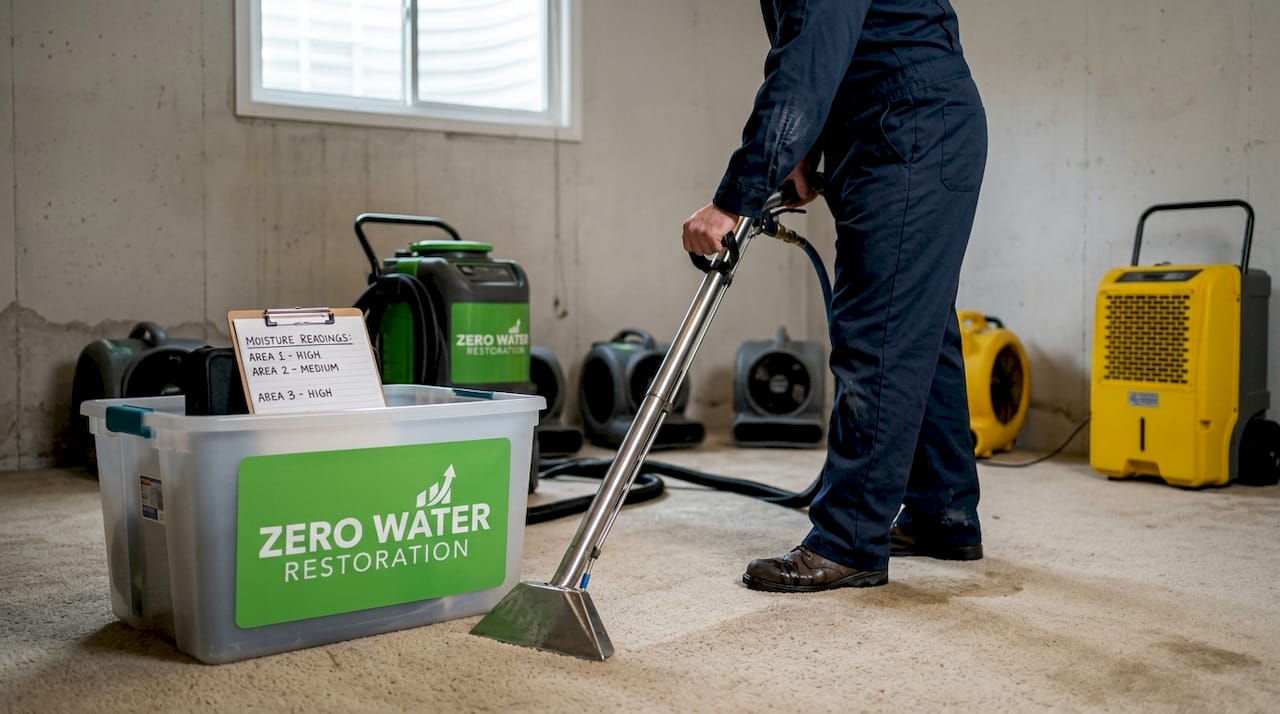
Mitigation includes assessing the extent of damage, extracting standing water, setting up industrial drying and dehumidification equipment, and stabilizing the structure. Prompt professional mitigation can minimize the risk of secondary damage like mold, warped framing, and compromised drywall. If you skip this step or delay it, those timely repair risks compound fast.
A lot of homeowners confuse mitigation with restoration or remediation. They’re related but distinct. Here’s how they break down:
| Service | What it means | When it happens |
|---|---|---|
| Mitigation | Stop further damage, extract water, dry out the site | Immediately after water intrusion |
| Restoration | Rebuild, repair, and return the home to pre-damage condition | After mitigation is complete |
| Remediation | Identify and remove mold, treat contaminated materials | During or after drying, if mold is found |
Mitigation is always first. Restoration and mold remediation steps come after the immediate threat is contained. Skipping mitigation to jump straight to repairs is like painting over rust — the problem keeps spreading under the surface.
Important: Every hour of standing water increases the risk of mold colonization, structural weakening, and electrical hazards. The 24 to 48 hour window is not a guideline — it’s the actual timeline before secondary damage becomes almost certain.
Why speed is critical: Time benchmarks and risks
Now that you understand the core purpose of mitigation, here’s why minutes matter and what’s at stake for your home and finances.
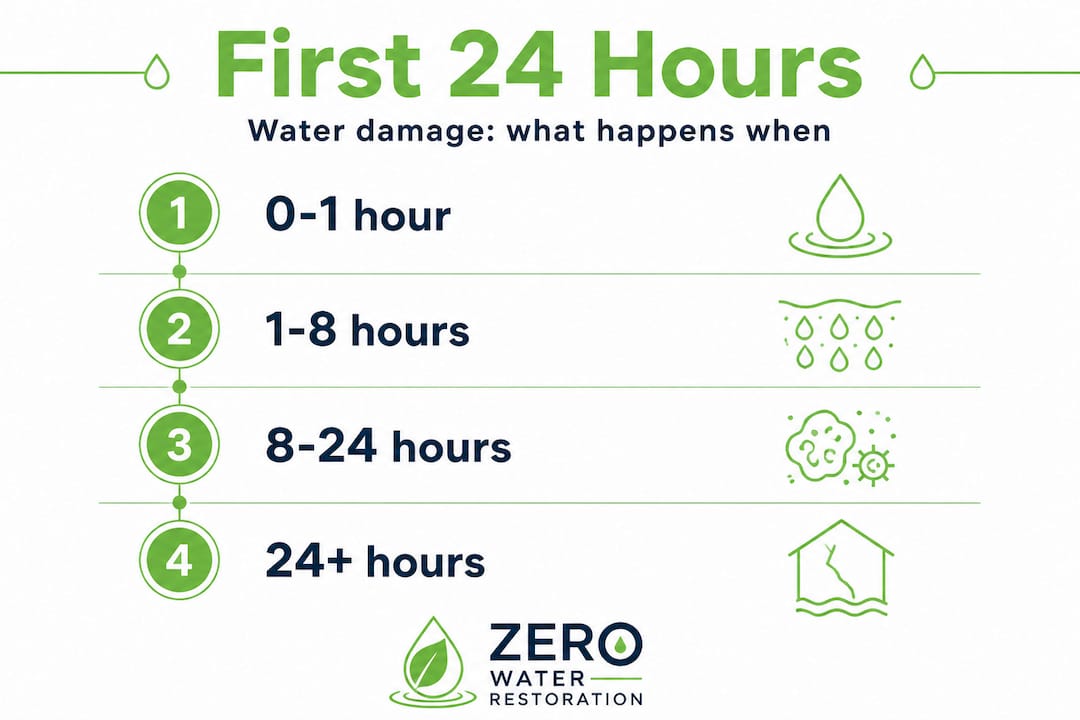
Water doesn’t sit still. It soaks into subfloors, wicks up drywall, and spreads through insulation. The longer it sits, the more material it penetrates and the more damage it causes. Here’s a realistic look at how the risks escalate over time:
| Time after water event | What’s happening in your home |
|---|---|
| 0 to 1 hour | Water spreads to floors, walls, and furniture |
| 1 to 12 hours | Drywall softens, wood swells, odors begin |
| 12 to 24 hours | Metal surfaces corrode, structural materials saturate |
| 24 to 48 hours | Mold growth risk begins, health concerns escalate |
| 48+ hours | Mold colonies form, structural damage worsens, remediation costs spike |
The financial impact of waiting is real. Restoration companies consistently report that homeowners who call within the first two hours after a water event face repair bills that are significantly lower than those who wait 24 hours or more. The difference can be measured in thousands of dollars, sometimes tens of thousands.
There’s also an insurance angle most people don’t think about until it’s too late. Most standard homeowner policies require that you take reasonable steps to prevent further damage after a covered loss. If you wait two days to call for help, your insurer may argue that the additional damage caused by delay wasn’t covered. That’s not a technicality — it’s a clause that adjusters actively look for.
Understanding how to protect your home before and immediately after a water event can make a meaningful difference in how your claim is handled.
Pro Tip: As soon as you discover water damage, call an emergency mitigation company and your insurance provider within the same hour if possible. Document everything with video before anyone touches a thing. That time-stamped footage is worth its weight in claim negotiations.
What to do immediately: Homeowner steps and safety tips
Understanding why speed is so critical, here are the actions you should take as soon as you discover water damage in your home.
Safety comes before everything else. Water and electricity are a life-threatening combination. If there is any chance that standing water has reached electrical outlets, your panel, or major appliances, do not enter the area until the power is shut off at the breaker.
Once you’ve confirmed it’s safe, here are the steps every homeowner should follow:
- Get everyone out of the affected area. People, pets, and anything sensitive to water should be moved to a dry part of the home immediately.
- Shut off the water source. If it’s a burst pipe, find your main shutoff valve and close it. If it’s a roof leak during a storm, there may not be much you can do to stop it, but stopping an internal source is critical.
- Document everything before touching it. Walk through the affected areas with your phone and record video and photos. Capture the source, the standing water, affected walls, ceilings, flooring, and any belongings.
- Move small valuables if it’s safe. Things like documents, electronics, and irreplaceable items can be relocated to dry areas. Don’t move large furniture or pull up flooring — that’s for the pros.
- Call your insurance company. Report the damage and ask what documentation they need. Follow their instructions and note the name of the representative you spoke with, along with the date and time.
- Call an emergency mitigation company. This is not a call to schedule for tomorrow morning. Safety-first actions and documentation are best for homeowners, but professionals must handle invasive work. Certified technicians need to get into your home as fast as possible.
If you’re in the northwest suburbs of Chicago, local restoration services are available around the clock. Having a number saved ahead of time could save you critical minutes when it matters most.
Pro Tip: Keep a written log from the moment you discover the damage. Write down what time you noticed it, what you did, who you called, and what they said. Save every receipt for any emergency supplies you buy. That paper trail strengthens your insurance claims guide process significantly.
What professionals do: The emergency water mitigation process
Once you’ve taken your initial steps, here’s what to expect from emergency mitigation professionals and how their approach protects your home.
When a certified mitigation team arrives, they don’t just show up with a shop vac and call it done. The process is methodical and built around stopping moisture from penetrating further into your home’s structure.
Here’s what a professional mitigation visit typically looks like:
- Initial inspection and moisture mapping. Technicians use thermal imaging cameras and moisture meters to find water that isn’t visible to the naked eye. Water hides behind walls, under flooring, and inside ceiling cavities.
- Water extraction. Industrial truck-mounted or portable extractors remove standing water far more effectively than any consumer equipment. We’re talking about machines capable of pulling hundreds of gallons from a space in a short time.
- Drying equipment setup. Commercial-grade air movers and dehumidifiers are placed strategically throughout the affected area. These aren’t box fans from the hardware store — they’re calibrated to create specific airflow patterns that accelerate evaporation from building materials.
- Controlled demolition if needed. Sometimes drywall, baseboards, or sections of flooring have to come out to allow drying equipment to reach saturated framing and subfloors. Invasive demolition and advanced drying must be left to trained professionals.
- Daily monitoring. Technicians return to check moisture readings and adjust equipment placement until everything reaches acceptable dry standards.
- Documentation throughout. Every reading, every equipment placement, and every step is logged. This documentation becomes part of your insurance file.
When choosing a restoration company, ask whether their technicians are IICRC certified (the Institute of Inspection, Cleaning and Restoration Certification is the industry standard). Certification means the team follows established drying science, not guesswork.
Pro Tip: Ask your mitigation technician for printed or emailed moisture readings at the start and end of the job. These reports are powerful evidence for your insurance adjuster and confirm that drying was completed to professional standards.
Insurance claims and emergency mitigation: How they connect
The connection between your quick action and the outcome of your insurance claim is direct and significant — here’s how emergency mitigation impacts your coverage.
Your insurance company isn’t just looking at the damage itself. They’re also evaluating whether you responded to it reasonably and quickly. When you call a certified mitigation company right away and document everything from the start, you’re building a case that shows you did everything right. That matters a lot when the adjuster sits down to calculate your payout.
Prompt water mitigation is often required by insurance to prevent denial of claims. Read that twice. If you delay, your insurer may argue that you allowed preventable secondary damage to occur, and that additional damage may fall outside your coverage.
Here’s what documentation you’ll need to support a strong claim:
- Timestamped photos and video of all damaged areas before mitigation begins
- Written record of the water source, when it was discovered, and when it was stopped
- Invoice and scope of work from your mitigation company
- Moisture readings from before and after the drying process
- Receipts for any out-of-pocket emergency supplies or hotel stays if you had to relocate
- Correspondence log showing every interaction with your insurance company
Working with a mitigation company that understands the claims process makes a huge difference. For detailed guidance, the navigating water damage claims resource breaks down what to expect at every stage.
An expert perspective: Why the first day shapes everything
After more than 10 years of responding to water emergencies across the northwest suburbs of Chicago, the pattern is unmistakable. Homeowners who call us within the first couple of hours almost always end up with better outcomes — lower out-of-pocket costs, smoother insurance claims, shorter project timelines, and far less emotional stress. Homeowners who wait, for whatever reason, almost always pay for it.
The most common reason for waiting is hope. People want to believe the wet carpet will dry on its own, that the ceiling will be fine if they run the furnace, or that they can deal with it in the morning. That thinking is understandable. Water damage is stressful and disorienting. But hope is not a drying strategy.
Consider two neighbors on the same street in Palatine after the same heavy storm event. Both experience basement flooding. One calls within two hours, gets extraction and drying equipment in place overnight, and has a clean, dry basement in four days with full insurance coverage. The other waits until the next morning, tries to manage it with a wet-dry vac and fans, and by day three has visible mold on the drywall and a musty smell throughout the basement. Their insurer questions why they waited before calling. The claim becomes a negotiation. The cost doubles.
The other thing we see regularly is that insurance providers are getting sharper about documentation. They know what professional mitigation looks like, and they can tell when documentation is thin or inconsistent. Companies that specialize in both mitigation and the insurance process give you a real advantage. For local restoration tips specific to this area, there’s solid guidance worth reviewing before an emergency happens.
The bottom line: the first day shapes everything. Don’t let hope cost you your home’s structure and your insurance payout.
Get help now: Professional water mitigation and support
When water hits your home, you need people who know the northwest suburbs, understand the insurance process, and can be on-site fast — any hour of the day or night.
Zero Water Restoration is available 24/7 for emergency water mitigation throughout communities including Schaumburg, Arlington Heights, Palatine, Hoffman Estates, Rolling Meadows, Mount Prospect, Elk Grove Village, Barrington, Bartlett, Lake Zurich, and Streamwood. If you’re dealing with flooding, burst pipes, storm damage, or any water intrusion, the team is ready to respond right now. For full coverage on water damage restoration in Barrington and surrounding areas, or for certified professional mold remediation when moisture has already led to growth, Zero Water Restoration handles it all from extraction to full rebuild. Their team also manages insurance claim help directly, keeping your out-of-pocket costs as low as possible. Call (847) 515-7000 or visit zerowaterrestoration.com for a free inspection.
Frequently asked questions
How fast can mold grow after water damage?
Mold can begin growing within 24 to 48 hours after water exposure if damp conditions persist. Warm indoor temperatures and organic materials like drywall and wood accelerate that timeline.
What should I do first during a water damage emergency?
Ensure everyone’s safety, shut off the water source if possible, then immediately document all visible damage with photos and video. Safety-first actions and documentation are best for homeowners before professionals arrive to handle the invasive work.
Will my insurance cover emergency water mitigation?
Most home insurance policies cover emergency mitigation if you respond quickly and document your actions from the start. Prompt water mitigation is often required by insurance to avoid denial of claims related to secondary damage.
Do I need to call professionals for all types of water damage?
Minor surface spills can often be handled yourself, but any significant flooding, sewage backup, or persistent moisture absolutely requires certified help. Invasive demolition and advanced drying must be left to trained professionals to ensure moisture is fully eliminated and mold is prevented.