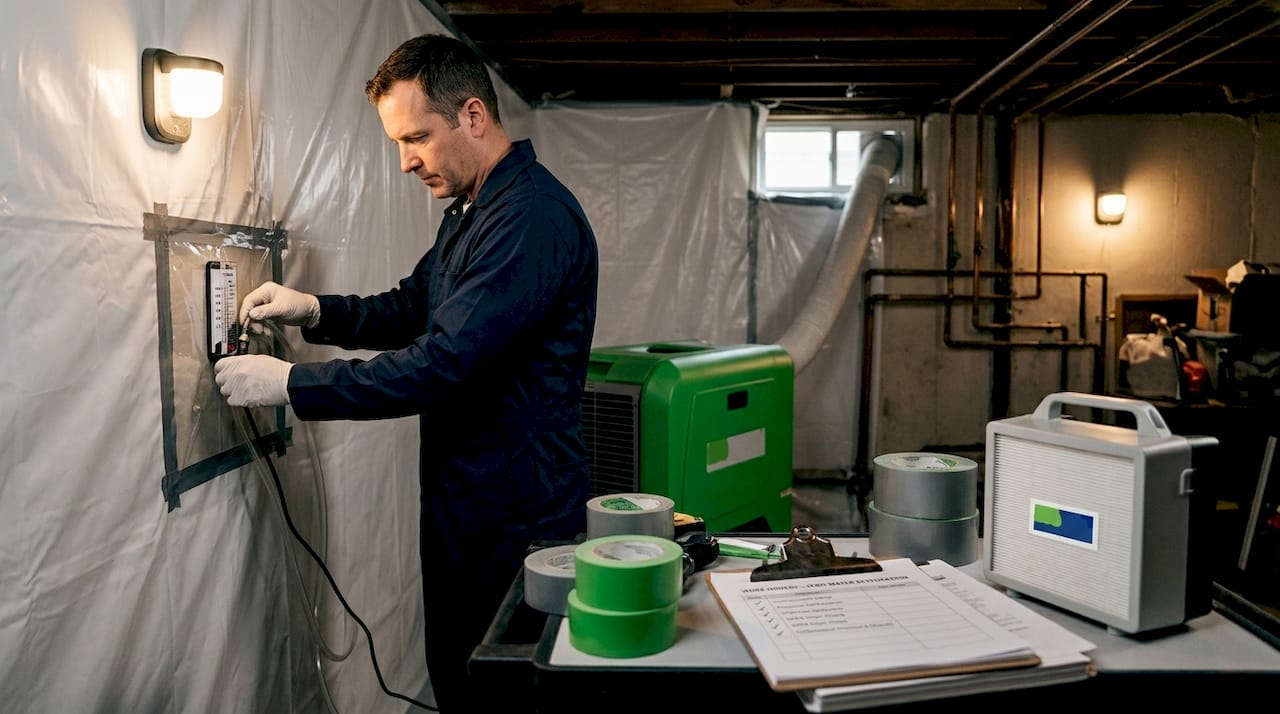
Negative air pressure in mold remediation is the controlled reduction of air pressure inside a contaminated work zone to prevent mold spores from migrating into clean areas of your home. Professionals call this technique “negative pressure containment,” and it sits at the center of every properly executed mold remediation project. The role of negative air pressure in mold remediation goes far beyond running a fan. It requires specific equipment, continuous monitoring, and strict workflow discipline. If a contractor skips it, spores disturbed during removal can spread through your entire house before the job is done.
How negative air pressure works to contain mold spores
Negative pressure containment works on a simple physical principle: air always flows from high pressure to low pressure. When a remediation team lowers the air pressure inside the work zone below the pressure in surrounding rooms, any air movement at gaps or barrier seams flows inward rather than outward. That inward flow carries spores toward the work zone instead of away from it.
The equipment that creates this effect is called a negative air machine (NAM). A NAM draws air from the sealed containment zone and exhausts it outside the building through a duct, typically through a window or exterior wall penetration. Every cubic foot of air exhausted outdoors is replaced by air drawn in through intentional entry points, keeping the zone under constant negative pressure. The IICRC S520 Standard describes this as a source control measure, combining barriers, negative pressure, HEPA filtration, and decontamination chambers into one integrated system.
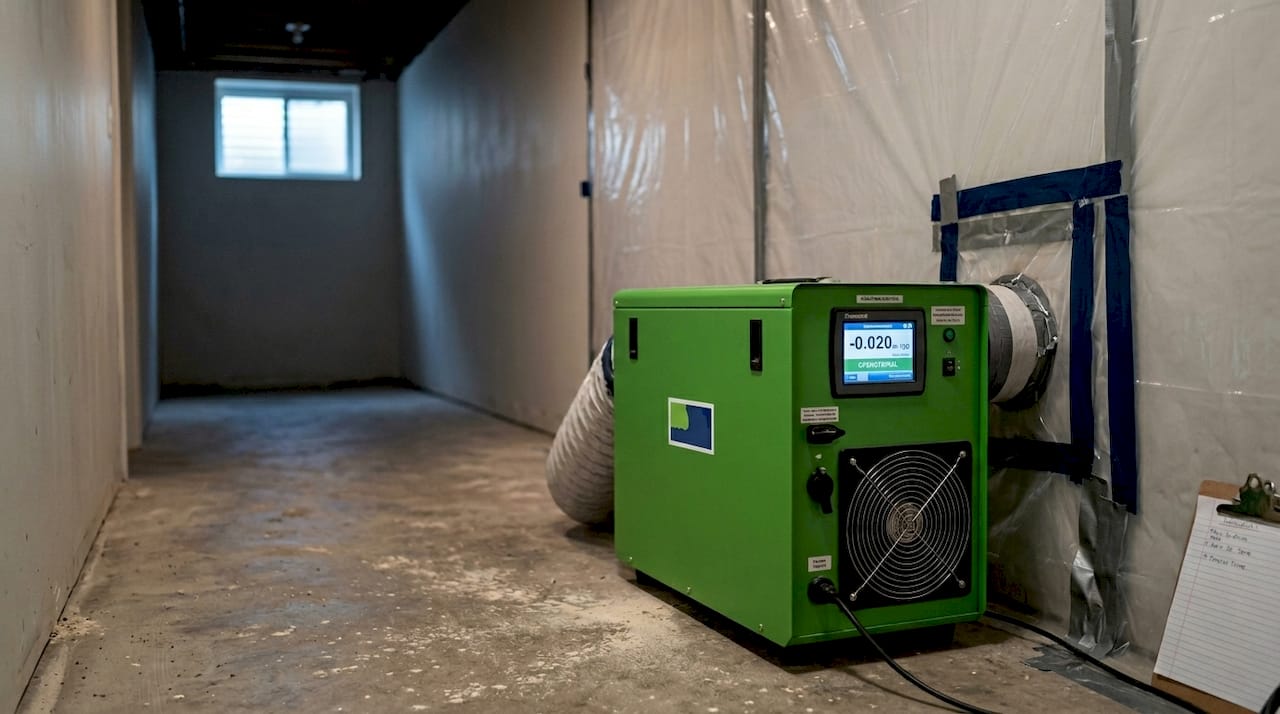
The pressure target professionals aim for is approximately negative 5 Pascals relative to adjacent spaces. That number matters because it is measurable and verifiable. Technicians use manometers or magnehelic gauges to confirm the differential is maintained throughout the job, not just at setup. A reading that drifts toward zero signals a breach somewhere in the containment.
HEPA filtration is the other half of the equation. Before exhausted air leaves the building, it passes through a HEPA filter rated to capture particles as small as 0.3 microns. Mold spores range from 1 to 100 microns, so a properly maintained HEPA filter stops them before they reach the outdoors or re-enter the structure.
Pro Tip: Ask your contractor to show you a live manometer reading before demolition begins. A professional crew will have one installed and will welcome the question. If they cannot produce a reading, containment is not verified.
Negative air machines vs. air scrubbers: what’s the real difference?
Homeowners frequently see both negative air machines and air scrubbers listed on remediation proposals and assume they do the same job. They do not. Understanding the distinction helps you evaluate whether a contractor is setting up proper containment or cutting corners.
| Equipment | Function | Creates negative pressure? | Best use case |
|---|---|---|---|
| Negative air machine (NAM) | Exhausts filtered air outside the building | Yes | Full containment zones requiring pressure differential |
| Air scrubber | Filters and recirculates air within the space | No | General air quality improvement, supplemental filtration |
Negative air machines exhaust filtered air outside, which is what creates the pressure differential. An air scrubber pulls air through a HEPA filter and returns it to the same room. That recirculation cleans the air, but it does not lower the room’s pressure relative to adjacent spaces. Spores can still migrate outward through gaps in barriers when only an air scrubber is running.
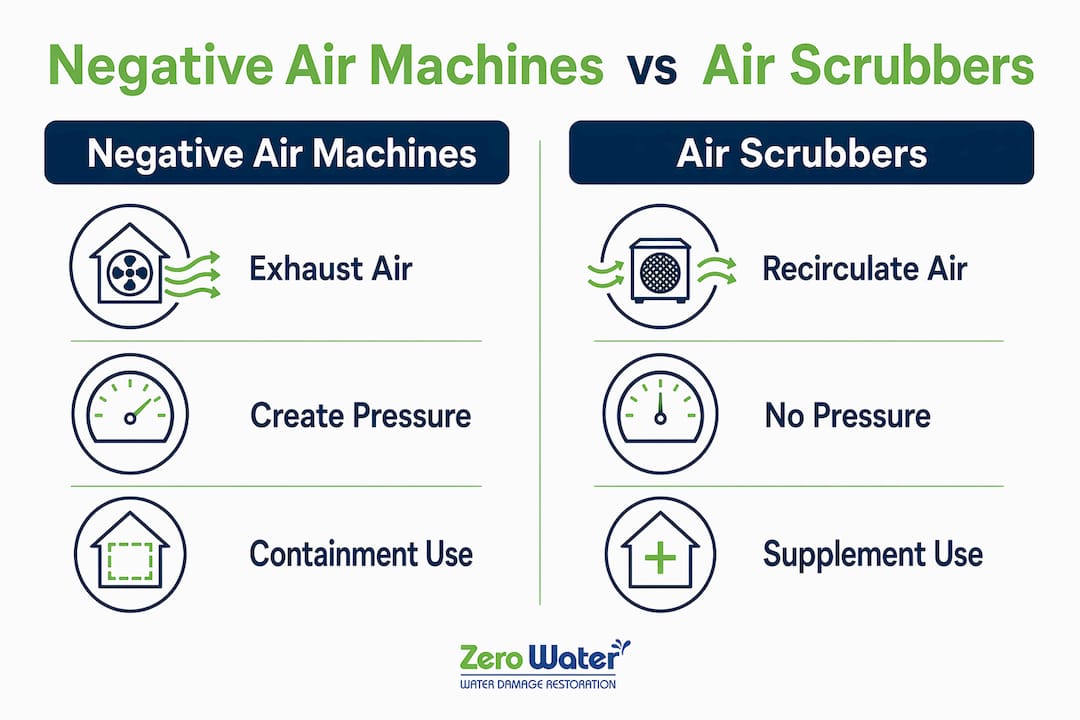
Air scrubbers are genuinely useful as a supplement. Running one inside the containment zone alongside a NAM improves overall air quality and reduces the spore load that workers breathe. But an air scrubber alone does not satisfy the containment requirements outlined in the IICRC S520 or EPA mold remediation guidelines for projects above a certain size.
For small, isolated mold patches under 10 square feet, limited containment with an air scrubber may be acceptable. For anything larger, or any project involving HVAC contamination, a NAM exhausting outdoors is the standard. Knowing this distinction lets you ask the right questions when reviewing a remediation proposal.
Common challenges in maintaining negative air pressure during remediation
Achieving negative pressure at the start of a job is the easy part. Maintaining it through demolition, drying, and cleanup is where most containment failures actually happen. Real-world containment often fails due to minor unsealed points or workflow breaks that allow pressure to trend back toward neutral.
Here are the most common failure points and how professionals address them:
- Barrier breaches. Polyethylene sheeting barriers develop small tears or unsealed seams during active work. Technicians should inspect barriers at the start of each shift and seal any gaps with spray foam or tape rated for containment use.
- Door openings. Every time a worker passes through the containment entry, pressure briefly equalizes. Zipper doors or double-flap entries reduce this effect significantly compared to a simple slit in the plastic.
- Machine downtime. Negative air pressure systems must run continuously through disturbance, cleanup, and drying phases. Turning the NAM off, even briefly, allows pressure to equalize and spores to migrate outward. This is one of the most common shortcuts taken on residential jobs.
- Inadequate exhaust capacity. A NAM sized for a 500-square-foot zone will not maintain adequate pressure in a 1,500-square-foot basement. Equipment must be matched to the volume of the containment area.
- HVAC system interference. If the building’s HVAC is running, it can pressurize or depressurize adjacent spaces, counteracting the NAM. Shutting down HVAC to the affected zone is standard practice.
Continuous monitoring throughout the project is more important than the initial setup reading. A manometer log showing pressure readings at regular intervals gives you documented proof that containment held for the entire job.
Pro Tip: Request a written pressure log from your contractor at project completion. Reputable firms using IICRC S520 protocols document readings throughout the job. This record also supports your insurance claim if one is involved.
When should you insist on negative air pressure during mold remediation?
Not every mold situation requires full negative pressure containment, but knowing the thresholds protects you from both under-treatment and unnecessary upselling.
Full containment with negative air pressure is required for remediation areas larger than 100 square feet or for more hazardous mold conditions. That is roughly a 10-by-10-foot patch. Below that threshold, limited containment may be appropriate depending on the mold type and location.
Situations that always warrant full negative pressure containment include:
- Mold growth exceeding 10 square feet, regardless of location in the home.
- HVAC system contamination, where spores can travel through ductwork to every room. You can learn more about this specific risk in this guide to duct sanitizing for mold.
- Mold in occupied buildings, particularly where vulnerable occupants such as children, elderly residents, or immunocompromised individuals are present.
- Hidden mold behind walls or under flooring, where demolition will release a concentrated burst of spores.
- Water damage events that affected multiple rooms or structural materials, since moisture migration often means mold has spread further than visible inspection reveals.
Disturbing mold without containment raises airborne spore counts dramatically. Fungal fragments can outnumber spores by 320 times, which means even a small disturbance without negative pressure can contaminate rooms that had no mold problem before work began. That cross-contamination turns a contained remediation into a whole-house problem, and the cost to address it multiplies accordingly.
The verification step matters as much as the setup. Professionals confirm negative pressure is working by checking that containment barriers pull slightly inward under suction, that manometer readings hold steady at the target differential, and that smoke pencil tests show airflow moving into the zone rather than out of it. Ask your contractor which of these methods they use before work begins. A step-by-step mold remediation guide for Chicago-area homeowners covers these verification steps in practical detail.
Negative air machines reduce spore spread but do not replace the need for personal protective equipment during mold removal. Proper containment and proper PPE work together. One does not substitute for the other.
Key takeaways
Negative pressure containment is the single most important factor separating a safe mold remediation from one that spreads the problem further through your home.
| Point | Details |
|---|---|
| Pressure target is measurable | Professionals target approximately negative 5 Pascals, verified with a manometer throughout the job. |
| NAMs and air scrubbers are not interchangeable | Only negative air machines exhausting outdoors create true pressure differentials; air scrubbers recirculate air without lowering pressure. |
| Continuous operation is non-negotiable | Turning off the NAM at any point during disturbance, drying, or cleanup compromises containment and risks cross-contamination. |
| Size thresholds trigger full containment | Any mold area over 100 square feet or involving HVAC contamination requires full negative pressure containment under EPA and IICRC S520 guidelines. |
| Documentation protects you | A written pressure log from your contractor provides proof of containment integrity and supports insurance claims. |
What I’ve learned from watching containment fail in the field
I have been on enough mold jobs to tell you that the most expensive remediation mistakes I have seen were not caused by the wrong chemical or the wrong mold type. They were caused by skipped containment steps that seemed minor at the time.
The pattern is almost always the same. A crew sets up barriers and gets the NAM running. Pressure looks good at the start. Then someone props the containment entry open to move equipment, or the NAM gets switched off at lunch and nobody restarts it immediately, or a seam in the barrier tears and gets taped over without checking whether pressure recovered. By the time the job is done, spores have migrated into the HVAC return, into adjacent rooms, into the clean side of the house. The homeowner calls back two weeks later wondering why there is now mold in rooms that were never touched.
Proper containment is a system, as expert Michael A. Pinto has documented. Barriers alone do not stop spores. Negative pressure alone does not stop spores. The combination of sealed barriers, continuous negative pressure, HEPA-filtered exhaust, and disciplined workflow is what actually works. Any contractor who treats these as optional add-ons rather than baseline requirements is not following the standard.
My advice to every homeowner and property manager: ask specifically about negative air pressure before you sign anything. Ask what equipment they use, how they verify pressure, and whether they keep a log. The answers will tell you more about a contractor’s competence than any certification on their website.
You can read more about containment’s role in mold remediation to understand exactly what a properly contained job looks like from start to finish.
— Jim
How Zero Water Restoration handles mold remediation the right way
Zero Water Restoration follows IICRC S520 protocols on every mold remediation job in the Chicagoland area, including full negative pressure containment, HEPA-filtered exhaust, and continuous manometer monitoring throughout the project. The team sets up sealed polyethylene barriers, runs negative air machines sized to the containment volume, and documents pressure readings so you have a verifiable record when the job is complete. Whether the mold is in a basement, crawl space, or behind drywall, the approach does not change. If you are dealing with mold in Schaumburg, Arlington Heights, Barrington, or anywhere in the northwest suburbs, get a free inspection from the mold remediation team at Zero Water Restoration. Call (847) 515-7000 or visit zerowaterrestoration.com.
FAQ
What is negative air pressure in mold remediation?
Negative air pressure in mold remediation is the deliberate reduction of air pressure inside a contaminated work zone so that airflow moves inward rather than outward, preventing mold spores from escaping into clean areas of the building. It is achieved using a negative air machine that exhausts filtered air outside the structure.
How many square feet of mold requires negative air pressure containment?
Full containment with negative air pressure is required for mold growth exceeding 100 square feet, or for any project involving HVAC contamination or hazardous mold conditions, according to EPA and IICRC S520 guidelines.
What is the difference between a negative air machine and an air scrubber?
A negative air machine exhausts air outside the building to create a measurable pressure differential, while an air scrubber filters and recirculates air within the same space without lowering pressure. Only a negative air machine achieves true negative pressure containment.
How do professionals verify negative air pressure is working?
Technicians use manometers or magnehelic gauges to confirm a pressure differential of approximately negative 5 Pascals relative to adjacent spaces. Visual checks such as inward-pulling barriers and smoke pencil tests also confirm that airflow is directed into the containment zone.
Can negative air pressure replace personal protective equipment during mold removal?
No. Negative air machines reduce airborne spore spread but do not eliminate worker or occupant exposure risk. Proper PPE including respirators, gloves, and protective suits remains required alongside negative pressure containment throughout the remediation process.