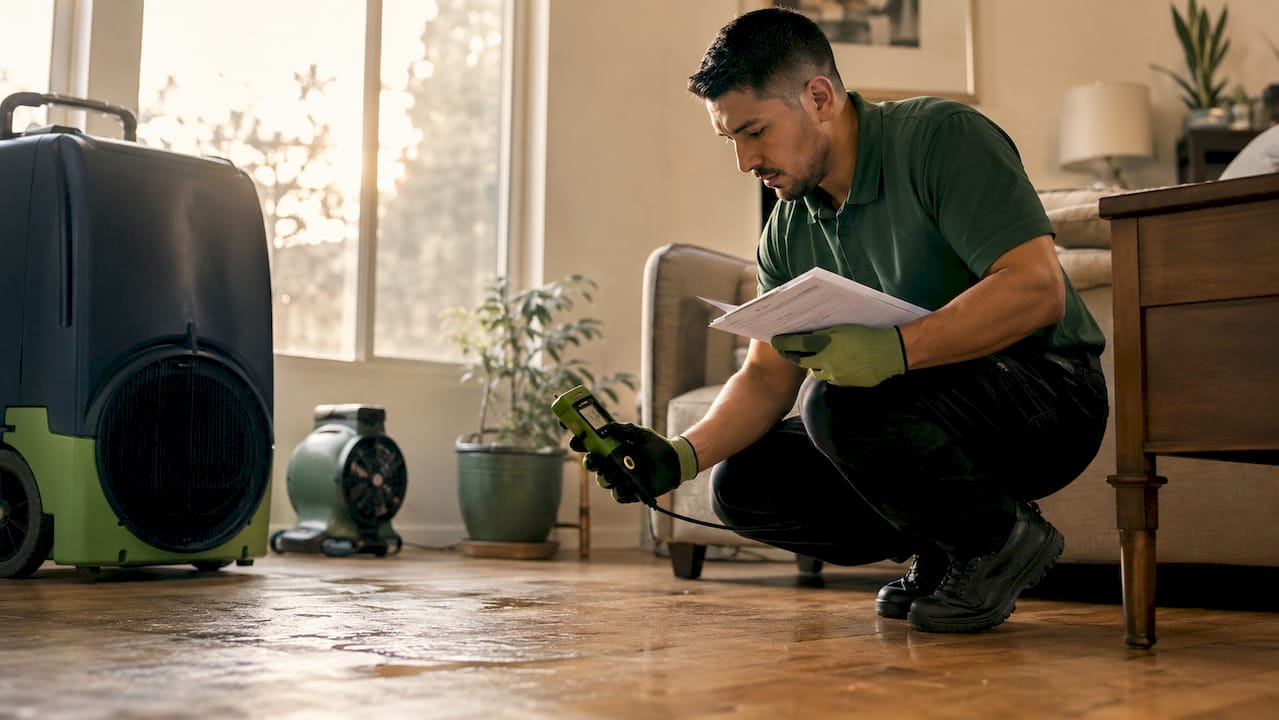
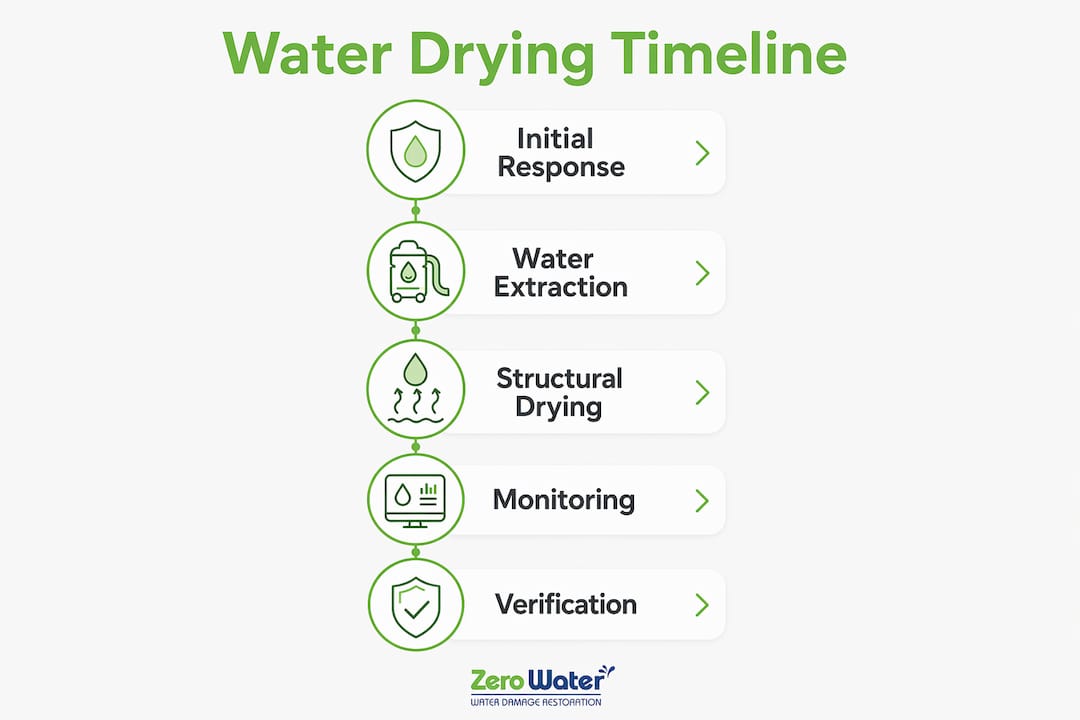
The water drying process, known in the restoration industry as structural drying, takes anywhere from 24 hours to 14 days or more depending on damage severity, water source, and building materials involved. Small leaks with clean water can resolve in 24–48 hours when addressed immediately, while extensive flooding with contaminated water routinely requires two full weeks. The IICRC S500 standard governs how professionals classify and dry water damage, and understanding that framework helps you set realistic timelines and hold your restoration team accountable. One non-negotiable rule: drying must begin within 24–48 hours, because microbial growth starts after that window closes.
How long does the water drying process take by damage class?
Restoration professionals classify water damage on two axes: water category and damage class. Together, these two factors determine your drying timeline more than any other variable.
Water category describes the contamination level of the source water. Category 1 is clean water from a supply line or appliance. Category 2, called gray water, carries biological contaminants from sources like washing machine overflow. Category 3, or black water, is grossly contaminated and includes sewage and floodwater. Higher categories require additional cleaning steps before drying can proceed, which adds time.
Damage class describes how deeply water has penetrated materials. The IICRC S500 drying standard defines four classes:
| Damage Class | Description | Typical Drying Time |
|---|---|---|
| Class 1 | Minimal absorption, hard surfaces only | 1–3 days |
| Class 2 | Significant absorption into carpet and walls | 3–7 days |
| Class 3 | Deep saturation, walls, ceilings, insulation | 7–14 days |
| Class 4 | Dense materials: hardwood, concrete, plaster | 14+ days |
Class 4 losses are the outlier most homeowners do not anticipate. Hardwood floors and concrete slabs absorb water slowly and release it even more slowly. A flooded basement with a concrete floor and wood framing can stay wet for three weeks even with professional equipment running continuously.
Pro Tip: Ask your restoration contractor to state the damage class in writing on day one. That single number tells you whether you are looking at a three-day job or a three-week job before a single fan is placed.
How do temperature, humidity, and equipment affect drying speed?
Environmental conditions control how fast water evaporates from wet materials. The optimal drying environment sits between 70°F and 90°F with relative humidity held at 30–40%. Outside that range, equipment performance drops sharply. Below 60°F, dehumidifier coils ice over and stop pulling moisture from the air. Above 90°F, some units shut down entirely to protect their motors.
Professional restoration crews use three primary tools to control the drying environment:
- Air movers push high-velocity air across wet surfaces to accelerate surface evaporation. During the initial constant-rate drying phase, airflow runs at roughly 600 feet per minute (FPM) to strip moisture from exposed surfaces.
- Dehumidifiers capture the water vapor that air movers release into the room air. Without dehumidification, humidity rises until evaporation stalls completely.
- HVAC integration supplements mechanical drying by maintaining consistent temperature throughout the structure. Crews often seal off affected rooms to prevent humid air from migrating to dry areas.
As drying progresses, the process enters what engineers call the falling-rate phase. Moisture migrates from deep within materials to the surface more slowly. Airflow drops to around 150 FPM during this phase because excess velocity can actually impede moisture migration in dense materials. This counterintuitive adjustment is one reason professional drying outperforms consumer fan placement every time.
Pro Tip: If a contractor places equipment and does not return for three days, that is a red flag. Drying conditions require daily adjustment as moisture levels change. A set-it-and-forget-it approach almost always leaves hidden moisture behind.
How is drying progress monitored and verified?
“Dry to the touch” is not a professional standard. Structural dryness means moisture content readings fall within 2–4% of unaffected reference materials in the same building. That gap matters because residual moisture trapped inside walls or subfloors triggers mold growth within 48 hours of equipment removal.
Professional monitoring follows a documented daily process:
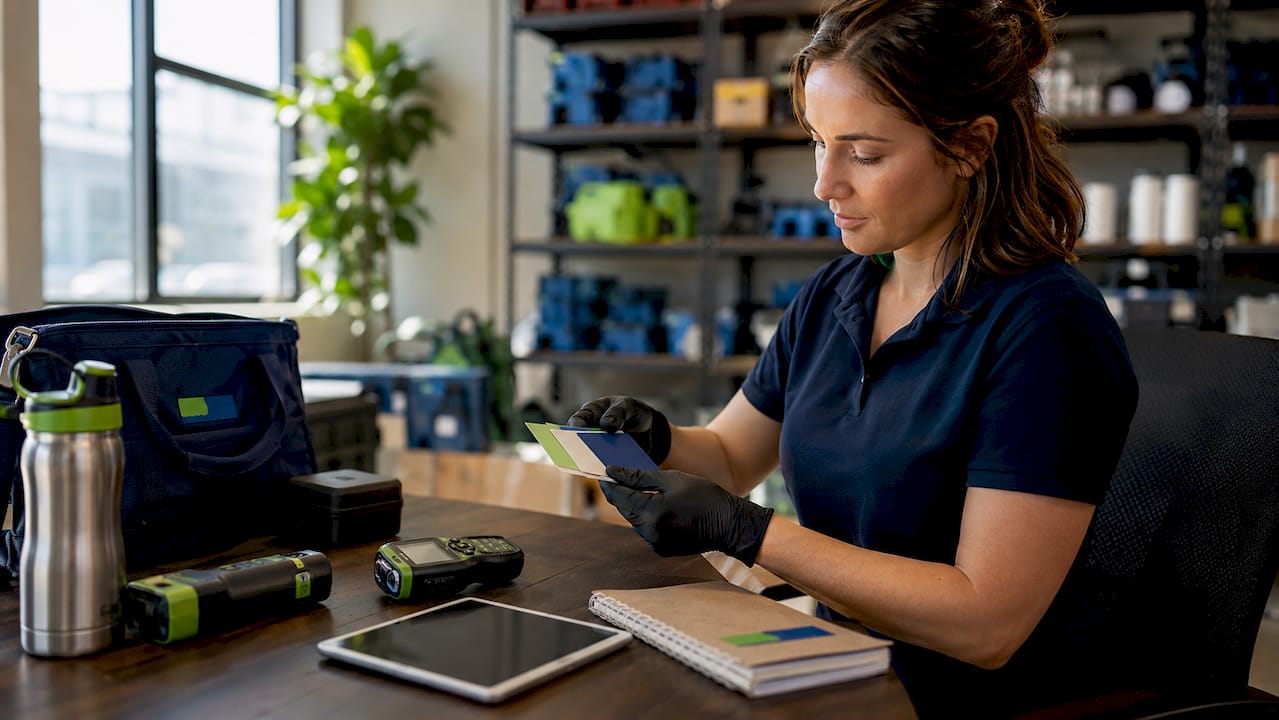
- Moisture meter readings taken at fixed measurement points on walls, floors, and ceilings. Technicians use both pin-type meters for surface readings and pinless meters for scanning deeper into materials without drilling.
- Thermo-hygrometer readings recorded to track ambient temperature and relative humidity inside the drying zone. These numbers confirm whether the equipment is maintaining the target environment.
- Thermal imaging scans used to detect moisture trapped inside wall cavities or beneath flooring that standard meters cannot reach. Thermal cameras show temperature differentials that indicate wet areas invisible to the naked eye.
- Daily moisture logs compiled into a drying report. These logs serve as documentation for insurance adjusters and prove that drying met the IICRC dry standard before reconstruction began.
The daily log is not just a formality. Skipping daily monitoring is the single most common cause of mold appearing weeks after a restoration job is declared complete. You can review how professionals approach this assessment process by reading about how pros evaluate water damage from the start of a job.
Proper documentation also protects your insurance claim. Daily logs and moisture records prove adherence to industry standards, which prevents adjusters from disputing the scope of work or denying coverage for secondary damage.
What factors can extend or shorten water drying time?
Several practical variables push drying timelines in either direction. Knowing them helps you anticipate delays before they become expensive surprises.
Factors that extend drying time:
- Delayed discovery. Water that sits undetected for days before restoration begins has already saturated deeper into materials and may have elevated the water category through microbial growth. Extended drying beyond 14 days often traces back to a delayed response.
- Dense or layered materials. Hardwood flooring, concrete, and multi-layer assemblies like tile over cement board over subfloor trap moisture between layers. Each layer must dry independently.
- Contamination requiring pre-cleaning. Category 2 and 3 water requires antimicrobial treatment before drying equipment goes in. That adds a day or more to the overall timeline.
- Access limitations. Furniture that cannot be moved, built-in cabinetry, and closets packed with belongings all block airflow and create pockets where moisture hides.
- Multi-room damage. Water migrates through walls and under flooring into adjacent rooms. Crews must set up drying zones in every affected space, which increases equipment needs and monitoring complexity.
Factors that shorten drying time:
- Immediate source control. Shutting off the water supply within minutes of a burst pipe limits total saturation volume. Every hour of active water flow adds material penetration depth.
- Prompt professional extraction. Removing standing water with truck-mounted extraction equipment before it soaks into subfloors dramatically reduces drying time. The water extraction process is the first and most time-sensitive step.
- Hard, non-porous surfaces. Tile, vinyl plank, and sealed concrete dry significantly faster than carpet, drywall, or hardwood.
- Low ambient humidity. Dry climates or well-conditioned indoor air gives dehumidifiers less work to do and accelerates the evaporation rate of water from wet materials.
Homeowners who act fast and call a professional within the first few hours consistently see shorter timelines and lower total costs. For a broader look at what the full restoration timeline looks like from start to finish, Zerowaterrestoration has published a detailed guide covering each phase. Knowing when a pipe burst and acting quickly on emergency plumbing before the restoration crew arrives also limits how much water enters the structure in the first place.
Key Takeaways
Structural drying takes 1–3 days for minor clean water damage and up to 14 days or more for deep saturation, contaminated water, or dense materials, and no reconstruction should begin until moisture readings confirm the IICRC dry standard is met.
| Point | Details |
|---|---|
| Drying timeline by class | Class 1 takes 1–3 days; Class 4 losses in dense materials take 14 days or more. |
| Start within 48 hours | Microbial growth begins after 48 hours, escalating damage category and cost. |
| Environment controls speed | Maintain 70–90°F and 30–40% humidity for equipment to perform at full capacity. |
| Daily monitoring is non-negotiable | Moisture logs taken daily protect against hidden mold and support insurance claims. |
| Structural dry beats touch dry | Professionals verify dryness within 2–4% of reference materials, not by feel. |
What I have learned after a decade of watching drying jobs go wrong
The most expensive mistake I see homeowners make is agreeing to reconstruction before the drying is verified complete. A contractor eager to move to the profitable rebuild phase will sometimes pull equipment a day or two early. The walls feel dry. The floors look fine. Six weeks later, the homeowner has mold behind the new drywall and a second claim to file.
My advice is direct: reconstruction should not start until you have seen the final moisture log showing readings within the IICRC dry standard. Ask for that document. If the contractor cannot produce it, that tells you everything you need to know about how they ran the job.
The second thing I push homeowners on is choosing a restoration company that follows IICRC S500 protocols and documents everything in writing. The standard exists for a reason. Companies that skip daily moisture logs are not cutting corners to save you money. They are cutting corners to save themselves time. The cost lands on you later.
Drying is a science, not a feeling. Faster is not always better. Pulling equipment too early because readings look “close enough” is how hidden moisture becomes a mold problem. The right crew adjusts equipment daily, reads the numbers, and does not declare victory until the data says so.
— Jim
Zerowaterrestoration’s approach to efficient, verified drying
Water damage does not follow a schedule, and neither does the Zerowaterrestoration team. Available 24/7 across the northwest Chicago suburbs, Zerowaterrestoration responds fast, extracts standing water immediately, and sets up a controlled drying environment built around daily moisture monitoring.
Every job includes documented moisture logs updated daily, giving you and your insurance adjuster a clear record of drying progress from day one. Zerowaterrestoration follows IICRC S500 protocols on every loss, from a single-room pipe burst to a multi-floor flood. If you are dealing with water damage in Barrington or anywhere in the Chicagoland area, get a free inspection and find out exactly what your drying timeline looks like. Call (847) 515-7000 or visit zerowaterrestoration.com.
FAQ
How long does water drying typically take after a flood?
Typical drying times range from 24–48 hours for minor clean water damage to two weeks or more for extensive flooding. The final timeline depends on damage class, water category, and how quickly restoration begins.
What happens if drying takes longer than 14 days?
Drying beyond 14 days usually signals deep saturation in dense materials, contaminated water, or a delayed response. A professional crew will reassess the drying plan and may need to open wall cavities or remove flooring to reach trapped moisture.
Can I speed up the drying process myself?
You can help by shutting off the water source immediately, removing standing water with a wet vacuum, and opening windows if outdoor humidity is low. Professional extraction and dehumidification equipment, however, dries structures far faster than consumer tools.
Why does my floor still feel damp after three days of fans running?
Consumer fans move air but do not remove moisture from the room. Without a dehumidifier capturing evaporated water, humidity rises until evaporation stops. Professional drying pairs air movers with dehumidifiers to maintain the 30–40% relative humidity target that keeps evaporation moving.
Does insurance cover the full drying process?
Most homeowner policies cover sudden and accidental water damage, including professional drying and documentation costs. Proper moisture logs are critical to supporting your claim and preventing adjusters from disputing the scope or duration of drying work.