
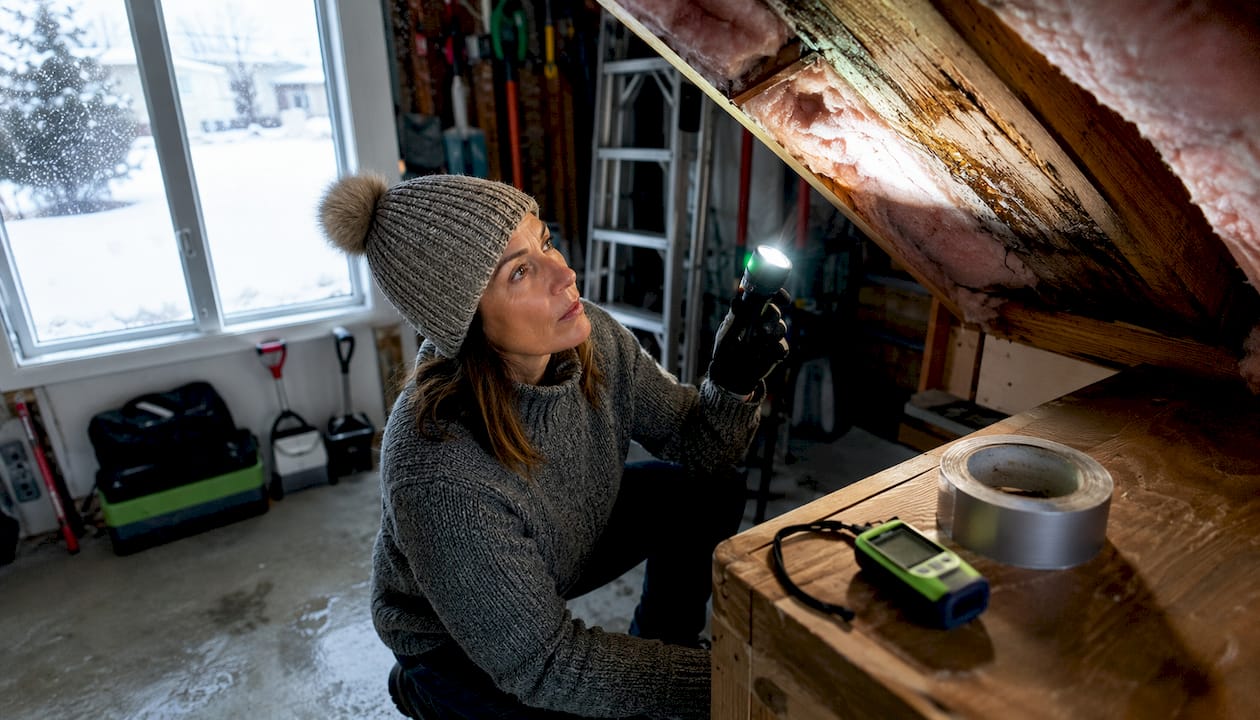
Winter water damage is any structural harm caused by freezing, thawing, trapped meltwater, ice dams, burst pipes, or condensation during cold months. If you’re reading this because something just went wrong, here’s what to do right now:
- Shut off the main water supply if a pipe has burst or water is actively flowing somewhere it shouldn’t be.
- Document everything immediately with photos and video before touching anything.
- Contain what you can with towels or buckets, and move valuables to dry ground.
- Call a restoration professional if water covers more than a small area, if you see ceiling stains, or if you’re unsure where the water came from.
The bottom line: winter water damage is often hidden until a thaw reveals the full extent. Acting fast in the first hours limits both the physical damage and your exposure to a denied insurance claim.
Table of Contents
- What is winter water damage, and why does it happen?
- Common scenarios and warning signs you shouldn’t ignore
- Water damage categories and the mold risk that follows
- How to prevent winter water damage before it starts
- What to do in the first hours after discovering water damage
- When you need a professional restoration company
- How homeowners insurance handles winter water damage
- Key Takeaways
- What homeowners in the Chicago suburbs get wrong about winter damage
- Zerowaterrestoration is ready when winter damage hits
- Useful sources
What is winter water damage, and why does it happen?
The short answer is physics. Water expands roughly 9% when it freezes. That expansion exerts enough pressure to crack concrete, fracture brick, and split copper or PVC plumbing. Every winter, that same force plays out inside the walls, foundations, and rooflines of homes across the country.
The freeze–thaw cycle is the engine behind most winter structural damage. Water seeps into a microscopic pore or hairline crack in masonry. It freezes, expands, and forces the gap slightly wider. It thaws. More water enters the now-larger gap. It freezes again. Each cycle incrementally widens pores and cracks in concrete and brick assemblies, and the cumulative damage can take years to become visible. By the time you see spalling brick or a cracked foundation wall, dozens of cycles may have already done their work.
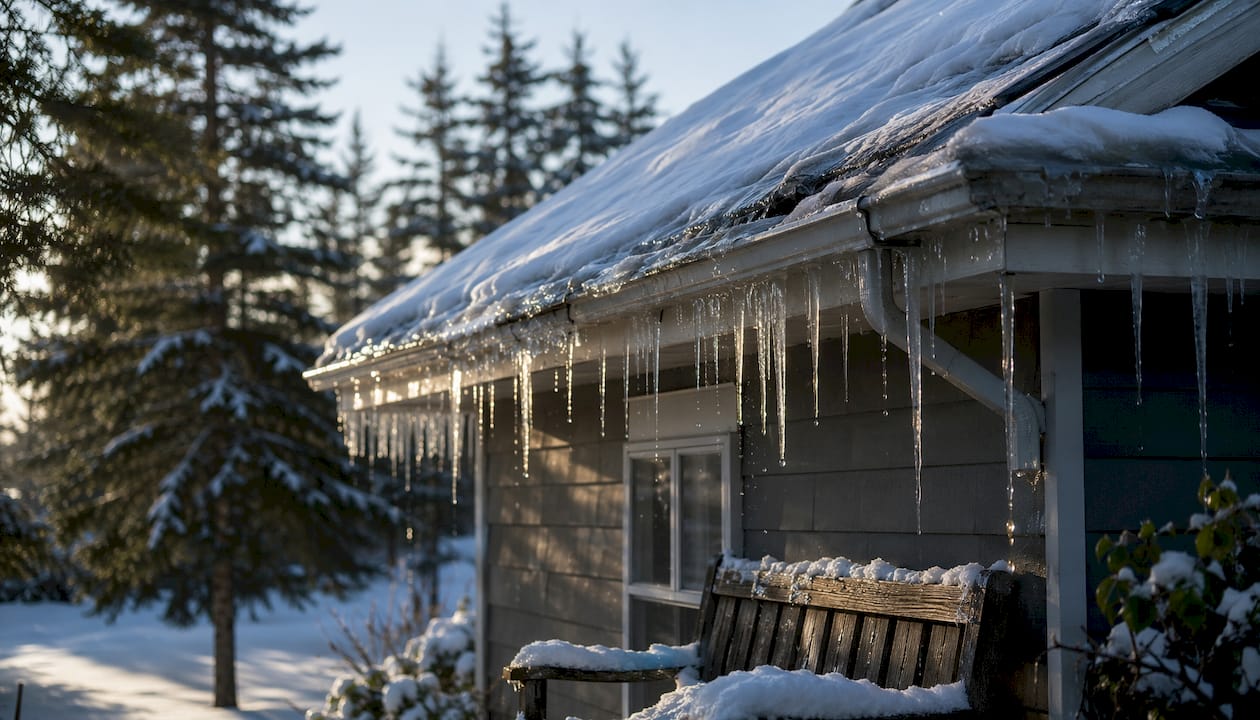
Ice dams are a separate but related problem. When the upper section of a roof is warm enough to melt snow, that water runs down toward the eaves, which are colder. It refreezes at the eaves and blocks drainage, forming a dam. Meltwater then backs up behind the dam, sits on the roof deck, and eventually forces its way under shingles and into the attic or ceiling cavity. You won’t see it until a stain appears on your ceiling weeks later.
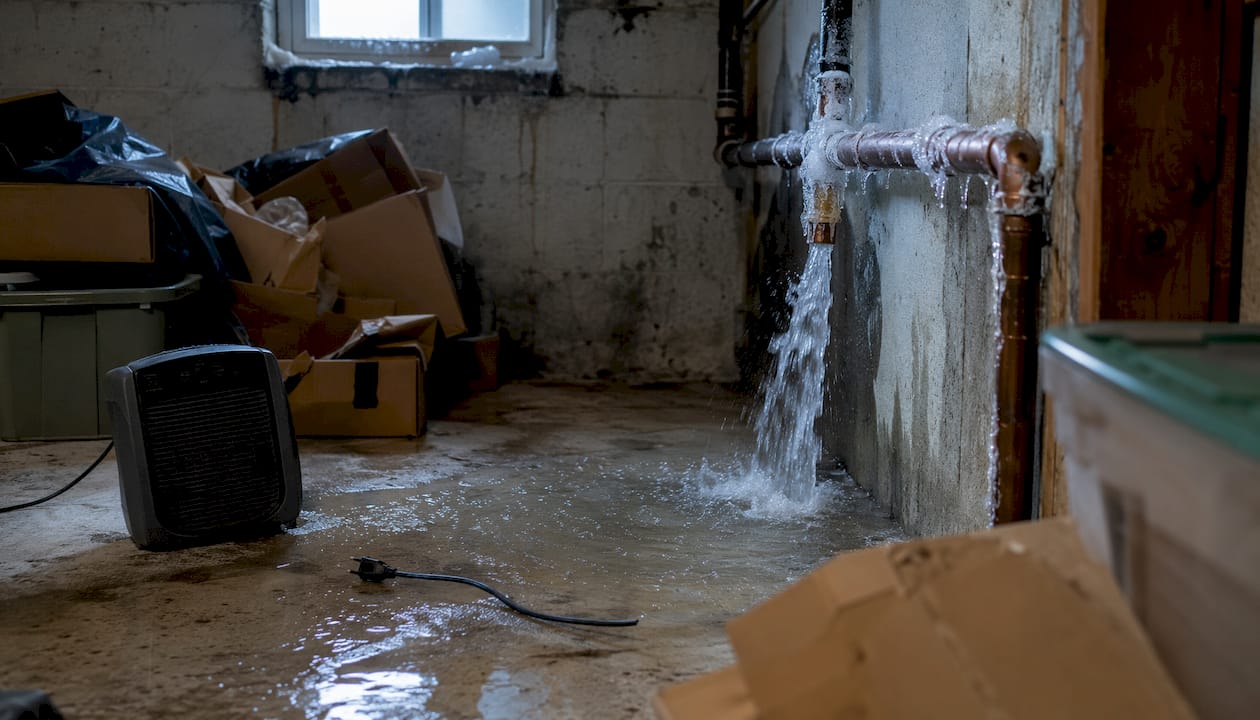
Frozen pipes follow a predictable pattern. Pipes running through exterior walls, unheated crawl spaces, or garages are most at risk because they’re exposed to the coldest air. When water inside freezes and expands, the pipe wall can’t flex, so it fractures. The real damage often comes at thaw, when pressure releases and water pours through the split.
Interior humidity adds another layer. Warm, moist indoor air contacts cold exterior walls and windows, condensing into liquid water. Over a winter, that condensation saturates insulation, feeds mold, and rots wood framing, all without a single pipe ever breaking.
Common scenarios and warning signs you shouldn’t ignore
Winter damage tends to stay hidden until a thaw forces it into the open. These are the failure points that show up most often:
Common winter water damage scenarios:
- Frozen or burst indoor supply pipes, especially in exterior walls or unheated spaces
- Frozen exterior hose bibs that crack and leak into the wall cavity when thawed
- Ice dams causing roof leaks into attics and upper-floor ceilings
- Clogged gutters that overflow and direct meltwater toward the foundation
- Snow piled against foundation vents, basement windows, or exterior wall penetrations
- Rapid thaw saturating soil and increasing hydrostatic pressure on basement walls
Signs to check after any significant thaw:
- Ceiling stains or soft spots, especially below the roofline or an upstairs bathroom
- Bubbling or peeling paint on exterior-facing interior walls
- Warped trim, buckled flooring, or swollen door frames
- Musty odors in basements, closets, or crawl spaces
- Damp or compressed insulation in the attic or walls
- Efflorescence (white mineral deposits) on basement walls
- Sagging or separated gutters
Where to look first: Start in the attic, checking rafters and insulation near the eaves. Move to the basement, scanning walls and the floor perimeter. Check exterior grade around the foundation and look at every exterior penetration — hose bibs, dryer vents, cable entries. Early attic and basement checks catch the majority of hidden winter moisture before it becomes a reconstruction job.
Pro Tip: After a hard freeze followed by a warm spell, walk your roofline from the ground with binoculars. Sagging shingles, dark wet patches, or ice buildup at the eaves are early signals that warrant a closer look before the next freeze.
Water damage categories and the mold risk that follows
Insurers and restoration professionals classify water into three categories, and the category determines how the cleanup gets handled.
| Category | Typical Winter Sources | Immediate Concerns |
|---|---|---|
| Category 1 (Clean) | Burst supply pipes, ice dam meltwater | Structural drying; low contamination risk |
| Category 2 (Gray) | Overflowing sump pits, condensate drain backups | Moderate contamination; requires protective equipment |
| Category 3 (Black) | Sewage backup from frozen drain lines, floodwater | High contamination; requires full remediation protocol |
Category escalates fast. Clean water sitting in a warm space for 24–48 hours can degrade to gray-water status as bacteria multiply. That’s why the clock matters.
The 9% expansion rule applies to more than pipes. Water frozen inside a wall cavity, floor assembly, or masonry joint exerts the same fracturing pressure as it does inside a pipe. The difference is that structural damage often goes undetected for months, while a burst pipe announces itself immediately.
Mold is the slow-moving consequence of winter moisture. Spores need three things: moisture, a food source (wood, drywall, insulation), and temperatures above roughly 40°F. A wet wall cavity that stays damp through a cold winter and then warms up in spring is a near-perfect incubator. Watch for musty odors, visible dark spotting on drywall or framing, and respiratory irritation that clears up when you leave the house. If you see or smell mold after a winter water event, mold remediation should happen before reconstruction, not after.
How to prevent winter water damage before it starts
Consistent seasonal maintenance prevents most winter water damage. The majority of claims trace back to skipped fall prep, not freak weather events.
Priority prevention checklist:
- Insulate exposed pipes in crawl spaces, garages, and exterior walls with foam pipe insulation or heat tape where appropriate
- Keep the thermostat at 55°F or above, even in vacant or rarely used spaces; maintaining at least 55°F is the industry-recommended minimum to prevent frozen pipes (see AdvantaClean).
- Seal gaps in exterior walls around pipe penetrations, cable entries, and dryer vents with caulk or expanding foam
- Clear gutters and downspouts in late fall and extend downspouts 6–10 feet from the foundation to move meltwater well away from the structure
- Check attic insulation and ventilation to reduce the temperature differential that creates ice dams; a cold, well-ventilated attic is less prone to ice dam formation than a warm one
- Disconnect and drain exterior hose bibs before the first hard freeze; leave the interior shutoff valve closed and the bib slightly open to release residual pressure
- Test your sump pump in late fall and confirm the backup power source (battery or water-powered backup) is functional
- Grade soil away from the foundation, aiming for roughly a 6-inch drop over the first 10 feet from the structure
Timing matters. Complete major winterization in late fall and photograph the work. Keep receipts for any contractor work on insulation, gutters, or plumbing. That paper trail is your best defense if an insurer later questions whether you maintained the property.
Pro Tip: Heat cables along the eave edge of a roof can prevent ice dams, but they work only when installed before ice forms and connected to a functioning GFCI outlet. Installing them mid-winter on an already-iced roof is a safety hazard, not a fix.
For broader guidance on protecting your home against water damage, the prevention principles apply year-round, not just in winter.
What to do in the first hours after discovering water damage
Stop the source first. Everything else comes after that.
Step-by-step immediate response:
- Shut off the main water supply if a pipe has burst or if you can’t identify the source. Know where your shutoff is before winter starts.
- Turn off electricity to any area where water has reached outlets, panels, or appliances. If you’re unsure, call an electrician before entering.
- Contain the water with towels, buckets, or plastic sheeting to slow spreading.
- Move valuables, electronics, and furniture to dry areas. Get rugs and soft goods off wet floors immediately.
- Call a restoration company if standing water covers more than a few square feet, if the source is contaminated, or if you see any structural signs.
Documentation checklist for your insurance claim:
- Photos and video of all affected areas before any cleanup begins
- Date and time stamps on all images
- Notes on when you discovered the damage and what actions you took
- Receipts for any emergency purchases (fans, dehumidifiers, tarps)
- Contractor inspection reports and written estimates
When restoration professionals arrive, they typically begin with water extraction using truck-mounted or portable units, followed by structural drying with industrial air movers and dehumidifiers. Drying timelines vary based on material type and saturation depth, but most residential jobs require several days of continuous equipment operation before moisture readings reach acceptable levels. Costs vary widely depending on affected square footage, water category, and whether reconstruction is needed. Treat any number you read online as a rough orientation, not a quote.
When you need a professional restoration company
Call a professional when any of these apply:
- Standing water covers a significant area or you can’t stop the source
- Water has reached electrical systems, HVAC equipment, or structural framing
- The water source is contaminated (sewage, floodwater, gray water)
- You see or smell mold, or the event happened more than 24–48 hours ago
- Moisture is suspected behind walls or under flooring but isn’t visible
What a restoration company actually does:
- Emergency water extraction using commercial-grade equipment
- Moisture mapping with infrared cameras and calibrated meters to find hidden saturation
- Structural drying with industrial air movers and dehumidifiers
- Mold assessment and mold remediation when spore growth is present
- Contents cleaning and pack-out for salvageable belongings
- Reconstruction of damaged framing, drywall, flooring, and finishes
- Direct coordination with your insurance adjuster throughout the process
The moisture-mapping step is one that DIY efforts almost always skip. Infrared and pin-type moisture meters find saturation inside wall cavities and subfloor assemblies that look completely dry to the eye. Leaving that hidden moisture in place means mold in spring.
For water damage restoration in Streamwood and surrounding northwest suburbs, Zerowaterrestoration responds 24/7 and brings the full equipment suite on the first visit.
How homeowners insurance handles winter water damage
Insurance often covers sudden, accidental water damage from winter events, but the word “sudden” is doing a lot of work in that sentence.
Common insurance questions answered:
- Will a burst pipe be covered? Usually yes, if the pipe froze and burst due to an unexpected cold event and you maintained adequate heat in the home.
- What about ice dam damage? Many standard homeowners policies cover resulting interior damage (ceiling stains, ruined insulation) but not the ice dam removal itself or the underlying roof condition.
- Can a claim be denied? Yes. Insurers can deny claims when damage results from neglect, deferred maintenance, or failure to maintain heat in an occupied or vacant property.
- Is it worth filing? Depends on the extent of damage versus your deductible. For significant structural damage or mold involvement, filing almost always makes sense.
Documenting pre-winter maintenance is one of the most effective ways to protect a claim from a neglect denial. Photos of insulated pipes, receipts from a gutter-cleaning service and a contractor invoice for hose bib winterization all demonstrate that you took reasonable precautions.
Policy language varies significantly between carriers and policy types. Read your homeowners policy’s water damage exclusions carefully, and speak directly with your adjuster before assuming coverage. A restoration company experienced in insurance coordination can help you present the claim accurately and completely.
For a deeper look at how restoration companies work alongside insurers, see how restoration companies work with your insurer.
This article is general information, not legal or insurance advice. Confirm coverage details with your insurance carrier or a licensed public adjuster for your specific situation.
Key Takeaways
Winter water damage is preventable, but when it happens, fast action and thorough documentation are what separate a manageable repair from a major reconstruction.
| Point | Details |
|---|---|
| Damage often hides until thaw | Freeze–thaw cycles and ice pressure cause structural harm that stays invisible until temperatures rise. |
| Prevention starts in late fall | Insulate pipes, clear gutters, extend downspouts, and maintain at least 55°F throughout your home to cut most winter risks. |
| Act within hours, not days | Shut off water, document everything, and call a restoration pro before hidden moisture escalates to mold. |
| Insurance covers sudden damage, not neglect | Keep maintenance receipts and winterization photos to protect your claim from a neglect denial. |
| Zerowaterrestoration handles the full job | From emergency extraction and moisture mapping to mold remediation and insurance coordination, Zerowaterrestoration serves the northwest Chicago suburbs 24/7. |
What homeowners in the Chicago suburbs get wrong about winter damage
Most homeowners treat winter water damage as a spring problem. They notice a ceiling stain in March, assume it’s a roof issue, and call a roofer. By then, the attic insulation has been wet for two months, mold has started in the wall cavity, and what could have been a straightforward drying job has become a partial reconstruction.
The pattern Zerowaterrestoration sees repeatedly in the northwest suburbs: a homeowner had a hard freeze in January, noticed nothing obvious, and then discovered significant hidden moisture during a late-February thaw. The freeze damage was real in January. The two-month delay is what turned it expensive.
Zerowaterrestoration has been locally owned and operating in the Chicagoland area for over 10 years. The team is available 24/7 for emergency response, and the approach is consistent: get there fast, measure what’s actually wet (not just what looks wet), and build a documented action plan before a single piece of drywall comes down. That sequence matters because it’s also what your insurer needs to process a claim without pushback.
Proactive winterization is the better path. But when prevention fails, the gap between calling immediately and waiting a few weeks is often the difference between a drying job and a gut-and-rebuild.
Zerowaterrestoration is ready when winter damage hits
When water damage happens in winter, the worst thing you can do is wait for warmer weather to assess it. Hidden moisture keeps working on your structure whether temperatures are rising or falling.
Zerowaterrestoration provides 24/7 emergency water response to homeowners and property managers throughout the northwest Chicago suburbs, including Schaumburg, Arlington Heights, Palatine, Hoffman Estates, Rolling Meadows, Mount Prospect, Elk Grove Village, Barrington, Bartlett, Lake Zurich, and Streamwood. The team arrives with extraction equipment, moisture meters, and industrial drying gear on the first visit. No waiting for a second appointment to start the actual work.
Every job includes direct insurance coordination. Zerowaterrestoration documents the damage, communicates with your adjuster, and keeps your out-of-pocket costs as low as the policy allows. For homeowners in Barrington or Lake Zurich dealing with a winter water event right now, call (847) 515-7000 for emergency dispatch or a free inspection.
Useful sources
- IBHS Winter Weather Ready Guide — Insurance Institute for Business and Home Safety; practical prevention actions backed by insurance-loss research.
- Ready.gov Winter Preparedness — Federal emergency preparedness guidance including home winterization and pipe-freeze prevention.
- NIH Freeze–Thaw Technical Bulletin — Structural engineering explanation of how freeze–thaw cycles damage concrete and brick; best source for the physics behind cumulative damage.
- Texas Water News: 7 Tips for Avoiding Winter Water Damage — Practical homeowner checklist for pipe protection and outdoor fixture winterization.
- ACS Adjusters: Winter Water Damage Hidden Risks — Insurance-adjuster perspective on why winter damage stays hidden and how to document claims correctly.
- Quality Remediation: Winterizing Your Home — Illinois and Wisconsin-specific winterization guidance with insurance documentation advice; directly relevant to Midwest homeowners.
- AdvantaClean: Preventing Residential Winter Water Damage — Covers pipe insulation, thermostat minimums, and downspout extension with specific measurements.