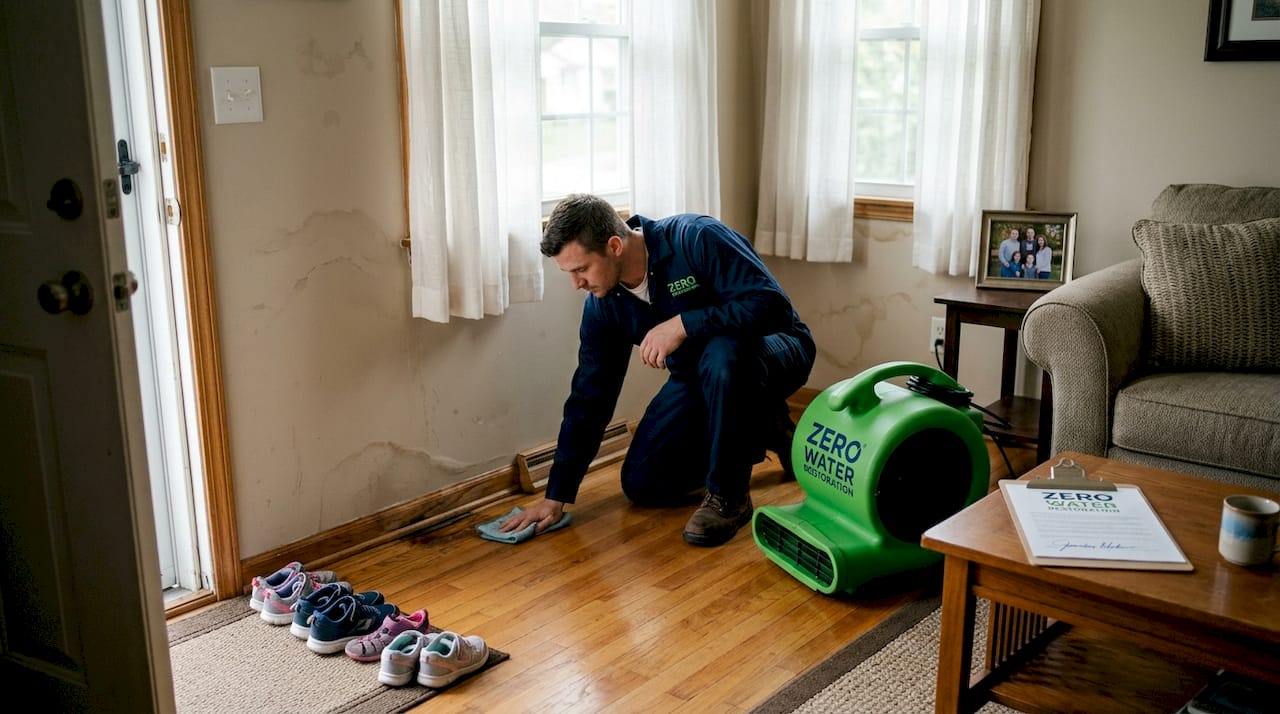
When water invades your home, the first instinct is to call someone fast. But here’s what most homeowners in Schaumburg, Arlington Heights, and the northwest suburbs don’t realize: not every contractor who shows up with a truck and a wet vac is actually qualified to restore your property safely. Certification in water damage restoration is not automatic, not universal, and not just a formality. It’s the difference between work that truly protects your home and your family’s health, and work that leaves hidden moisture, future mold, and a denied insurance claim in its wake.
Table of Contents
- What does water damage restoration certification mean?
- Who certifies water damage restoration companies?
- How is certification earned and maintained?
- Why does certification matter for your safety and insurance?
- How to check if your provider is certified
- What most homeowners overlook about certification
- Work with a certified water damage restoration team
- Frequently asked questions
Key Takeaways
| Point | Details |
|---|---|
| Certification matters | Certified restoration ensures your property and health are protected by recognized industry standards. |
| IICRC is the gold standard | Always look for proof that a provider follows the ANSI/IICRC S500 guidelines. |
| Insurance prefers certified work | Certified providers streamline claims and protect you from insurance disputes. |
| Verify credentials | Don’t take claims at face value—ask for documented proof and check status with the IICRC. |
| Ongoing training counts | A reputable provider keeps up with new standards through regular recertification and staff education. |
What does water damage restoration certification mean?
Certification is not a business license or a general contractor’s permit. It’s a formal, validated recognition that a restoration provider has been trained to specific industry standards and has demonstrated the knowledge to apply those standards in the field. Think of it like the difference between someone who took a weekend cooking class and a licensed chef who passed a culinary board exam. One learned some basics; the other is accountable to a recognized standard.
The primary body that sets these standards is the Institute of Inspection, Cleaning and Restoration Certification, better known as the IICRC. This organization has been developing technical standards for the cleaning and restoration industry for decades, and its certifications are recognized by insurance companies, property managers, and government bodies across North America and beyond.
For water damage specifically, the key document is the ANSI/IICRC S500, a technical framework that defines how water damage work should be assessed, documented, and performed. ANSI stands for the American National Standards Institute, which is a federally recognized body that accredits standards from organizations like the IICRC to ensure they meet rigorous, third-party criteria.
Here’s what certification actually signals to you as a homeowner:
- The provider’s technicians have passed standardized exams and coursework
- Their methods align with the ANSI/IICRC S500 procedures, not just personal experience
- They are accountable to a code of ethics enforced by a third party
- Their approach includes documented drying protocols, not guesswork
- Their work is defensible to your insurer during the claims process
Not all providers carry this certification. Some companies operate with general handyman skills or construction backgrounds and have never completed formal restoration training. When choosing a restoration firm, verifying certification before you agree to anything is the single most important step you can take.
“Certification is not just about the company’s reputation. It’s about whether the people walking into your home have been trained to protect your property and your health according to a standard that insurance companies, courts, and regulators actually recognize.”
Who certifies water damage restoration companies?
Two bodies matter most in this space: the IICRC and ANSI. Understanding how they work together helps you see why their combined stamp of approval carries real weight.
The IICRC is the internationally recognized leader in restoration certification. It develops the actual technical standards, trains educators and instructors, and administers the exams that technicians must pass to earn credentials. When a company says its team is IICRC certified, it means individual technicians have completed specific IICRC coursework such as the Water Damage Restoration Technician (WRT) course and passed a proctored exam.
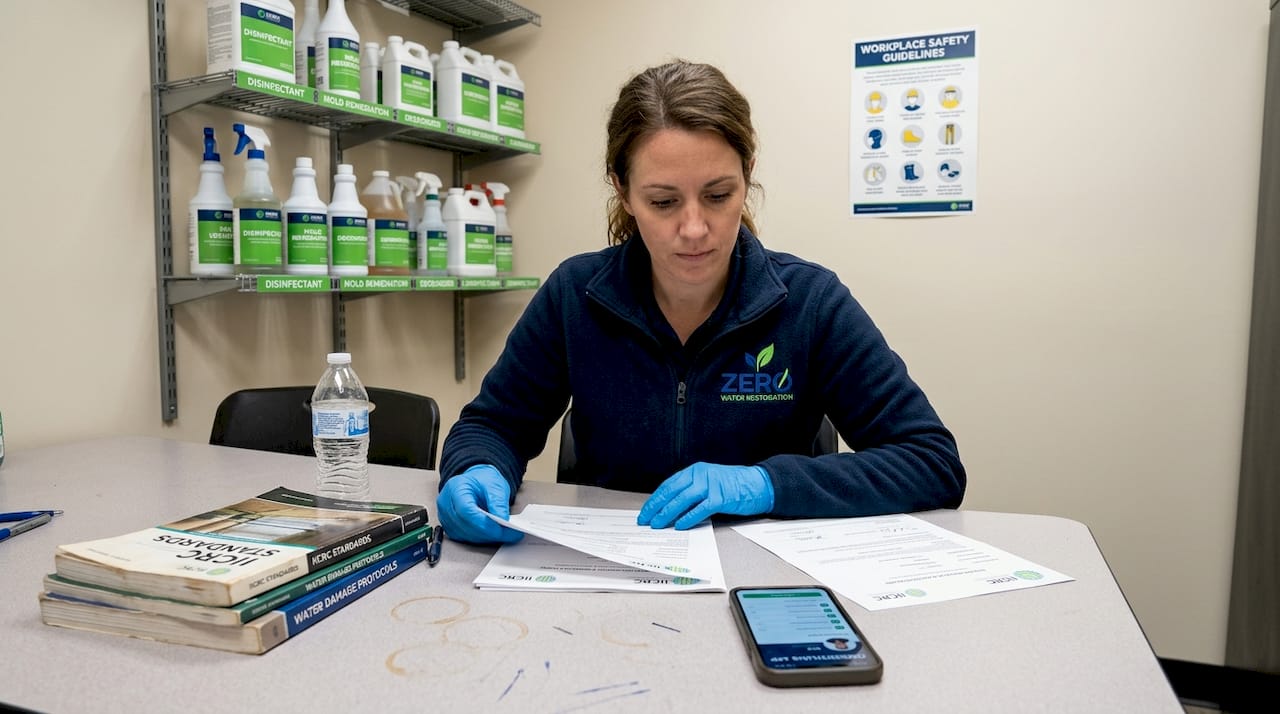
ANSI plays a different but equally important role. It does not train technicians directly. Instead, it accredits the standards that organizations like the IICRC publish. ANSI accreditation is the gold seal that confirms a standard was developed using a transparent, consensus-based process with input from industry professionals, independent experts, and public stakeholders. This is why the ANSI-accredited S500 standard carries so much weight with insurers and regulators.
| Organization | Role | What it means for homeowners |
|---|---|---|
| IICRC | Develops standards and certifies technicians | Technicians are trained and tested |
| ANSI | Accredits IICRC standards as nationally recognized | Standards meet federal credibility requirements |
| State licensing boards | May require contractor licenses | Does not replace IICRC certification |
| Insurance companies | Often require IICRC-certified providers | Affects claims approval and coverage |
State and local licensing requirements vary. Illinois does require contractors to carry proper licenses for certain scopes of work, but state licensing alone does not mean a contractor follows IICRC protocols. These are separate requirements that often exist side by side. Most insurance-backed restoration jobs, however, lean heavily on IICRC certification as the benchmark for what constitutes a qualified and compliant provider.
The risks of improper water damage repair are serious. Incomplete drying, missed moisture readings, and non-standard procedures can turn a fixable flood into a long-term mold and structural problem.
Pro Tip: Before signing anything, ask the company directly: “Which of your technicians hold current IICRC credentials, and what specific certifications do they carry?” A confident, specific answer is a green flag. A vague or defensive response is not.
How is certification earned and maintained?
Earning IICRC certification is not a one-time online quiz. It requires structured education, field knowledge, and passing a formal examination. Here’s how the process works for restoration technicians:
- Enroll in an approved IICRC training course. For water damage, the primary credential is the Water Damage Restoration Technician (WRT) certification. Coursework covers moisture science, psychrometrics (how air temperature and humidity affect drying), equipment usage, documentation requirements, and safety protocols.
- Pass a proctored exam. The exam tests technical knowledge and the ability to apply IICRC principles in realistic scenarios. It’s not a simple multiple-choice quiz; it requires demonstrating real understanding of the ANSI/IICRC S500 standard.
- Meet experience requirements. Many IICRC credentials require documented field experience in addition to coursework. A technician cannot simply take a class and call themselves certified.
- Submit to a code of ethics. IICRC certificants agree to ethical conduct standards, which gives homeowners a formal avenue for complaints if a provider acts improperly.
- Maintain certification through continuing education. IICRC credentials are not permanent. Technicians must complete ongoing training and renew their certifications periodically to stay current with evolving standards and techniques.
This ongoing education requirement is particularly important. Water damage restoration equipment and methods improve over time. A company that earned its certification years ago but has done nothing since may be operating on outdated knowledge. Active certification means active training.
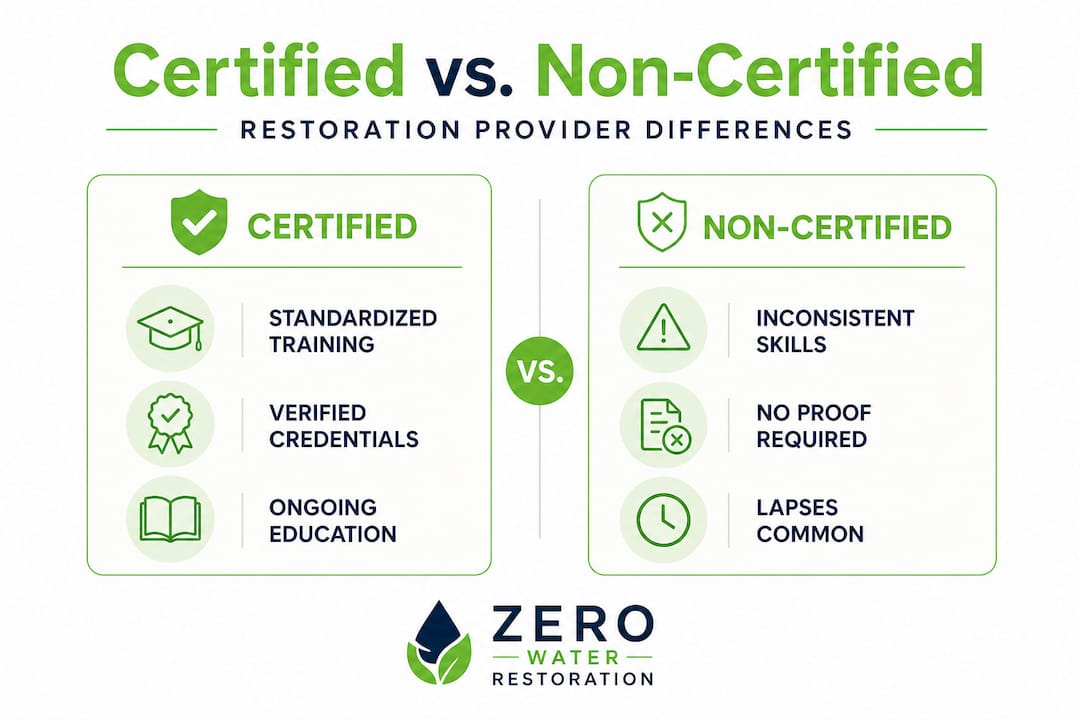
| Feature | Certified provider | Non-certified provider |
|---|---|---|
| Standardized training | Yes, IICRC courses and exams | No formal requirement |
| Written drying protocols | Required by ANSI/IICRC S500 | Varies; often informal |
| Insurance documentation | Standardized and defensible | May be incomplete |
| Ongoing education | Mandatory for renewal | No requirement |
| Accountability | Third-party oversight | Self-regulated only |
The contrast is stark. For practical restoration guidance, the difference between a certified and non-certified crew can determine whether your home truly recovers or whether hidden problems develop over months.
Why does certification matter for your safety and insurance?
This is where certification becomes deeply personal for homeowners. It’s not an abstract industry credential. It directly affects whether your family is safe in your home after a water event, and whether your insurance company will actually pay your claim.
Mold and health risks are the most urgent concern. Water damage that is not properly dried and documented according to ANSI/IICRC S500 procedures creates the ideal environment for mold growth. Mold can begin developing within 24 to 48 hours of water exposure. Certified technicians use calibrated moisture meters, thermal imaging, and industrial drying equipment to confirm that materials are truly dry, not just surface dry. Non-certified providers may towel things down and move on, leaving trapped moisture inside walls and under flooring.
Here’s what certified restoration protects you from:
- Mold colonies forming inside wall cavities and under flooring
- Long-term structural weakening from persistent moisture in wood framing
- Air quality problems that can trigger respiratory issues in your household
- Costly secondary damage that develops weeks or months after the initial event
- A failed reinspection when your insurer sends an adjuster
Insurance claims are the second critical concern. Most insurance carriers require that water damage restoration work follow recognized industry standards. The ANSI/IICRC S500 framework is the standard most often referenced in insurance policies and adjuster guidelines. When a certified provider documents the job with moisture readings, drying logs, and equipment records, your claim has a strong factual foundation. When a non-certified provider does the work without that documentation, claims get disputed or denied.
Smart insurance claim management starts with hiring the right people from the beginning.
Pro Tip: Ask your restoration provider to show you the drying logs and moisture readings for your job before they pack up their equipment. A certified crew will have this documentation ready. It’s also exactly what your insurance adjuster will want to see.
Long-term property value is the third factor. Certified work creates a paper trail that follows your property. If you sell your home, a documented, professionally certified restoration is far easier to disclose and defend than informal repair work. Good water damage prevention and recovery practices protect not just your immediate safety but your investment over time.
How to check if your provider is certified
Knowing certification matters is one thing. Verifying it before you hire is another. Here’s how to do it quickly and confidently.
- Ask directly for proof. Request to see the IICRC certification card or official documentation for the technicians who will be working in your home. A legitimate certified provider will have this readily available.
- Search at iicrc.org. The IICRC maintains a public database where you can search for certified firms by name. Go to iicrc.org, find the “Find a Professional” search tool, and enter the company name. If they are current, they will appear. If they don’t, that’s a red flag worth taking seriously.
- Ask about recent training. Certification requires ongoing education. A trustworthy provider should be able to tell you when their technicians last completed continuing education and what topics were covered.
- Watch for vague language. Phrases like “we follow industry best practices” or “we have years of experience” are not the same as IICRC certification. If a company deflects when you ask for specifics, that’s telling.
- Check reviews for restoration-specific feedback. Look for reviews that specifically mention professional equipment, drying documentation, and working with insurance adjusters. These details indicate certified procedures in practice.
“Any company can put a logo on a website. The real test is whether they can hand you a certification number you can verify with a third party right now.”
When evaluating what to ask your provider before you hire them, treat certification verification as a non-negotiable starting point rather than an optional item on your checklist.
What most homeowners overlook about certification
Here’s the part most articles don’t say out loud. We’ve been doing this work in the northwest suburbs for over 10 years, and we see the same pattern repeatedly. Homeowners find a company online, see a badge or a logo on the website, and assume that’s enough. It’s often not.
Some companies display certifications that are technically real but are not ANSI-accredited and carry no third-party oversight. They look official, use similar language, and sound credible. But they are essentially industry marketing dressed up to look like something more. A badge that is not tied to the IICRC or another nationally recognized accreditation body is not the same thing, even if it looks similar.
Real certification means validated, verifiable, current credentials tied to a body that enforces them. Not a badge a company designed themselves. Not a training seminar without a proctored exam. Not a certification that was earned once and never renewed.
We’d also push back gently on the idea that certification is the finish line. It’s the baseline. What sets a trustworthy local provider apart is a combination of current credentials, genuine experience in the specific conditions of your region, and a track record you can verify with real references and documented projects.
The northwest suburbs of Chicago have specific weather patterns, home construction styles, and drainage conditions that shape how water damage happens and how it should be addressed. A certified company with years of local experience reads a flooded basement in Barrington differently than one that’s certified but has only ever worked in drier climates.
Building trust with your restoration provider means looking at the whole picture: valid credentials, local knowledge, documented results, and honest communication from the first call.
Work with a certified water damage restoration team
Choosing the right restoration company in a crisis shouldn’t feel like guesswork. Zero Water Restoration’s technicians are IICRC certified and have been serving homeowners throughout the northwest suburbs of Chicago for over a decade.
Whether you’re dealing with a flooded basement in Barrington or water damage from a burst pipe in Schaumburg, our team follows ANSI/IICRC S500 procedures from start to finish. We handle the documentation your insurer needs, work directly with adjusters, and see every job through to full restoration. If you need certified water damage restoration in Barrington or professional mold remediation services anywhere in the area, call us at (847) 515-7000 or visit zerowaterrestoration.com for a free inspection and estimate.
Frequently asked questions
What is the IICRC S500 standard and why is it important?
The ANSI/IICRC S500 sets the technical procedures and best practices recognized internationally for water damage restoration, giving both providers and homeowners a clear, verifiable framework for what proper restoration looks like.
Do all water damage contractors need to be IICRC certified?
Not all contractors are legally required to hold IICRC certification, but most insurers and property owners prefer IICRC-certified providers for reliability, documentation quality, and claims compliance.
How can I check if a company is IICRC certified?
Ask for their certification number directly and verify it by searching the company at iicrc.org, where all current certified firms are publicly listed in a searchable database.
What are the risks of hiring a non-certified restoration company?
Non-certified providers may not follow the ANSI/IICRC S500 standards, risking incomplete moisture removal, hidden mold growth, and a documentation gap that can lead to partial or full denial of your insurance claim.
Do I need a certified provider for insurance claims approval?
Most insurance companies require or strongly prefer certified restoration services to validate and efficiently process claims, and using a non-certified provider can complicate or delay your settlement.