
Restoration company selection best practices begin with one non-negotiable: verify IICRC certification and documented local experience before you call anyone else. Water damage restoration costs average $1,300 to $6,300, and structural or mold complications push that number far higher. That range makes the difference between a qualified contractor and a cut-rate one extremely costly. This guide gives homeowners and businesses a concrete restoration service selection guide, covering credentials, local expertise, equipment, contracts, and situational fit, so you choose right the first time.
1. What certifications and licenses should you prioritize?
IICRC certification is the single most important credential in the restoration industry. The Institute of Inspection, Cleaning and Restoration Certification sets the technical standards for water damage mitigation, drying science, and mold remediation. A company holding active IICRC credentials has demonstrated that its technicians follow proven cleanup, drying, and repair techniques rather than improvising.
Beyond IICRC, you need to confirm:
- State contractor license: Illinois requires licensed contractors for structural repair work. Ask for the license number and verify it through the Illinois Department of Financial and Professional Regulation.
- General liability insurance: This protects your property if a technician causes additional damage during the job.
- Workers’ compensation coverage: Without it, you could be liable if a worker is injured on your property.
- Mold remediation certification: If your damage involves moisture that has sat for more than 24 to 48 hours, mold is a real risk. Confirm the company holds specific mold remediation credentials.
These credentials directly affect your insurance claim. Adjusters from carriers like Allstate, State Farm, and Farmers are far more likely to approve scopes of work submitted by IICRC-certified firms because the documentation follows recognized industry protocols.
Pro Tip: Ask the company to email you copies of their IICRC certificate, liability policy, and workers’ comp certificate before signing anything. A legitimate firm sends these without hesitation.
2. Why local experience matters when choosing restoration services
Local tenure is a key factor that most homeowners overlook when comparing restoration firms. A company that has operated in your specific region for five or more years has seen the damage patterns common to your area. In the northwest suburbs of Chicago, that means burst pipes from hard freezes, basement flooding from clay soil saturation, and roof leaks from ice dams. A company from out of state has no frame of reference for those conditions.
Local experience also translates into working relationships with the people who control your timeline:
- Building inspectors who approve structural repairs
- Insurance adjusters who authorize payment
- Material suppliers who can expedite delivery
- Subcontractors for specialized trades like electrical or HVAC
These relationships reduce delays and cost. A locally established firm knows which inspector covers your municipality and how that office prefers documentation submitted.
“Local expertise improves claims and permits interaction, reducing delays and cost.” This is not a soft benefit. It is the difference between a two-week restoration and a two-month ordeal.
The flip side is the risk of storm chasers, contractors who arrive door-to-door after major weather events with no local ties, no established reputation, and no accountability once they collect payment. They are common after hail storms and flooding events throughout the Chicago suburbs. If a company cannot give you a physical local address, a verifiable track record, and references from nearby homeowners, walk away.
3. How to evaluate equipment, emergency response, and communication
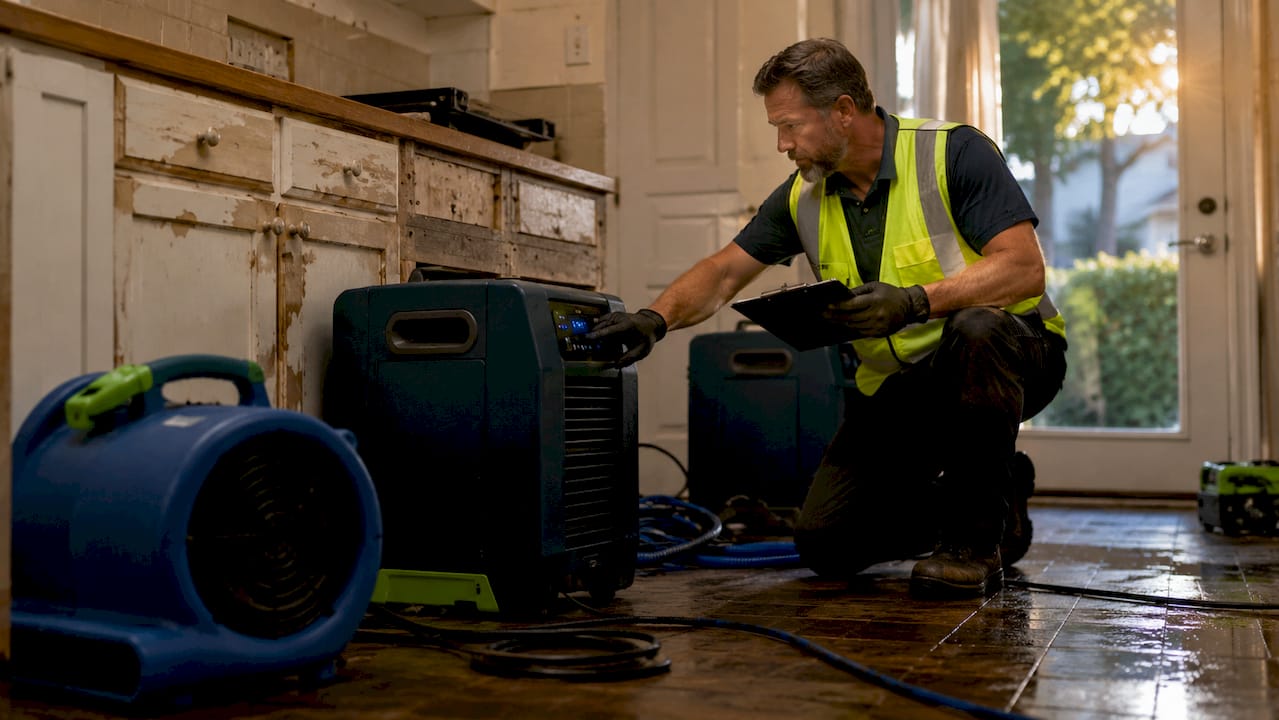
The equipment a restoration company uses determines whether your property actually dries correctly or just appears dry. Industry-standard tools include thermal imaging cameras (to detect moisture behind walls), commercial-grade dehumidifiers rated by AHAM, and calibrated moisture meters that log readings over time. A company using consumer-grade box fans and a single dehumidifier from a hardware store is not equipped to handle a serious water loss event.
| Evaluation Factor | What to Look For | Red Flag |
|---|---|---|
| Drying equipment | Commercial dehumidifiers, air movers, thermal cameras | Box fans, no moisture logging |
| Emergency response | On-site technician within hours, 24/7 actual dispatch | Answering service only, next-day arrival |
| Documentation | Written scope, daily moisture readings, photo logs | Verbal estimates, no written record |
| Insurance coordination | Direct adjuster communication, claim documentation | “You handle the insurance” |
Genuine 24/7 emergency response means a trained technician mobilizes to your property within hours, not a call center that takes a message until morning. Ask directly: “If I call at 2 AM on a Sunday, who answers and how long until someone is at my door?” The answer tells you everything.
Transparent communication is equally critical. A qualified company documents the scope of work in writing before starting, provides daily moisture readings during the drying phase, and keeps you informed at every decision point. This documentation also protects you during the claims process.
Pro Tip: Request a sample drying log or scope of work document from any company you are seriously considering. If they cannot produce one, their documentation practices are not up to standard.
4. Comparing quotes and contracts: best approaches and red flags
Contact at least three restoration companies for quotes before committing, even when the damage feels urgent. Three quotes give you a baseline for fair pricing and reveal outliers on both ends. A quote that is 40% below the others is not a deal. It is a signal that the scope is incomplete or the company plans to cut corners.
A professional restoration company provides an itemized written estimate before work begins. That estimate should break down labor, equipment, materials, and any subcontracted work as separate line items. This structure reduces the risk of cost overruns and gives your insurance adjuster a clear document to review.
Watch for these specific red flags:
- Verbal-only agreements: Nothing is binding without a written contract. Any company that resists putting the scope in writing is protecting itself, not you.
- Assignment of benefits pressure: Some contractors push homeowners to sign over their insurance claim rights before work begins. This removes your control over the settlement.
- No physical address: A company operating from a P.O. box or a vehicle has no local accountability.
- Upfront payment demands: Legitimate firms typically collect payment in stages tied to completed work, not a lump sum before starting.
- Unusually fast verbal quotes: A real scope requires a physical inspection. Any company quoting you a price over the phone without seeing the damage is guessing.
Reading the contract carefully before signing is not optional. Pay specific attention to the cancellation clause, the dispute resolution process, and whether the contract references IICRC S500 or S520 standards as the technical basis for the work.
5. Choosing between specialized and full-service restoration companies
The right type of company depends on the nature and complexity of your damage. Understanding the difference between specialized and full-service firms is a practical part of any restoration company evaluation criteria.
- Water-only firms handle extraction, drying, and dehumidification. They are appropriate for clean water losses like a burst supply line with no secondary damage.
- Mold remediation specialists focus on containment, removal, and post-remediation verification. Use them when mold is the primary problem and the moisture source has already been resolved.
- Fire and smoke restoration firms specialize in soot removal, odor neutralization, and content cleaning after fire events.
- Full-service restoration companies handle water, mold, fire, and structural reconstruction under one roof.
| Damage Scenario | Best Fit | Reason |
|---|---|---|
| Burst pipe, no mold | Water specialist or full-service | Fast drying focus |
| Storm damage with roof, water, and mold | Full-service only | Single point of accountability |
| Mold found after slow leak | Mold specialist or full-service | Remediation protocol required |
| Fire with suppression water damage | Full-service only | Multiple damage types overlap |
A full-service restoration company handles multiple damage types and avoids the coordination problems that arise when fire, water, and mold damage coexist. When damage spans multiple categories, using separate contractors creates gaps in accountability and can delay your insurance settlement. For complex losses, a single full-service firm is the more reliable choice, even if the per-line cost appears slightly higher.
For businesses, the calculus is even clearer. Commercial properties cannot afford extended downtime from contractor handoff delays. A full-service firm with commercial restoration experience keeps the project moving under one project manager.
Key takeaways
Selecting the right restoration company requires verifying IICRC credentials, confirming local experience, and demanding written documentation before any work begins.
| Point | Details |
|---|---|
| Verify IICRC certification first | Certified firms follow proven drying and remediation standards that protect your property and support insurance claims. |
| Prioritize local tenure | Companies with established local roots have adjuster and inspector relationships that reduce delays and out-of-pocket costs. |
| Demand written estimates | An itemized written scope before work starts protects you from cost overruns and gives adjusters a clear document. |
| Get at least three quotes | Multiple quotes reveal fair market pricing and expose low-ball bids that signal incomplete scopes or corner-cutting. |
| Match company type to damage | Full-service firms are the right call when fire, water, and mold damage overlap on the same property. |
What I have learned about picking a restoration company under pressure
I have watched homeowners make the same mistake repeatedly. Water is pouring in, panic sets in, and they call the first number that answers. Speed feels like the right priority in that moment. It is not.
Fastest response time is not the best quality indicator. Transparency and the ability to explain the remediation process are more important. A company that arrives in 45 minutes but cannot tell you how they will verify dryness or what equipment they are using is not a better choice than one that arrives in 90 minutes with a clear plan and documented credentials.
The questions that actually matter are simple. Ask: “How do you verify that the structure is dry before you close walls?” Ask: “Can you walk me through how you document moisture readings?” Ask: “Who will be my point of contact throughout the project?” A qualified contractor answers all three without hesitation. An unqualified one deflects or gives vague answers.
I have also seen the damage that assignment of benefits clauses cause. Homeowners sign away their claim rights in a moment of stress and then lose all leverage when the final bill does not match the original estimate. Read every line before you sign. If a company pressures you to sign quickly, that pressure itself is the answer you need.
The homeowners and businesses who come out of water damage events in the best shape are the ones who spent 30 minutes asking the right questions before work started. That investment pays back many times over. For a practical starting point, the homeowner selection checklist at Zerowaterrestoration covers the core verification steps in plain language.
— Jim
Why Zerowaterrestoration is the right call for Chicagoland homeowners
Zerowaterrestoration is a locally owned, IICRC-certified water damage restoration company serving the northwest suburbs of Chicago, including Barrington, Lake Zurich, and Streamwood. With over 10 years of local experience, the team knows the regional damage patterns, the local inspectors, and the insurance adjusters who handle claims in this market. Technicians are available 24/7 for genuine emergency dispatch, not just an answering service. The company handles water extraction, drying, mold remediation, and full reconstruction, and works directly with your insurance carrier to manage documentation and keep your out-of-pocket costs as low as possible. Call (847) 515-7000 or visit zerowaterrestoration.com for a free inspection and estimate.
FAQ
What does IICRC certification mean for a restoration company?
IICRC certification means the company’s technicians are trained to follow the industry’s recognized standards for water damage mitigation, drying, and mold remediation. Insurers recognize IICRC-certified scopes of work, which supports faster claim approvals.
How many quotes should I get before hiring a restoration firm?
Get at least three detailed, itemized quotes before committing. Three quotes establish a fair price baseline and make it easy to spot bids that are either inflated or suspiciously low.
What is a storm chaser contractor and why should I avoid one?
A storm chaser is a contractor who arrives unsolicited after a weather event with no local business address or established reputation. These vendors often disappear after collecting payment, leaving homeowners with incomplete work and no recourse.
Should I sign an assignment of benefits agreement?
No. Signing an assignment of benefits transfers your insurance claim rights to the contractor, removing your ability to negotiate or dispute the final settlement. Always retain control of your own claim.
When does a full-service restoration company make more sense than a specialist?
A full-service company is the right choice when your property has overlapping damage types, such as fire, water, and mold occurring together. Using separate specialists for each category creates coordination gaps and can delay your insurance settlement significantly.