
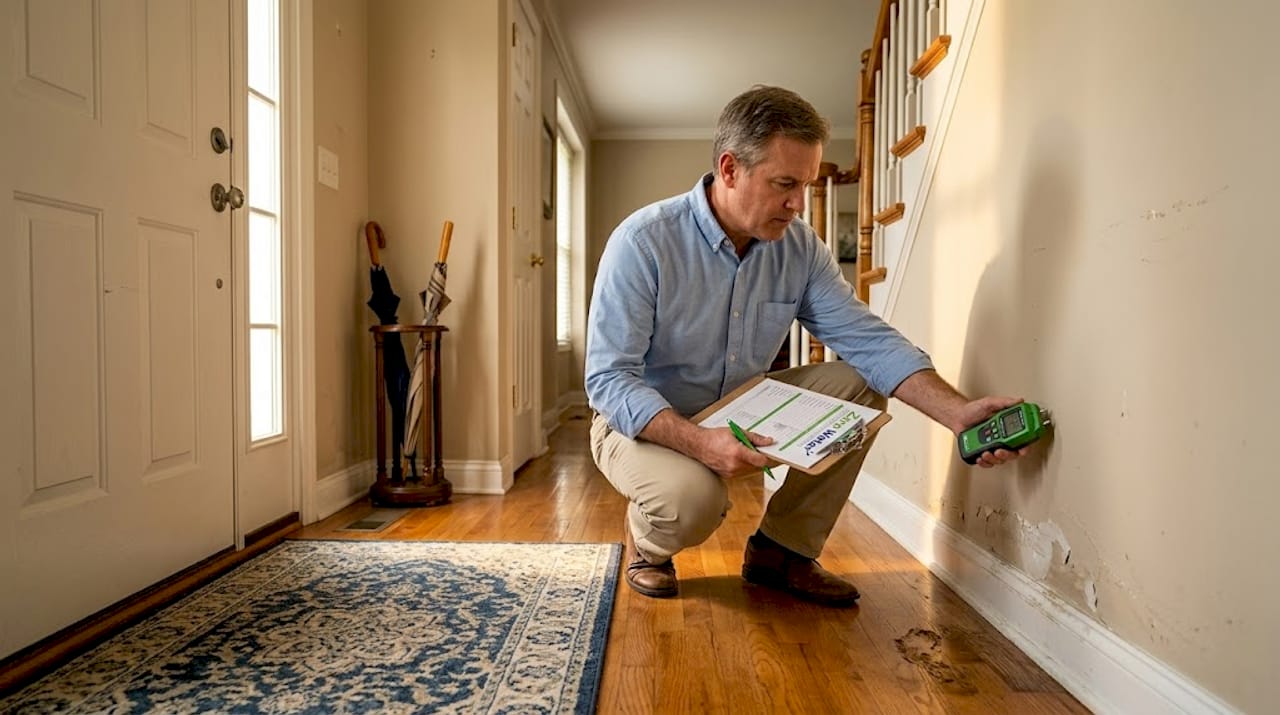
Water damage looks obvious until it isn’t. You mop up the puddle, run a fan overnight, and figure you’ve handled it. But what’s happening inside your walls, under your subfloor, and behind your drywall is a completely different story. Even one inch of water can mean up to $25,000 in repairs, and the moisture you can’t see is almost always the moisture that ends up costing you the most. This guide breaks down what professional water damage assessment actually involves, why it matters so much in Schaumburg and the northwest suburbs, and how it protects your home from the kind of hidden damage that sneaks up on homeowners every single year.
Table of Contents
- What is water damage assessment?
- Why speed matters: escalating risks and costly delays
- How experts find hidden dangers under the surface
- How water damage assessment guides restoration and your insurance
- Local mold and secondary risks: why Chicagoland is high risk
- Our take: why skipping professional assessment is rarely worth the risk
- Choose professional water damage assessment for peace of mind
- Frequently asked questions
Key Takeaways
| Point | Details |
|---|---|
| Assessment finds hidden damage | Professional assessments use instruments to detect moisture in places you can’t see. |
| Faster action reduces costs | Quick assessment prevents mold growth and extensive repairs that drive up expenses. |
| Documentation streamlines claims | Insurance companies need professional reports to process your water damage claim. |
| Local risk factors matter | Schaumburg homes face higher mold risk due to regional weather and construction types. |
What is water damage assessment?
Water damage assessment is not just walking through a wet room with a flashlight. It’s a structured, tool-driven process designed to find every pocket of moisture in your home, measure how serious the damage is, and document everything needed to build a real recovery plan.
The goals of a professional assessment are straightforward:
- Locate all affected areas, including spaces you can’t see
- Measure moisture levels inside structural materials, not just on the surface
- Document damage thoroughly for restoration planning and insurance purposes
- Establish drying targets so you know when materials are actually dry, not just when they look dry
- Prevent secondary damage like mold growth, wood rot, and structural weakening
Professionals check floors, walls, ceilings, insulation, framing, and the areas around plumbing fixtures and appliances. How professionals assess water damage goes well beyond a visual walkthrough. They use instruments that detect moisture content inside building materials, which is the only reliable way to know the true scope of what you’re dealing with.
One of the biggest misunderstandings homeowners have is that a surface that feels dry or looks normal is safe. It isn’t. Water migrates. It travels along framing, soaks into insulation, and pools in low spots inside wall cavities. Relying on appearance alone means leaving damage in place until it becomes a much bigger problem. Assessment prevents secondary damage by using measurable drying targets rather than relying on how things look.
Pro Tip: If a wall feels cool to the touch in a spot that shouldn’t be cool, that’s a potential sign of trapped moisture. Don’t assume it’s nothing. That’s the kind of clue a professional assessment is designed to catch.
Why speed matters: escalating risks and costly delays
Once water gets into your home, the clock starts immediately. This isn’t a situation where you can wait a few days to figure out next steps. The damage escalates quickly, and every hour you wait makes the problem more expensive and more dangerous to fix.
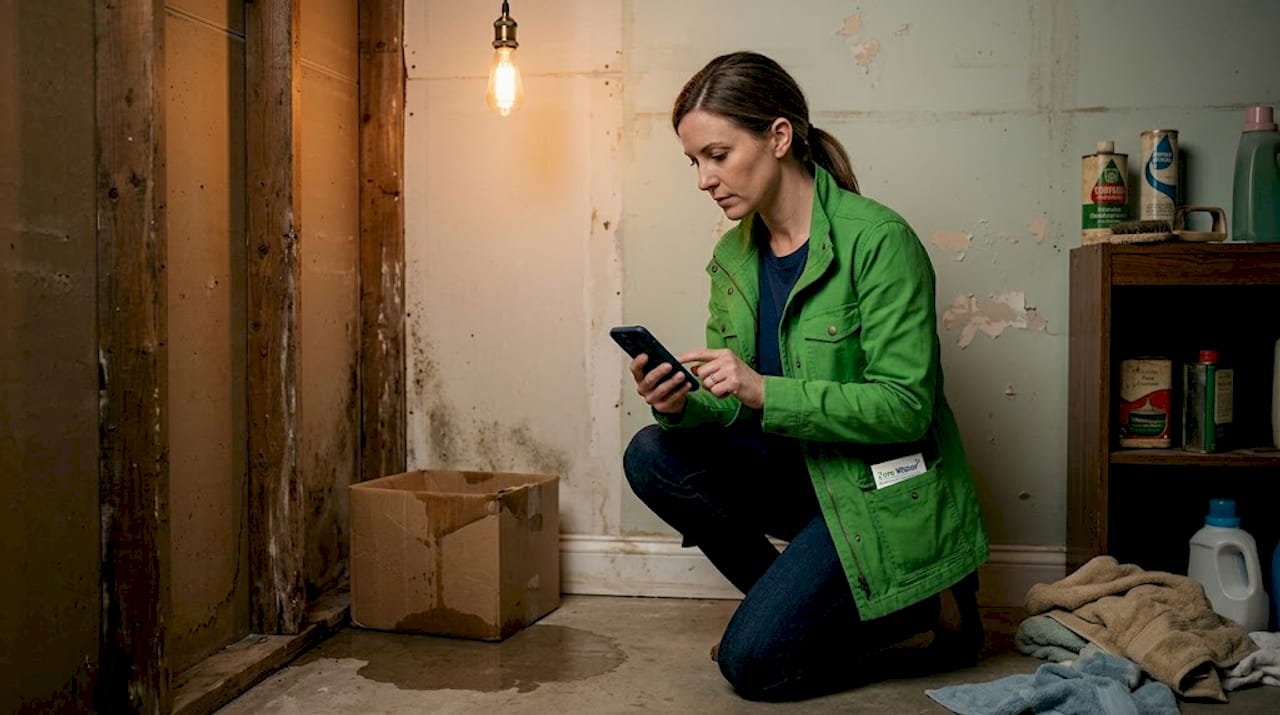
Mold can start growing within just 24 hours of water exposure. In a Schaumburg basement during a damp spring, that timeline can be even shorter because of the existing humidity in the air.
Here’s how the damage timeline typically plays out:
| Time since incident | What’s happening | Potential cost impact |
|---|---|---|
| 0 to 1 hour | Water spreads, soaks into porous materials | Lowest, most manageable |
| 1 to 24 hours | Drywall swells, wood begins absorbing moisture | Moderate, still very treatable |
| 24 to 48 hours | Mold spores begin activating, odors develop | Significant, more materials affected |
| 48 to 72 hours | Mold visible, structural materials compromised | High, remediation now required |
| 1 week or more | Rot, widespread mold, potential structural failure | Severe, full reconstruction possible |
The progression from a minor leak to a major structural problem follows a predictable pattern:
- Water enters through a pipe burst, roof leak, appliance failure, or storm event
- Water saturates visible surfaces and spreads laterally beneath floors and inside walls
- Organic building materials absorb moisture and become environments where mold thrives
- Mold colonies establish and begin releasing spores into your living air
- Structural components weaken as wood fibers break down
- Repair costs multiply because more materials now require full replacement
“The most expensive water damage jobs we see are almost never the ones that happened fast. They’re the ones where a homeowner waited, thinking it wasn’t that bad.”
Understanding the risks of delaying repairs is what separates homeowners who recover quickly from those who spend months dealing with mold remediation and reconstruction. Speed isn’t just smart. It’s the single biggest factor in controlling your total costs.
How experts find hidden dangers under the surface
Visual checks have their place, but they tell you maybe 20 percent of the story when it comes to water damage. The other 80 percent is hiding in places you can’t see, and finding it requires tools specifically built for the job.
Professional restoration companies use a combination of instruments to detect moisture that has no visible signs:
- Moisture meters measure the water content inside wood, drywall, and other materials at specific points
- Infrared (thermal) cameras detect temperature differences in walls and ceilings that indicate trapped moisture
- Hygrometers measure the humidity level of the surrounding air to track drying progress
- Penetrating probes reach inside cavities and materials where non-invasive tools can’t get a complete picture
Here’s how professional assessment compares to a basic DIY visual check:
| Factor | Visual check | Professional assessment |
|---|---|---|
| Hidden moisture detection | None | Full, using meters and infrared |
| Coverage | Surface only | Floors, walls, ceilings, cavities |
| Accuracy | Low | High, based on actual measurements |
| Documentation | None | Full written and photographic record |
| Long-term protection | Minimal | Verified drying targets met |
| Mold risk reduction | Low | Significantly reduced |
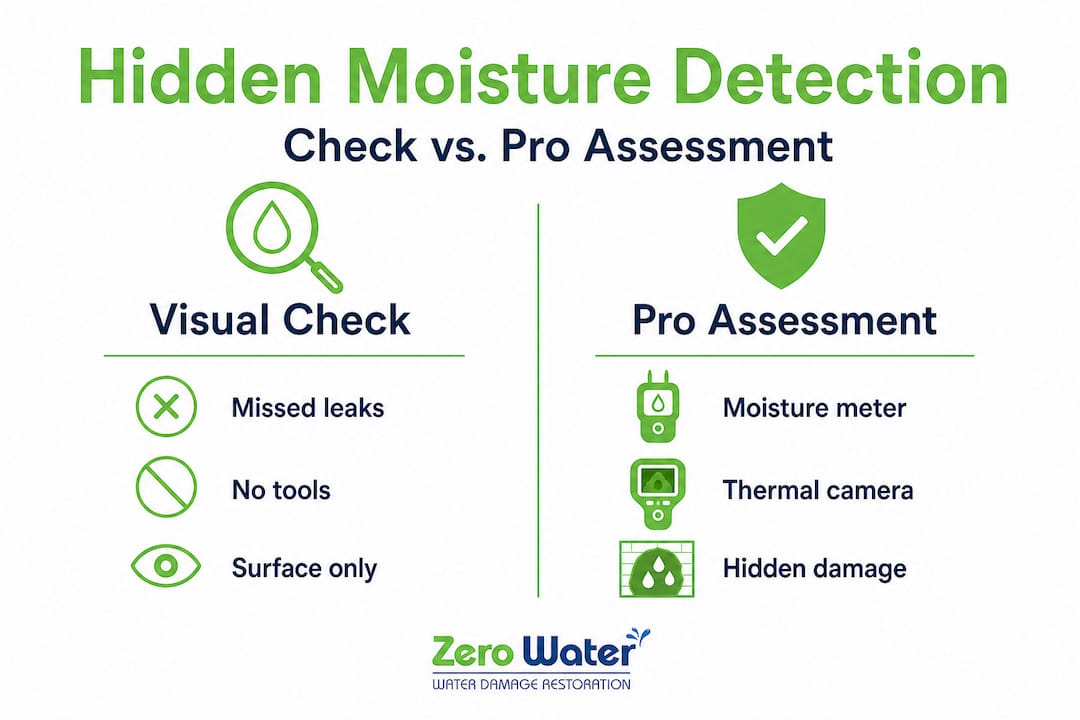
Prevention of secondary damage depends entirely on measurable drying targets, not on appearance. A professional assessment gives you those numbers. Without them, you have no way to know if the job is actually done.
Common places homeowners miss hidden water damage include:
- Behind finished drywall in basements
- Beneath hardwood or laminate flooring
- Inside wall cavities near exterior pipes
- In insulation between the first and second floor
- Under and behind dishwashers, refrigerators, and washing machines
- In crawl spaces and around floor drains
Pro Tip: Even a slow, small leak behind a refrigerator water line can create a serious mold problem inside a finished wall over several months. If you’re choosing a restoration firm, look for one with the right tools and documented experience. Knowing what to look for when choosing a restoration firm can save you from hiring someone who’s just going to dry the surface and walk away.
How water damage assessment guides restoration and your insurance
The assessment isn’t just about finding damage. It’s about creating a detailed record that drives everything that comes next, including the restoration plan and your insurance claim.
Once an assessment is complete, the restoration team uses those findings to build a step-by-step recovery plan. Without assessment data, restoration is guesswork. With it, every step is targeted and verifiable.
Here’s how the full process typically flows:
- Emergency response and water extraction begin immediately
- Professional assessment identifies all affected zones and moisture levels
- Documentation is prepared with moisture readings, photographs, and damage scope
- A restoration plan is built around the specific affected materials and areas
- Drying equipment is placed based on assessment data, not estimation
- Daily monitoring tracks moisture levels until verified drying targets are met
- Repairs and reconstruction begin once materials are confirmed dry
- Final inspection verifies all areas are within normal moisture ranges
Assessment documentation is critical for insurance claims and for proving that proper drying targets were met. This matters more than most homeowners realize.
Insurance companies are experienced at identifying incomplete or undocumented claims. Without a professional assessment report, adjusters have no way to verify the true scope of damage, and claims frequently get delayed or denied as a result.
The average water damage insurance claim is around $11,000 to $12,000. Detailed assessment documentation significantly increases the likelihood that your claim is approved at the correct amount, not a reduced figure based on what’s visible at the surface.
To support your insurance claim effectively, homeowners should:
- Call your insurer immediately to report the incident and open a claim
- Avoid throwing away damaged materials before documentation is complete
- Take your own photos and notes as soon as it’s safe to do so
- Request a full written assessment report from your restoration company
- Make sure your restoration provider communicates directly with your adjuster
Filing an insurance claim after water damage is stressful enough without also having to fight for proper compensation. Assessment documentation is the evidence that makes the process go faster and smoother.
Local mold and secondary risks: why Chicagoland is high risk
If you live in Schaumburg or anywhere in the northwest suburbs, you’re dealing with a climate that creates near-perfect conditions for mold growth after water damage. Cool, wet springs combine with homes that have significant finished basement square footage, and that combination raises the stakes considerably.
Chicagoland homes are particularly vulnerable to mold and deterioration if drying is not confirmed using professional moisture measurements. The local climate is a factor you can’t ignore.
The construction types most at risk in the Schaumburg area include:
- Finished basements with drywall over concrete block — moisture migrates through the block and gets trapped behind drywall where it’s invisible
- Homes built in the 1970s through 1990s — older insulation and framing materials absorb moisture more aggressively
- Slab-on-grade construction — water intrusion under slab floors has nowhere to evaporate and creates persistent moisture problems
- Homes with attached garages and interior plumbing walls — freeze-thaw cycles in Illinois winters put pipes at high risk of bursting
Working with a restoration company that understands local building codes, construction styles, and weather patterns matters. A company based in Schaumburg knows what to expect from these homes and how to approach the specific construction details that create hidden moisture risks in this region. Understanding the local mold risks in Chicagoland is something a local team handles better than a generic national chain.
Our take: why skipping professional assessment is rarely worth the risk
We’ve been doing this work for over 10 years in Schaumburg and the surrounding communities. And the pattern we see most often isn’t homeowners who panicked unnecessarily. It’s homeowners who felt confident everything was fine, and found out months later that it wasn’t.
A homeowner in Hoffman Estates once had a washing machine supply line leak for what they estimated was a few hours before they caught it. They cleaned up the standing water, ran a shop vacuum, and placed a box fan in the corner. The floor felt dry within two days. They considered the problem solved. About four months later, they noticed a musty smell and some discoloration near the baseboard. By the time they called us, mold had established itself behind the drywall and underneath the subfloor across a significant portion of the laundry room. What a professional assessment would have cost them upfront was a fraction of what the full remediation and reconstruction ended up running.
The tricky part is that visible dryness feels conclusive. It feels like evidence. But concrete and drywall can hold significant moisture internally while feeling completely normal on the surface. The only way to know is to measure.
Water damage prevention advice always circles back to the same principle: catch it early, document everything, and don’t trust what you can see over what the instruments tell you. In Chicagoland’s climate, where basements are living spaces and moisture has nowhere to escape easily, that principle is especially true.
The homeowners who fare best are the ones who call us fast, let us do a proper assessment, and follow the documentation through to the insurance claim. The ones who struggle are the ones who wait, try to handle it themselves, and call us only when the smell becomes impossible to ignore.
Choose professional water damage assessment for peace of mind
If water has entered your home, even if it seems minor, the smartest move you can make is getting a professional assessment done immediately. It’s the step that tells you what you’re actually dealing with, protects your insurance claim, and prevents the kind of hidden damage that turns a manageable situation into a major reconstruction project.
At Zero Water Restoration, we serve Schaumburg and the entire northwest suburbs, including communities like Barrington, with 24/7 emergency response and a full-service approach from assessment through final restoration. Our team handles the documentation, works directly with your insurance adjuster, and doesn’t consider the job done until every moisture reading is where it needs to be. Learn more about our water damage assessment process or explore our local mold remediation services. Call us at (847) 515-7000 for a free inspection and estimate.
Frequently asked questions
How is water damage assessment different from a regular inspection?
Water damage assessment uses specialized tools like moisture meters and infrared cameras to detect hidden moisture and verify actual drying, while a regular inspection mostly identifies visible issues. Assessment prevents secondary damage by establishing measurable moisture targets rather than relying on appearance.
How soon should I arrange an assessment after a water incident?
Arrange an assessment immediately, within hours if possible, because mold can start growing within 24 hours after water exposure and delays make damage significantly more expensive to remediate.
Do insurance companies require water damage assessment reports?
Most insurers require professional assessment documentation to approve water damage claims at the correct amount. Assessment documentation is critical for proving damage scope and that proper drying targets were met.
Can water damage hide inside walls or under floors?
Yes, water regularly penetrates behind walls, beneath flooring, and into insulation where it causes mold and structural rot long before any visible signs appear. Professional assessment covers concealed materials, not just the damage you can see at the surface.