

Water damage is one of the most financially damaging events an Illinois homeowner can face, and the insurance claim process is where many people lose money they are rightfully owed. The water damage insurance claim steps you follow in the first 24 to 72 hours can determine whether you receive a full payout or spend months fighting a partial denial. With 1 in 67 homes filing a water damage claim and the average payout sitting around $15,400, this is not a process to navigate by guesswork. This guide walks you through every step, with Illinois-specific timelines and legal protections built in.
Table of Contents
- Key Takeaways
- 1. Stop the source and protect your property immediately
- 2. Document everything before you touch anything
- 3. Notify your insurance company right away
- 4. Understand what your policy actually covers
- 5. Meet the adjuster and control the walkthrough
- 6. Submit your sworn proof of loss within 60 days
- 7. Evaluate the insurer’s response and know your dispute rights
- 8. Manage your legal deadlines before they expire
- What I have learned after a decade of walking through flooded homes
- How Zero Water Restoration makes this process easier
- FAQ
Key Takeaways
| Point | Details |
|---|---|
| Act fast on documentation | Photograph and video all damage before any cleanup to protect your claim from disputes. |
| Know Illinois insurer deadlines | Insurers must acknowledge your claim within 15 working days and begin investigating within 21 working days. |
| Submit proof of loss on time | File your sworn proof of loss within the 60-day deadline to preserve your legal rights. |
| Understand your dispute options | Denials must cite specific policy language; vague letters may indicate bad faith handling. |
| Track the two-year litigation window | Illinois homeowners have two years from the date of loss to file suit over a disputed claim. |
1. Stop the source and protect your property immediately
The moment you discover water damage, your first obligation is to stop it from getting worse. That means shutting off the main water supply if a burst pipe is the cause, cutting power to flooded areas to prevent electrical hazards, and moving valuables out of the affected space.
This is not just common sense. Delayed mitigation causing additional damage can give your insurer grounds to deny portions of your claim. Your policy almost certainly includes a duty to mitigate, which means you are required to take reasonable steps to prevent further loss after the initial event.
Use fans, open windows if weather permits, and remove standing water with a wet vac if it is safe to do so. If the damage is beyond what you can handle, call a licensed restoration company immediately. Keep every receipt for emergency services, rental equipment, or temporary housing. Those costs are often reimbursable.
Pro Tip: Do not throw away damaged materials before your adjuster visits. Insurers sometimes dispute claims when they cannot physically inspect the damaged items.
2. Document everything before you touch anything
This step is where most homeowners make their biggest mistake. They start cleaning up before pulling out their phone. Do not do this. Your documentation is your evidence.
Walk through the entire affected area and record all damage with photos and video before cleanup begins. Capture the water source, the spread of damage across floors, walls, and ceilings, and every affected item including furniture, appliances, and personal belongings. Timestamp everything if your device allows it.
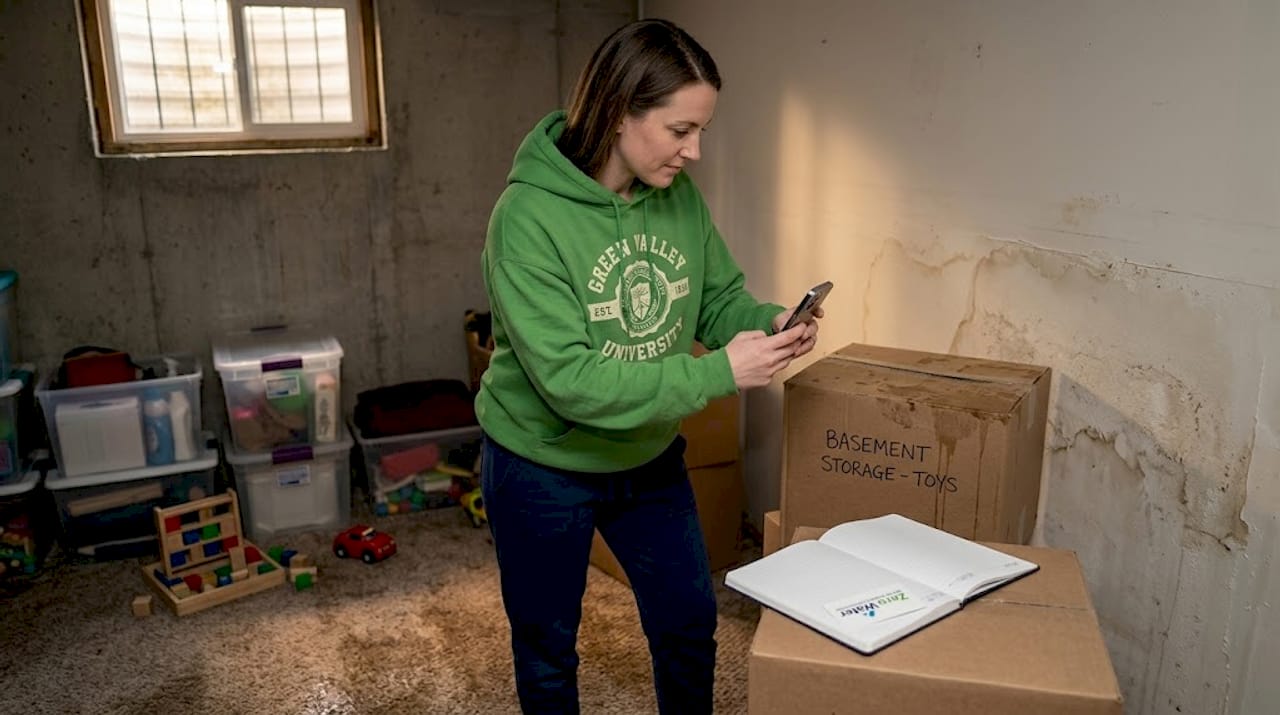
Beyond photos and video, write a detailed inventory list of damaged items. Include the make, model, approximate age, and estimated replacement value for each item. This list becomes the backbone of your water damage claim documentation steps and carries serious weight when the adjuster reviews your submission.
Save and back up everything to a cloud account immediately. A lost phone or stolen laptop should not cost you your claim.
Pro Tip: Use a free app like Encircle or iClaim to organize your photo documentation by room. Adjusters respond better to organized, timestamped files than a disorganized folder of hundreds of images.
3. Notify your insurance company right away
Once the immediate hazard is contained and your documentation is underway, call your insurance company to report the damage. Do not wait days or weeks. Most policies require prompt notification, and Illinois law distinguishes between policy notice requirements and legal deadlines. Missing either one creates problems.
When you call, have the following ready:
- Your policy number
- The date and time the damage occurred
- The cause of damage (burst pipe, storm, roof leak, etc.)
- A description of affected rooms and items
- The emergency mitigation steps you have already taken
- Contact information for any contractors already on site
Illinois law requires insurers to acknowledge your claim within 15 working days of notification and to begin their investigation within 21 working days once liability appears reasonably clear. Write down the name of every representative you speak with, the date and time of each call, and a summary of what was said. This communication log is your protection if things go sideways later.
4. Understand what your policy actually covers
Before you have a productive conversation with your adjuster, you need to know what your policy says. This sounds obvious, but most homeowners have not read their policy since they signed the mortgage paperwork.
Pull out the declarations page and look for the following sections. First, check your dwelling coverage, which pays to repair the physical structure. Second, check your personal property coverage for damaged belongings. Third, review your loss of use or additional living expenses provision, which covers temporary housing if your home is uninhabitable.
Pay close attention to exclusions. Standard homeowners policies in Illinois typically cover sudden and accidental water damage from burst pipes or appliance failures. They generally do not cover flooding from external sources, which requires a separate National Flood Insurance Program policy, or gradual damage from slow leaks you failed to address. If the adjuster later tries to classify your damage as gradual, you will need your documentation to counter that claim.
The types of water damage insurance coverage vary significantly between policies, so understanding your specific limits and deductibles before the adjuster arrives puts you in a much stronger negotiating position.
5. Meet the adjuster and control the walkthrough
Your insurance company will send an adjuster to inspect the damage. This is not an adversarial meeting, but you should treat it as a business transaction, not a casual conversation. Be present. Take your own notes. Bring your photo documentation.
Walk the adjuster through every area of damage systematically. Point out issues that may not be immediately visible, including water that wicked up into walls, moisture behind baseboards, or staining on subflooring beneath carpet. Adjusters see a lot of claims and sometimes move quickly. Your job is to make sure nothing gets missed.
If you have already gotten independent repair estimates from licensed contractors, bring those too. A contractor’s written estimate carries weight and gives the adjuster a baseline to work from.
Do not sign anything the adjuster presents to you on the day of inspection. You have the right to review any documents before signing, and an on-the-spot signature on a release or settlement agreement may limit your rights permanently.
6. Submit your sworn proof of loss within 60 days
This step is the one that sinks the most Illinois homeowners, and it is almost never discussed in generic insurance guides. After the adjuster visits, your insurer will expect you to submit a sworn proof of loss, a formal, notarized statement that details all claimed damages and their values.
Most policies set a 60-day deadline for this document from the date of loss or the date of the insurer’s request. What makes this document critical goes beyond its role in your claim. Filing a sworn proof of loss pauses the insurer’s suit-filing deadline under Illinois law 215 ILCS 5/143.1. That means submitting this document on time protects your legal right to sue if the claim goes into dispute.
Your proof of loss should include:
- A complete list of damaged property with values
- The cause and date of loss
- The total amount you are claiming
- Confirmation that you owned the property at the time of loss
- Your signature, witnessed and notarized
Get this document notarized at your bank or a local UPS store. Keep a copy for your records and send the original by certified mail so you have proof of delivery and timing.
7. Evaluate the insurer’s response and know your dispute rights
Once the investigation wraps up, Illinois law gives your insurer 30 days to either pay undisputed portions of your claim or issue a written denial. That is the statutory deadline, and the clock matters.
If the insurer approves your claim in full, review the payment carefully before cashing any check. Make sure the amount actually covers the cost of repairs based on contractor estimates. A check is not always a final settlement, but it can be framed as one.
If you receive a partial payment or a denial, read the denial letter word by word. Insurers must explain denials by citing specific policy language and provisions. A vague letter that simply states your claim is “not covered” does not comply with Illinois law and may itself be evidence of bad faith handling.
Your options at this point include:
- Filing a formal appeal with your insurer
- Filing a complaint with the Illinois Department of Insurance
- Hiring a licensed public adjuster to represent your interests
- Consulting an insurance attorney, especially if the amounts involved are significant
Under Illinois law Section 155, vexatious and unreasonable delays or denials expose insurers to penalties including attorney fees. Your communication log from step three becomes your most powerful tool here.
If your insurer is slow to respond, vague in their explanations, or makes offers that do not come close to your documented costs, do not accept it as the final word. Illinois law gives you real remedies, but only if you have documented the conduct that triggered them.
8. Manage your legal deadlines before they expire
Illinois homeowners have a two-year window from the date of loss to file a lawsuit against their insurer over a disputed claim. This deadline is separate from the policy’s notice-of-loss deadline and the proof of loss deadline. Confusing them is a costly mistake.
Here is how the key deadlines compare:
| Deadline | Timeframe | Consequence of Missing |
|---|---|---|
| Notice of loss | Per policy, often 30 to 60 days | Possible claim denial (insurer must show prejudice) |
| Sworn proof of loss | Typically 60 days from loss or request | Loss of right to sue without tolling protection |
| Insurer acknowledgment | 15 working days | Violation of Illinois insurance regulations |
| Payment or denial | 30 days after investigation | Potential bad faith liability |
| Suit filing deadline | Two years from date of loss | Permanent loss of litigation rights |
Pro Tip: Mark every deadline on your calendar the day the claim is opened. Set alerts two weeks before each date. Missing a deadline by one day is treated the same as missing it by a year.
Illinois courts have held that insurers must demonstrate actual prejudice before denying a claim solely because of late notification. But do not rely on that protection. File on time, follow the steps in order, and preserve every right available to you.
What I have learned after a decade of walking through flooded homes
I have been through this process with hundreds of homeowners across the northwest suburbs, and the pattern I see most often is not complicated. People who get full payouts are people who documented early, submitted their proof of loss on time, and pushed back when the first offer did not match their actual costs.
The homeowners who get shortchanged almost always waited too long on the paperwork, cleaned up before documenting everything, or accepted the first check without reviewing contractor estimates. The claim process is not designed to be easy to navigate. It rewards the organized and penalizes the passive.
One thing most guides will not tell you: the communication log you keep with your insurer is sometimes worth more than the photos. I have seen adjusters dispute damage that was clearly visible in pictures. But when a homeowner walks into mediation with a six-page log showing every missed call, every vague response, and every deadline that slipped, the dynamic shifts fast. Illinois law 215 ILCS 5/155 exists precisely because insurers sometimes act unreasonably. Documentation turns that law into a real lever.
My honest take on public adjusters: hire one when the claim is complex, the dollar amounts are high, or the insurer has already lowballed you. Their fee, typically a percentage of the settlement, usually pays for itself on disputed claims above $30,000. For simpler claims, your own documentation and a solid contractor estimate may be enough.
— Jim
How Zero Water Restoration makes this process easier

Filing a water damage claim on top of dealing with the actual damage is genuinely overwhelming. Zero Water Restoration was built around that reality. When you call the team at (847) 515-7000, they respond 24/7 and arrive ready to document, extract, dry, and restore. Every service they perform is documented with the insurer in mind, which means the photos, drying logs, and restoration records they produce are exactly what adjusters need to process your claim efficiently.
For homeowners in Barrington, Schaumburg, Palatine, and surrounding communities, Zero Water Restoration handles more than the physical work. Their team communicates directly with your insurance adjuster, helps organize your claim file, and works to keep your out-of-pocket costs as low as possible. Whether you are dealing with a burst pipe in the middle of winter or mold remediation following a slow leak that went undetected, they see the job through start to finish.
Learn more about water damage restoration in Barrington or call today for a free inspection and estimate.
FAQ
What are the first steps after water damage for an insurance claim?
Stop the water source, take photos and video of all damage before cleanup, and call your insurer to report the loss promptly. Document every emergency expense with receipts, as these costs are often reimbursable under your policy.
How long does an Illinois insurer have to respond to a water damage claim?
Illinois law requires insurers to acknowledge a claim within 15 working days and begin their investigation within 21 working days. Payment for undisputed amounts must follow within 30 days of completing the investigation.
What happens if I miss the proof of loss deadline?
Missing the proof of loss deadline can weaken your legal protections significantly. Filing it on time under Illinois law 215 ILCS 5/143.1 pauses the suit-filing deadline, preserving your right to pursue the claim in court if needed.
Can my insurer deny my claim for late notification in Illinois?
Illinois courts require insurers to demonstrate actual prejudice before denying a claim based on late notice alone. That said, notifying your insurer promptly is always the safest approach to protect your full rights.
When should I hire a public adjuster for a water damage claim?
A licensed public adjuster is worth considering when your claim is disputed, the insurer’s offer falls well short of your documented costs, or the damage is complex enough to require professional negotiation support.