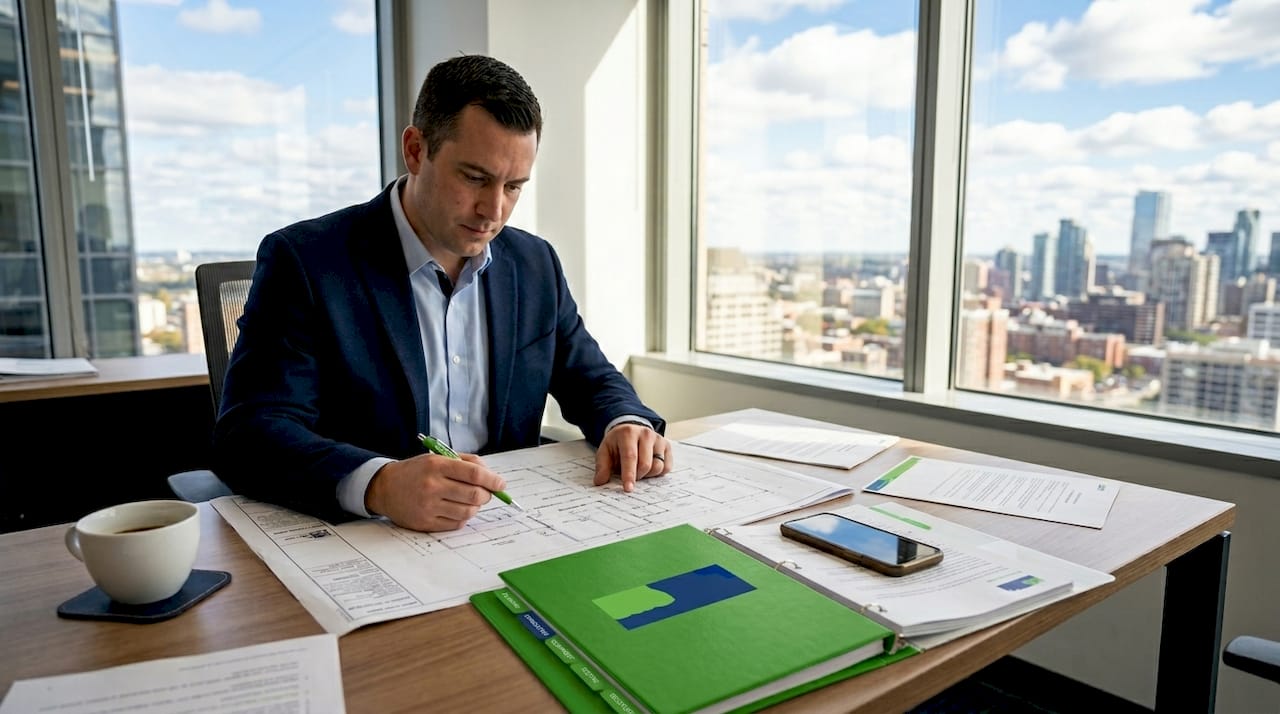
Commercial water damage restoration is the professional process of extracting water, drying structural materials, cleaning contaminated surfaces, and repairing damaged components in a business property after water intrusion. The industry standard governing this process is the IICRC S500, which was significantly updated in 2026 to require mandatory documentation, verified drying goals, and clearer contamination protocols. For property managers and business owners, understanding this process is not optional. Mold risk develops within two days of water exposure, meaning every hour of delay compounds both the health risk and the repair bill.
What is commercial water damage restoration, and why does classification matter?
Water damage restoration professionals categorize every loss by two systems: contamination category and saturation class. These classifications determine the scope of work, the safety measures required, and ultimately the cost of recovery.
Contamination categories define the water source and its health risk:
- Category 1 (clean water) originates from supply lines, rain intrusion, or clean appliance overflow. Restoration involves extraction and drying with no antimicrobial treatment required.
- Category 2 (gray water) contains biological or chemical contaminants from sources like dishwasher overflow or HVAC condensate. Category 2 water requires antimicrobial application and selective material removal.
- Category 3 (black water) is grossly contaminated, originating from sewage backups, floodwater, or storm surge. Full hazmat protocols, porous material removal, and post-remediation testing are required.
Saturation classes measure how deeply water has penetrated building materials:
| Class | Description | Affected Materials |
|---|---|---|
| Class 1 | Minimal absorption | Partial floor area, low-porosity materials |
| Class 2 | Significant absorption | Full room, walls wet to 24 inches |
| Class 3 | Maximum absorption | Ceilings, walls, floors, insulation saturated |
| Class 4 | Specialty drying required | Hardwood, concrete, plaster, crawl spaces |
The combination of category and class directly shapes the restoration scope. A Class 4, Category 3 loss in a commercial kitchen requires a fundamentally different response than a Class 1, Category 1 pipe leak in a break room. Misclassifying the loss is one of the most expensive mistakes a property manager can make, because it leads to under-scoped work and secondary damage.
What are the step-by-step phases of the restoration process?
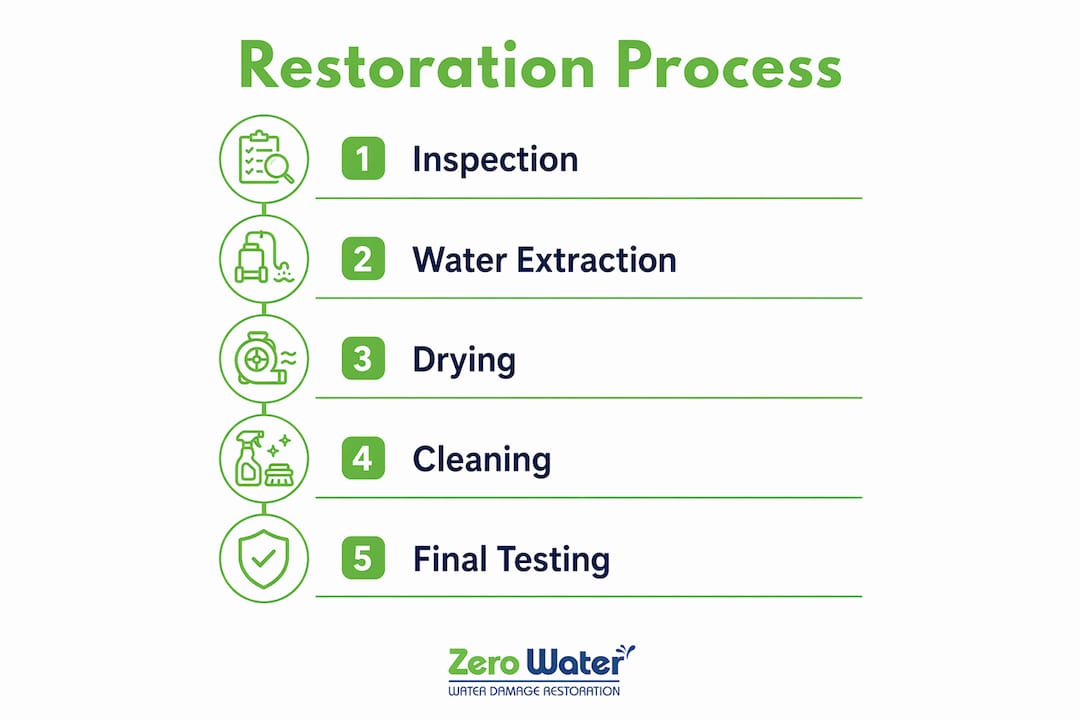
Commercial water damage repair follows a structured workflow. Knowing each phase helps you hold your contractor accountable and set realistic timelines with tenants and insurers.
-
Inspection and moisture mapping. Technicians use thermal imaging cameras and pin-type moisture meters to locate all wet areas, including hidden cavities behind walls and above ceilings. Water migrates beyond visible damage zones, so mapping must cover the full building assembly, not just the obvious wet spots.
-
Water extraction. Truck-mounted or portable extractors remove standing water. Submersible pumps handle deep flooding. Speed here directly limits the saturation class and reduces drying time.
-
Structural drying. Industrial dehumidifiers, air movers, and desiccant systems work together to pull moisture from building materials. Typical drying takes three to five days under IICRC S500 protocols, though Class 4 losses can run significantly longer.
-
Cleaning and antimicrobial treatment. Category 2 and 3 losses require EPA-registered antimicrobial agents applied to all affected surfaces. Porous materials that cannot be adequately cleaned are removed and documented.
-
Drying verification. This step is where many contractors cut corners. Drying concludes only when moisture meter readings match pre-established goals or unaffected reference materials, not when equipment is simply turned off.
-
Repair and reconstruction. Drywall, flooring, insulation, and structural components are replaced. This phase can range from cosmetic patching to full structural rebuilding depending on the loss scope.
-
Final documentation and closeout. The 2026 IICRC S500 revision requires mandatory documentation of moisture maps, daily readings, drying goals, and timestamps as evidence of standard-of-care compliance.
Pro Tip: Ask your contractor to show you the drying goal set at project outset and the final moisture readings that confirmed completion. If they cannot produce both, the job was not completed to current IICRC S500 standards.
How does commercial water damage restoration address health risks?
Contaminated water in a commercial property creates health risks that extend well beyond the visible damage. The restoration process for water damage must address microbial growth, airborne particulates, and occupant exposure as core deliverables, not afterthoughts.
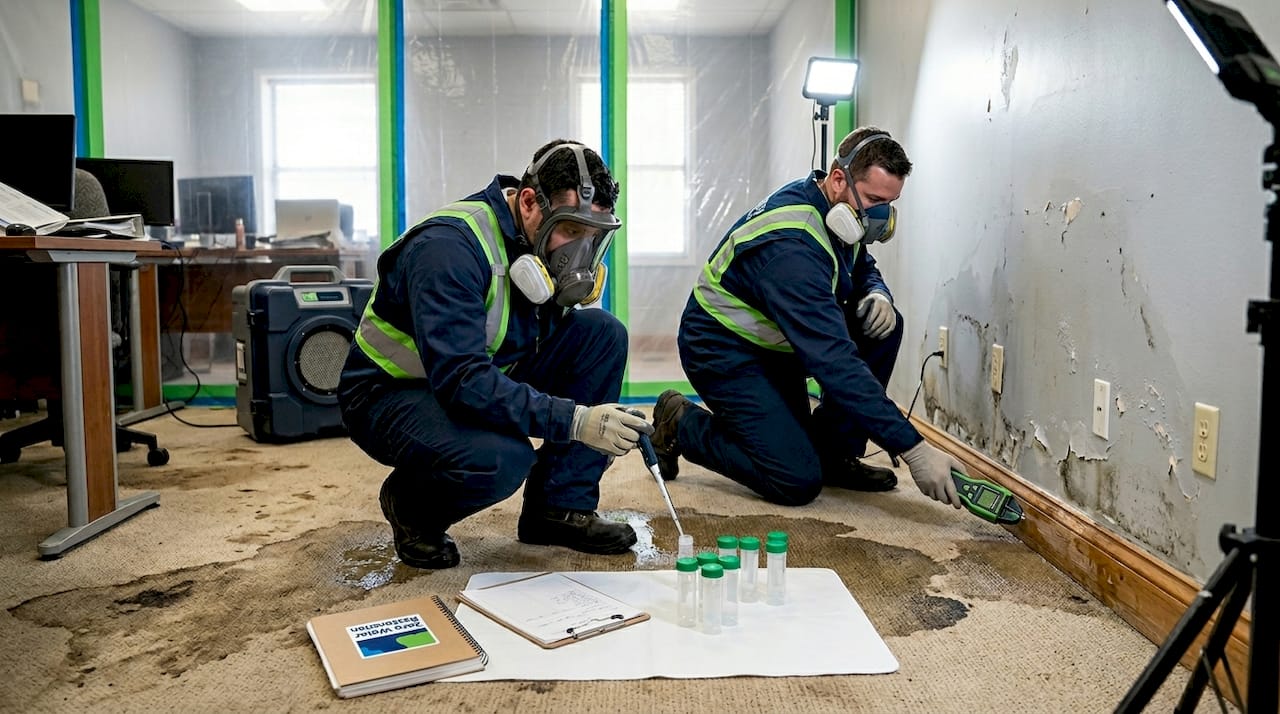
Floodwater and Category 3 sources contain bacteria, viruses, and chemical contaminants that require full containment with polyethylene barriers and negative air pressure systems. Technicians working in these environments use N95 respirators, Tyvek suits, gloves, and eye protection as minimum PPE. Occupants must be relocated from affected zones until post-remediation clearance testing confirms safe conditions.
Category 2 losses carry a risk that many property managers underestimate. Gray water degrades to Category 3 contamination within 24 to 72 hours if left untreated. A slow-responding contractor who treats a Category 2 loss as Category 1 exposes your tenants and your liability.
EPA guidance specifically highlights the need to protect vulnerable populations, including individuals with respiratory conditions, compromised immune systems, or mold sensitivities, during any water damage cleanup. Indoor Environmental Professionals (IEPs) can conduct air quality testing and provide independent clearance reports, which are particularly valuable for healthcare facilities, schools, and multi-tenant office buildings.
Key safety protocols every commercial restoration project should include:
- Containment barriers isolating the work zone from occupied areas
- HEPA air filtration running continuously during demolition and drying
- Daily moisture monitoring with documented readings
- Antimicrobial treatment on all Category 2 and 3 affected surfaces
- Post-remediation clearance testing before occupant re-entry
Pro Tip: For properties with mold-sensitive occupants, hire an IEP independent of your restoration contractor to conduct clearance testing. This eliminates the conflict of interest that exists when the same company both performs and certifies the work.
What are the best practices and common pitfalls in commercial restoration?
The gap between a well-executed commercial water damage repair and a costly failure almost always comes down to documentation, speed, and contractor accountability. Property managers who understand the common failure points are far better positioned to protect their assets.
Premature sign-off before moisture goals are verified is the single most common technical failure in restoration. Residual moisture trapped behind walls or under flooring creates ideal conditions for mold amplification within days. By the time visible mold appears, the secondary damage often costs more than the original loss.
The 2026 IICRC S500 update also clarifies the boundary between structural drying (governed by S500) and microbial remediation (governed by S520). When a loss crosses into S520 territory, the scope, containment requirements, and documentation standards escalate significantly. Contractors who fail to recognize this boundary and escalate accordingly create both health risks and insurance disputes.
Best practices for property managers overseeing a commercial restoration project:
- Require a written drying plan with documented goals before work begins
- Verify that your contractor holds current IICRC certification
- Request daily moisture logs with timestamps and meter readings
- Do not authorize reconstruction until drying verification is complete and documented
- Maintain your own copy of all moisture maps, photos, and scope documents
- Confirm that scope language aligns with the 2026 S500 category and class definitions
Pitfalls to avoid:
- Accepting verbal assurances that “it’s dry” without documented meter readings
- Allowing reconstruction to begin before antimicrobial treatment is confirmed complete
- Failing to notify your insurer promptly, which can affect claim eligibility
- Choosing a contractor based on price alone without verifying IICRC certification
How can property managers coordinate restoration and insurance claims effectively?
Insurance claims for commercial property water damage live or die on documentation quality. The 2026 S500 standard now treats moisture maps, drying logs, and timestamped readings as the primary evidence base for defensible claims and litigation. This is a direct response to years of disputes between contractors, insurers, and property owners over whether work was actually completed to standard.
The most effective approach is to treat documentation as a parallel workstream from day one. Your contractor should provide daily progress reports that include moisture readings, equipment placement, and any scope changes. These records support the adjuster’s review and reduce the back-and-forth that delays settlements.
| Documentation Type | Purpose in Claims Process |
|---|---|
| Initial moisture maps | Establishes extent of damage at project start |
| Daily drying logs | Proves ongoing compliance with IICRC S500 |
| Scope of work revisions | Justifies cost changes tied to category/class escalation |
| Antimicrobial treatment records | Confirms health and safety protocols were followed |
| Final clearance report | Supports claim closure and occupant re-entry authorization |
Scope revisions are a normal part of commercial restoration. Water migrates, classifications change as more is uncovered, and what starts as a Category 1 loss can escalate when hidden contamination is found. Contractors who update scope documents in real time and communicate changes to the insurer promptly reduce the risk of disputed line items at settlement. Zerowaterrestoration handles insurance documentation directly with adjusters, which removes a significant administrative burden from the property manager’s plate.
Key takeaways
Commercial water damage restoration requires verified drying, documented contamination classification, and IICRC S500-compliant records to protect both the property and the insurance claim.
| Point | Details |
|---|---|
| Classification drives scope | Correctly identifying water category and saturation class determines the full restoration method and cost. |
| Drying must be verified | Drying ends only when moisture meters confirm goals are met, not when equipment is removed. |
| Documentation is non-negotiable | The 2026 IICRC S500 requires timestamped moisture maps and daily logs as standard-of-care evidence. |
| Health risks escalate fast | Category 2 water degrades to Category 3 within 72 hours, and mold can develop within 48 hours of exposure. |
| Insurance claims need records | Moisture maps, drying logs, and scope revisions form the defensible foundation for dispute-free settlements. |
What I’ve learned after a decade of commercial water losses
The most persistent misunderstanding I see among property managers is treating water damage restoration as a commodity service where the lowest bid wins. It is not. The difference between a contractor who documents drying goals and one who just runs equipment until it “feels dry” is the difference between a clean insurance settlement and a mold remediation project six months later that costs three times the original loss.
The 2026 IICRC S500 updates are a genuine shift in accountability. For the first time, documentation is not a best practice. It is a requirement. That changes the conversation between property managers and contractors significantly. You now have a clear standard to point to when demanding daily logs and verified moisture readings. Use it.
I also think the health dimension of commercial restoration is consistently underweighted. A Category 2 loss in an occupied office building is not just a property problem. It is an occupant health problem. Getting an independent IEP involved for clearance testing on any Category 2 or 3 loss in an occupied building is the kind of decision that protects both your tenants and your liability exposure.
The technology side is moving fast too. Thermal imaging and wireless moisture sensors now allow real-time monitoring of drying progress across large commercial floor plates. Contractors who use these tools produce better outcomes and better documentation. When you are evaluating water damage recovery solutions for your property, ask specifically about the monitoring technology your contractor uses. The answer tells you a lot about their standard of care.
— Jim
How Zerowaterrestoration supports commercial water damage recovery
When water damage hits your commercial property, the response window is measured in hours, not days. Zerowaterrestoration provides 24/7 emergency response across the northwest suburbs of Chicago, including Schaumburg, Arlington Heights, Palatine, and Barrington, with crews that arrive ready to extract, map, and begin drying immediately.
The team handles Category 2 and Category 3 losses with full containment protocols, HEPA filtration, and EPA-registered antimicrobial treatments. Every project follows current IICRC S500 standards, including documented drying goals and daily moisture logs. Zerowaterrestoration also works directly with your insurance adjuster to manage documentation and scope communication, keeping your claim on track from first call to final clearance. For a free assessment, visit the water damage restoration service page or call (847) 515-7000.
FAQ
What is commercial water damage restoration?
Commercial water damage restoration is the professional process of removing water, drying structural materials, treating contamination, and repairing damage in a business property following water intrusion. The process follows IICRC S500 standards and covers everything from initial moisture mapping through final reconstruction.
How long does commercial water damage restoration take?
Structural drying typically takes three to five days under IICRC S500 protocols, but total restoration time depends on the saturation class and the scope of cleaning and repairs required. Category 3 losses or Class 4 saturation can extend the timeline significantly.
What are the three categories of water damage?
Category 1 is clean water from supply lines or rain, Category 2 is gray water with biological or chemical contaminants, and Category 3 is black water from sewage or floodwater requiring full hazmat protocols. Each category requires a different level of remediation and PPE.
How do I know when drying is actually complete?
Drying is complete only when moisture meter readings confirm that affected materials have returned to normal moisture levels or match unaffected reference materials in the same building. Equipment runtime alone is not a valid indicator of completion under current IICRC S500 standards.
Why does documentation matter for my insurance claim?
The 2026 IICRC S500 revision requires timestamped moisture maps, daily drying logs, and scope documentation as the primary evidence base for insurance claims. Without this documentation, disputed line items and delayed settlements become significantly more likely.