
Comparing water restoration company quotes is the single most effective way to protect yourself from overpaying or hiring an underqualified contractor after water damage strikes your home or business. Water damage repair estimates in the Chicagoland area range from $450 to over $16,000, with an average around $3,863 depending on damage extent and water type. That spread is enormous, and it exists because quotes vary wildly in what they include, how they price labor, and whether they meet current industry standards like the 2026 revision of ANSI/IICRC S500. Knowing how to read and compare those bids puts you in control.
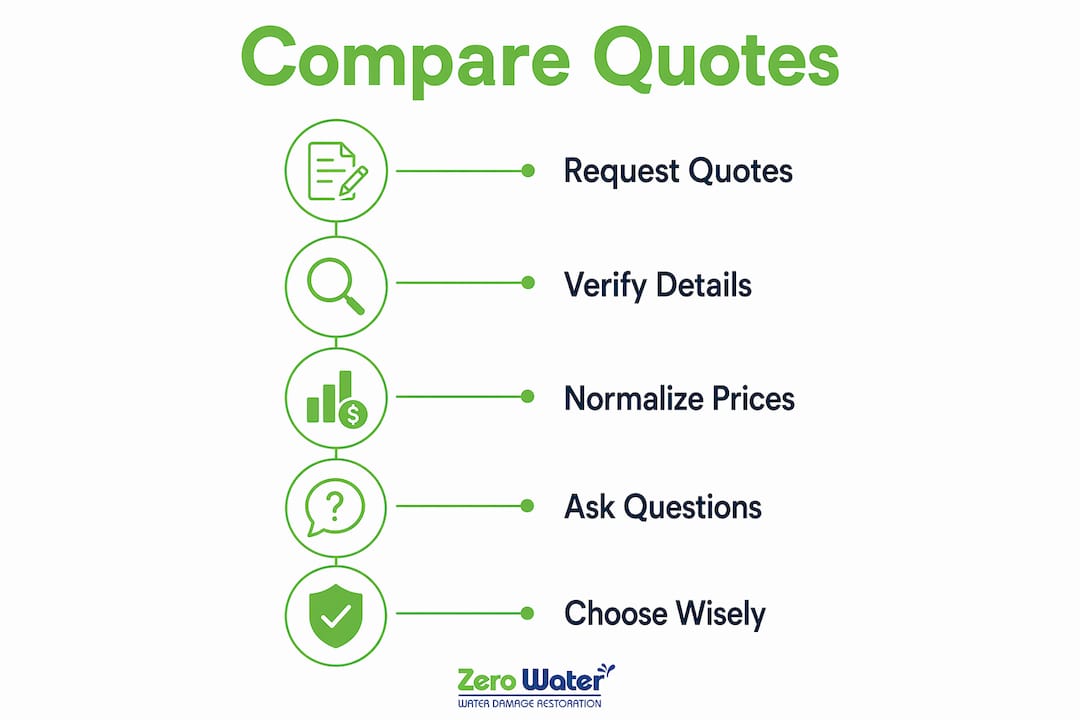
How to compare water restoration company quotes the right way
The industry term for what most homeowners call “getting quotes” is competitive bid analysis, and doing it correctly means more than collecting three numbers and picking the lowest. Angi recommends at least three quotes from licensed restoration contractors before making any hiring decision. That baseline matters because a single quote gives you no reference point, and two quotes can still leave you guessing which is fair.
The goal is an apples-to-apples comparison. That means every bid you receive must cover the same scope of work, the same water category, and the same affected square footage. When one contractor quotes $2,200 and another quotes $4,800 for what looks like the same job, the difference almost always lives in the details of what each quote actually includes.

Start by requesting itemized written estimates from each company. Verbal quotes are not useful for comparison. A written estimate forces the contractor to commit to specific line items, which you can then evaluate side by side.
What should be included in water damage restoration quotes?
A complete water damage restoration quote covers more than extraction and drying. Every bid you receive should include the following:
- Water extraction and removal with the specific equipment listed (truck-mounted extractors, portable units, or both)
- Moisture mapping showing which materials and areas were tested and at what readings
- Drying goals stated as specific target moisture levels for each affected material type
- Monitoring schedule detailing how often a technician will return to check equipment and readings
- Mold remediation if contamination is present or likely given the water source
- Final verification readings confirming that drying goals were achieved before equipment removal
- Scope of demolition if wet drywall, flooring, or insulation must be removed
Vague line items and missing drying verification are the most common traps in restoration quotes. A bid that says “drying services” without specifying equipment, monitoring frequency, or target moisture levels is not a complete quote. You cannot compare it fairly against one that spells out every detail.
Insurance claim assistance is another inclusion worth confirming upfront. Some contractors document the process and assist with claims, while others hand you a bill and leave the insurance paperwork entirely to you. Knowing which type you are hiring changes the total value of the quote significantly. You can learn more about how this works by reading about insurance claim coordination before you start calling contractors.
Pro Tip: Ask each contractor whether their documentation meets the 2026 ANSI/IICRC S500 standard, which now requires recorded drying goals, verification methodology, and final moisture readings as part of every job file. A contractor who knows what you are asking is a contractor worth taking seriously.
How do pricing factors and water damage categories affect restoration quotes?
Water damage restoration pricing is driven primarily by two variables: the contamination category of the water and the total square footage affected. Understanding both makes it possible to normalize bids that look very different on the surface.
The IICRC classifies water damage into three categories. Clean water costs approximately $3.50 per square foot to restore, gray water runs around $5.25 per square foot, and black water reaches approximately $7.50 per square foot. Those differences reflect the additional labor, protective equipment, antimicrobial treatments, and disposal requirements that contaminated water demands.
| Water category | Source examples | Avg. cost per sq ft |
|---|---|---|
| Category 1 (clean) | Burst supply line, appliance overflow | ~$3.50 |
| Category 2 (gray) | Washing machine discharge, toilet overflow without solids | ~$5.25 |
| Category 3 (black) | Sewage backup, floodwater, long-standing water | ~$7.50 |
The location of the damage also affects cost. A flooded basement in Schaumburg or Barrington typically costs more to restore than a single room on the main floor because of access, humidity management, and the likelihood of structural materials absorbing water over a larger area. Damage that has been sitting for more than 24 to 48 hours escalates costs further because secondary damage and mold risk increase.
Comparing total dollar amounts alone causes confusion. Divide each quote’s total by the affected square footage and confirm the water category each contractor is pricing against. That single calculation reveals whether you are comparing equivalent work or whether one contractor is scoping a smaller job than the others.
Pro Tip: If two contractors disagree on the water category, ask each one to walk you through their classification reasoning. Category disagreements are a red flag that one contractor may be underscoping the job to win the bid.
What questions should you ask water restoration companies when comparing quotes?
Asking the right questions separates contractors who know their craft from those who are guessing. Before you sign anything, get clear answers to each of the following:
- What are your drying goals for this job? A qualified contractor states specific target moisture content percentages for wood, drywall, and concrete rather than saying “until it’s dry.”
- How will you verify that drying goals were met? The 2026 ANSI/IICRC S500 revision requires documented verification methodology and final readings. Any contractor working to current standards should have a clear answer.
- Do you assist with insurance claims and adjuster communication? This question reveals whether the contractor will help you navigate your water damage claim or leave you to manage it alone.
- What equipment will you use, and how often will you monitor it? Industrial air movers and dehumidifiers are standard. Daily or every-other-day monitoring is the professional baseline.
- What is your emergency response time? For active water damage, response within two to four hours limits secondary damage and mold growth.
- Does your quote include mold testing or remediation if mold is discovered during drying? Some quotes exclude this entirely, which can create a surprise cost mid-project.
- Are you IICRC certified? Certification through the Institute of Inspection, Cleaning and Restoration Certification confirms that technicians have been trained to current standards.
- Can you provide references from similar jobs in the Chicagoland area? Local references from communities like Arlington Heights, Palatine, or Elk Grove Village are more relevant than out-of-state testimonials.
These questions also serve as a quality filter. A contractor who cannot answer questions about drying goals or moisture verification is unlikely to perform to the standard that your insurance company and your property require.
How to evaluate and choose between water restoration quotes effectively
Once you have three or more written quotes in hand, follow this evaluation process to make a confident decision.
-
Confirm the water category on each quote. Every bid should state whether the damage involves Category 1, 2, or 3 water. If a quote does not specify, ask the contractor to add it in writing before you compare anything else.
-
Calculate the price per square foot for each bid. Divide the total restoration cost by the affected square footage. This single number makes bids with different total prices directly comparable.
-
Audit the scope language on each quote. Look for specific drying goals, equipment lists, monitoring schedules, and final verification steps. Bids missing drying goals and moisture verification risk insurance claim disputes and signal lower quality work. Remove those bids from serious consideration.
-
Check for insurance claim support. A contractor who documents the job thoroughly and communicates with your adjuster adds real value beyond the physical restoration work. That support is worth paying for, and it often reduces your out-of-pocket costs.
-
Verify certifications and references. IICRC certification is the industry baseline. Call at least one reference from a job similar in scope and water category to yours. Ask specifically whether the contractor met their stated drying timeline and whether the final moisture readings were documented.
-
Identify red flags. Missing drying goals, no monitoring schedule, no mention of final verification, and pressure to sign quickly are all warning signs. A contractor who cannot explain their process in writing is a contractor who may not follow one.
The best water restoration services are not always the cheapest or the most expensive. They are the ones whose quotes are specific, whose processes are documented, and whose technicians can answer your questions without hesitation.
Pro Tip: Before signing, ask the contractor to confirm in writing that their documentation will meet the requirements of the 2026 ANSI/IICRC S500 standard. This protects you if your insurer later questions the scope or outcome of the work.
Key takeaways
Accurate quote comparison requires normalizing bids by water category and square footage, not just comparing total prices.
| Point | Details |
|---|---|
| Get at least three quotes | Multiple bids create a reference range and reveal scope differences between contractors. |
| Normalize by price per sq ft | Divide each total by affected square footage and confirm the water category to compare fairly. |
| Require documented drying goals | Quotes without specific moisture targets and verification steps fail the 2026 ANSI/IICRC S500 standard. |
| Confirm insurance claim support | Contractors who document and communicate with adjusters reduce your out-of-pocket costs and claim risk. |
| Treat vague line items as red flags | Missing equipment lists, monitoring schedules, or final readings signal an incomplete or underscoped bid. |
What I’ve learned from watching homeowners get burned on restoration quotes
After more than a decade working in the Chicagoland restoration market, the pattern I see most often is this: a homeowner gets one quote, it sounds reasonable, and they sign the same day because the damage is stressful and they want it handled. Three weeks later, they are disputing a bill that doubled because the original scope excluded mold remediation, monitoring, or final verification.
The 2026 ANSI/IICRC S500 revision is genuinely useful here, not as a bureaucratic standard but as a practical checklist. If a contractor’s quote does not include documented drying goals and a verification methodology, their documentation will not hold up when your insurer’s adjuster reviews the claim file. That gap costs homeowners real money.
The other thing I would push back on is the instinct to choose the lowest bid. In water restoration, a low bid almost always means a narrower scope. The contractor pricing Category 1 clean water work at $2.50 per square foot is either cutting corners on monitoring or planning to bill separately for anything that comes up during drying. Neither outcome is good for you.
My honest advice: normalize every bid to price per square foot, confirm the water category in writing, and ask every contractor the same set of questions. The one who answers clearly, documents thoroughly, and does not pressure you to sign fast is almost always the right choice. In the northwest suburbs, that combination is not as common as it should be, which is exactly why doing this comparison work matters.
— Jim
Get a free quote from Zero Water Restoration
Zero Water Restoration serves homeowners and business owners throughout the Chicagoland area, including Barrington, Lake Zurich, and Streamwood, with 24/7 emergency response and free on-site estimates. Every quote includes documented drying goals, moisture verification, and full insurance claim support, meeting the 2026 ANSI/IICRC S500 standard from day one. The team works directly with your insurance adjuster to manage documentation and keep your out-of-pocket costs as low as possible. Call (847) 515-7000 or visit zerowaterrestoration.com to schedule your free inspection today.
FAQ
How many quotes should I get for water damage restoration?
Get at least three quotes from licensed restoration contractors before hiring. Multiple bids give you a pricing reference range and reveal differences in scope that a single quote cannot expose.
What is the average cost of water damage restoration in Chicagoland?
Water damage restoration averages around $3,863 nationally, with a range from $450 to over $16,000 depending on water category, affected square footage, and damage severity. Chicagoland pricing follows this range closely, with basement flooding and black water events typically landing at the higher end.
What does ANSI/IICRC S500 mean for my restoration quote?
The 2026 ANSI/IICRC S500 revision requires contractors to document drying goals, verification methodology, and final moisture readings on every job. A quote that lacks these elements may not satisfy your insurer’s documentation requirements during a claim review.
What are red flags in a water restoration quote?
Missing drying goals, no monitoring schedule, vague line items like “drying services,” and no mention of final moisture verification are all red flags. Bids without this documentation increase the risk of insurance claim disputes and indicate the contractor may not follow a documented process.
Should my restoration contractor help with my insurance claim?
Yes. Contractors who assist with insurance documentation and communicate directly with adjusters reduce your administrative burden and often help maximize your covered benefits. Confirm this service is included in the quote before signing.