
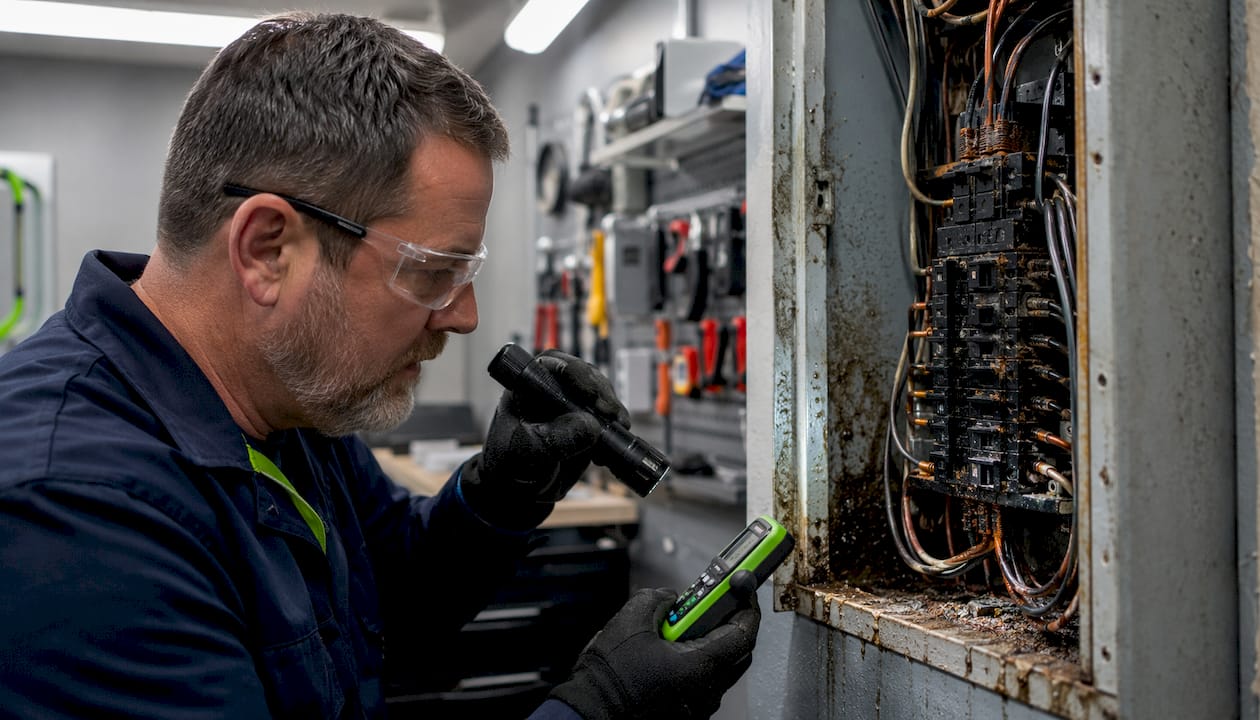
Water-damaged electrical wiring is any wiring or electrical equipment that has been submerged or exposed to contaminated moisture — and it should not be re-energized until a licensed electrician evaluates and clears it. Full stop. The moisture itself is only part of the problem; floodwater typically carries sewage, oil, salt, and chemicals that leave conductive and corrosive residues behind long after everything looks dry. Three U.S. authorities set the standard here:
- NEC (National Electrical Code) 300.4©: requires replacement of conductors and wiring methods rendered unsuitable by water or corrosive influences.
- NEMA GD-1: the industry’s primary technical guide for evaluating water-damaged equipment, distinguishing what must be replaced from what may be reconditioned under strict protocols.
- ESFI (Electrical Safety Foundation International): provides homeowner-facing guidance and consistently recommends professional evaluation before any re-energization.
Pro Tip: If your home flooded and you are unsure whether the electrical panel was submerged, treat it as submerged. The cost of an inspection is far lower than the cost of a fire or electrocution.
Table of Contents
- What does water damaged electrical wiring actually do to your system?
- Which electrical equipment must be replaced vs. reconditioned?
- How do electricians inspect and test water-damaged wiring?
- What should you do immediately after water reaches your electrical system?
- When should you call a licensed electrician, and what happens next?
- What U.S. code and authoritative guidance say about water-damaged wiring
- How restoration contractors, electricians, and insurers coordinate after water damage
- Key Takeaways
- Why safety-first decisions save more than they cost
- Zerowaterrestoration is ready when water damage reaches your electrical system
- Useful sources and where to read more
What does water damaged electrical wiring actually do to your system?
Water harms electrical equipment through several overlapping mechanisms, and understanding them explains why “let it dry” is not a plan.
Short circuits and conductive residues. Pure water is a poor conductor, but floodwater almost never arrives pure. Contaminants like sewage, oil, and chemicals dissolved in the water become conductive films on wire insulation, bus bars, and contact surfaces. When power is restored, those films can create immediate shorts or slow-burning arcs.
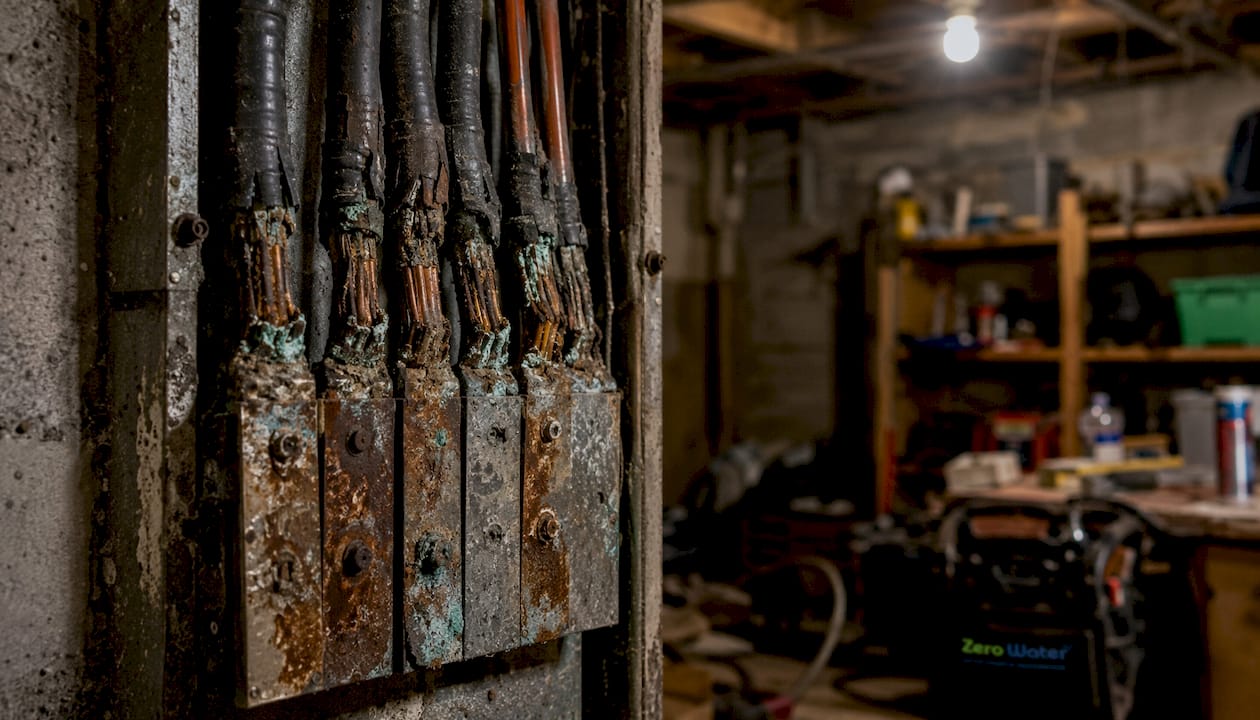
Corrosion of metal components. Copper conductors, aluminum bus bars, and steel enclosures all corrode when wet. Corrosion at termination points raises resistance, generates heat, and can eventually cause a connection to fail or ignite surrounding materials. Saltwater and storm-surge exposure accelerate this process dramatically because the salt residue is both conductive and chemically aggressive.
Insulation degradation. Wire insulation is rated for specific environments. Cable listed for dry locations only — like common NM-B (Romex) used throughout most homes — can become a shock hazard the moment it is energized after water exposure. Moisture trapped inside the jacket degrades the dielectric strength of the insulation over time, even if the wire appears intact.
Impaired protective devices. Molded-case circuit breakers rely on precise mechanical and thermal components. Water can wash away lubricants, deposit foreign particles, and corrode contacts, all of which affect how and whether the breaker trips under fault conditions. Breakers with electronic trip units face an additional risk: the electronics themselves can be permanently damaged. The effects of wet electrical wiring on protective devices are often invisible until a fault occurs.
Key point: Visible dryness is not proof of safety. Contaminants and corrosion persist inside enclosures and wire jackets long after surfaces feel dry.
Which electrical equipment must be replaced vs. reconditioned?
This is where homeowners often get surprised. The answer depends heavily on what the device is, what it was exposed to, and what the manufacturer says.
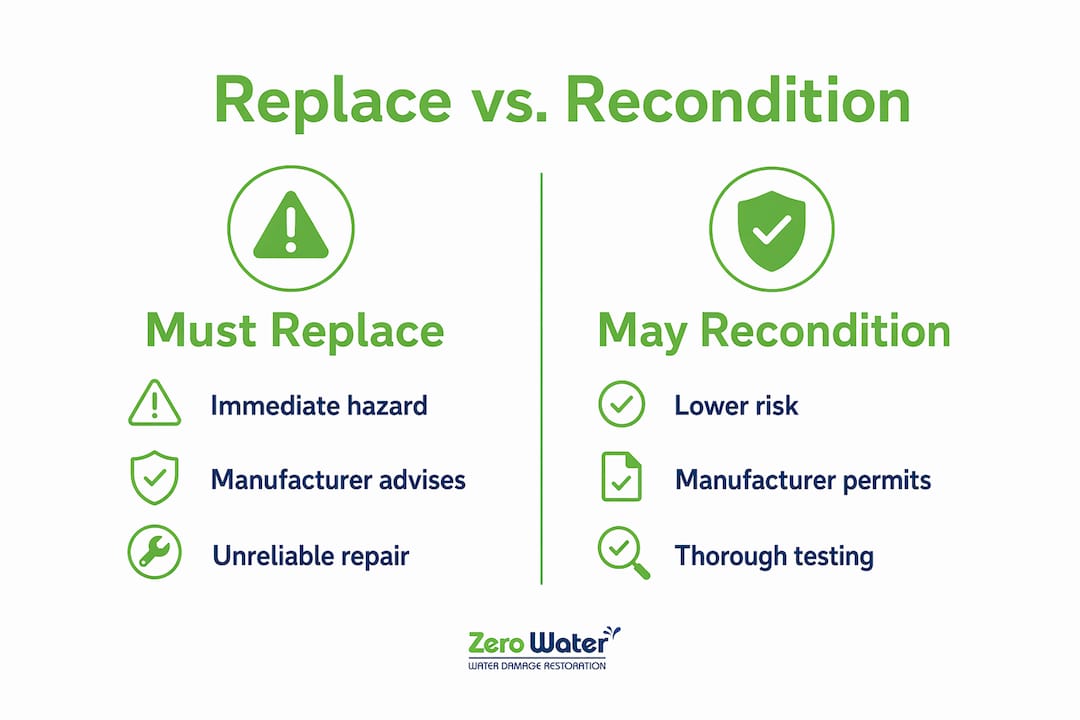
Equipment that generally must be replaced
- AFCIs and GFCIs: Electronic circuitry inside these devices cannot be reliably restored after submersion. Air drying and washing should not be attempted. Replace them.
- Surge protective devices: Same reasoning as AFCIs/GFCIs. Internal electronics are compromised.
- Receptacles and switches: Sediments migrate into internal components and remain even after drying.
- Smoke and CO alarms: Life-safety devices with no margin for uncertainty. Replace without exception.
- NM-B (Romex) cable: Listed for dry locations only. Once wet, it must be replaced per NEMA guidance.
- Fuses: Water affects the filler material, degrading insulation and interruption capability.
- Most appliances that were plugged in while wet: Internal electronics and motors face the same contamination risks.
Equipment that may sometimes be reconditioned
Some equipment can be salvaged, but only under controlled conditions with manufacturer involvement. NEMA GD-1 identifies these candidates:
- Panelboards and switchboards: May be reconditioned if the manufacturer approves and qualified personnel perform the work. Contact the manufacturer before taking any action.
- Some motors: Depending on exposure severity and motor type, reconditioning under manufacturer protocols may be possible.
- Certain low-voltage power circuit breakers: Manufacturer consultation is required; electronic trip units typically must be replaced even if the breaker frame is salvageable.
- Wire and cable rated for wet locations (ends not exposed): May remain suitable, but a qualified person must confirm suitability and an insulation-resistance test is required before re-energization.
| Dimension | Must Replace | May Be Reconditioned |
|---|---|---|
| Risk severity | Immediate hazard if re-energized | Inspect-and-test before any decision |
| Typical tests required | None (replace outright) | Megger/IR, continuity, load test, manufacturer sign-off |
| Timeline | Days (swap for new) | Weeks (manufacturer consultation, controlled drying) |
| Cost shape | Predictable unit cost | Variable; reconditioning can exceed replacement cost |
Pro Tip: When a manufacturer recommends replacement, that recommendation overrides any field assessment. Keep the written manufacturer guidance in your claim file.
How do electricians inspect and test water-damaged wiring?
A licensed electrician’s evaluation follows a structured sequence. Knowing what to expect helps you ask the right questions and understand the report you receive.
The typical inspection sequence:
- Lock out and tag out affected circuits before any hands-on work begins.
- Visual inspection of all accessible wiring, enclosures, panels, and devices for corrosion, discoloration, water staining, and physical damage.
- Photographic documentation of every affected component, including serial numbers on panels and breakers.
- Isolation of affected circuits from the rest of the system.
- Component-level assessment to determine replace vs. test further.
Common tests electricians use:
- Insulation-resistance (megger) test: Applies a high DC voltage to measure how well insulation resists current leakage. A low reading indicates compromised insulation. This is the most common field test for water-damaged wiring.
- Continuity checks: Confirm circuit paths are intact and identify open conductors or failed connections.
- Contact/resistance measurements: Identify high-resistance connections that generate heat under load.
- Load testing: Verifies device performance under operating conditions after other tests pass.
- Thermal imaging: Infrared cameras reveal hot spots inside panels and behind walls that visual inspection misses entirely.
These tests have real limits. A megger test gives a pass/fail on insulation resistance at the moment of testing. It cannot predict future corrosion from contaminants already embedded in the insulation or enclosure. That is why manufacturer reconditioning protocols are required for many devices, not just field testing alone.
What should you do immediately after water reaches your electrical system?
Speed matters, but the wrong move can be fatal. Here is the sequence that keeps people safe.
Immediate safety checklist:
- Shut off main power at the breaker panel if you can reach it without standing in water or touching wet surfaces. If you cannot reach it safely, call your utility company to disconnect service from outside.
- Stay out of standing water in any area where electrical equipment is present. Water conducts electricity; a live circuit in a flooded room can electrocute anyone who steps in.
- Keep children and pets away from the affected area entirely until power is confirmed off.
- Do not touch any electrical device, outlet, or panel that was submerged or splashed, even if the power appears to be off.
- Call emergency services if service equipment (the meter base or main panel) was submerged. Utility disconnection is required before any work can begin.
The drying caveat deserves its own emphasis. Drying time alone is not a reliable indicator of safety. Moisture can remain trapped behind walls, inside conduit, and within device enclosures for days or weeks after surfaces feel dry. Understanding why water damage worsens over time helps explain why a panel that looks fine on day three can still cause a fire on day thirty.
Dehumidification and water extraction are legitimate mitigation steps, but they are not repairs. They reduce ongoing moisture damage and preserve evidence for insurers. They do not substitute for electrical inspection and testing.
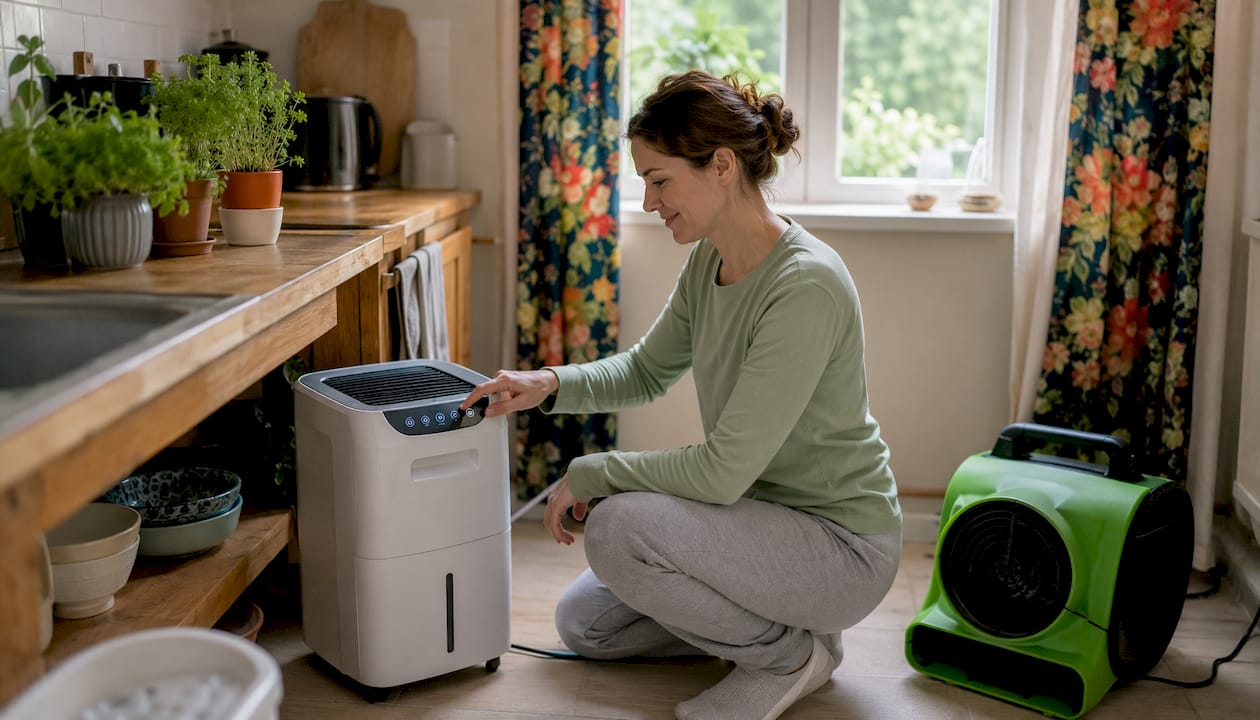
Pro Tip: Run dehumidifiers and air movers in affected spaces as soon as it is safe to do so, but document the moisture readings before and after. Those numbers support your insurance claim.
When should you call a licensed electrician, and what happens next?
Call a licensed electrician immediately if any of the following apply:
- The electrical panel or subpanel was submerged or splashed.
- Any appliance was plugged in during the water event.
- Breakers trip repeatedly after the water recedes.
- You smell burning, see discoloration, or notice corrosion on outlets or panels.
- Any wiring behind walls was exposed to floodwater.
Protecting your home after water exposure means not waiting to see if things “seem fine.” They often do, right up until they don’t.
On site, the electrician will lock out affected circuits, run the inspection and testing sequence described above, consult manufacturers for any devices with electronic components, and deliver a written repair or replacement plan. For most homes, outcomes range from replacing individual receptacles and breakers (a few hundred dollars) to partial rewiring or full panel replacement (several thousand dollars). The type of water involved — clean pipe water versus contaminated floodwater — significantly affects both the scope of replacement and the insurance classification of the damage.
Insurance documentation affects the timeline and your out-of-pocket costs. An electrician’s written inspection report, combined with photos and mitigation receipts, is what adjusters need to process a claim. Get the report in writing before any work begins.
What U.S. code and authoritative guidance say about water-damaged wiring
Three sources carry the most weight for homeowners and electricians alike.
NEC 300.4© is the clearest code statement on the subject. It requires that conductors and wiring methods rendered unsuitable by water exposure or corrosive influences be replaced. The provision references NEMA GD-1 for evaluation procedures, which means the two documents work together: the Code sets the legal obligation, and NEMA GD-1 provides the technical roadmap.
NEMA GD-1 covers the full range of electrical equipment and distinguishes between items requiring complete replacement and those that may be reconditioned under controlled conditions. Its core message is that contamination from chemicals, sewage, oil, and debris changes the risk profile fundamentally, and that manufacturer consultation is required before any reconditioning decision.
“Electrical equipment exposed to water can be extremely hazardous if reenergized without performing a proper evaluation and taking necessary actions.” — NEMA GD-1
ESFI and state agencies translate these technical standards into homeowner-facing guidance. The Texas Department of Insurance (TDI), for example, warns that even thoroughly dried equipment can pose long-term fire risk if not properly evaluated. The Minnesota Department of Labor and Industry publishes similar guidance. ESFI’s water-damaged equipment guidance consistently recommends professional evaluation and replacement of electronic protective devices after any significant water exposure.
The practical implication of all three sources is the same: do not re-energize, call a licensed electrician, and replace what the manufacturer and code say to replace.
How restoration contractors, electricians, and insurers coordinate after water damage
The workflow after a water event has a defined sequence, and knowing it helps you move faster and avoid gaps that delay your claim.
The typical coordination flow:
- Emergency mitigation: water extraction and controlled drying to stop ongoing damage and preserve evidence.
- Documentation: time-stamped photos of all affected areas, appliance serial numbers, and moisture readings.
- Electrician evaluation and testing: written inspection report with findings and a repair/replacement plan.
- Manufacturer consultation: for any device where reconditioning is being considered.
- Insurer adjuster review: the adjuster uses the electrician’s report, photos, and mitigation receipts to scope the claim.
- Repair or replacement: work begins only after the adjuster approves scope, or the homeowner authorizes out-of-pocket work.
What homeowners should document from the start:
- Time-stamped photos of every affected room, panel, outlet, and appliance before anything is moved or dried.
- Serial numbers and model numbers from panels, breakers, and major appliances.
- The electrician’s written inspection report, including test results.
- All mitigation receipts (water extraction, dehumidification, drying equipment).
Restoration contractors and electricians work in parallel during the early phase. The contractor handles extraction and drying while the electrician evaluates what is safe to leave in place. Understanding how restoration pros assess water damage gives you a clearer picture of how these roles fit together. A plumber’s role in shutting off supply lines and repairing the source of the leak is equally important in the early hours.
Pro Tip: When an electrician removes a breaker or device for replacement, ask them to set it aside rather than discard it immediately. Some adjusters want to inspect replaced components before closing a claim.
Key Takeaways
Water-damaged electrical wiring must be treated as unsafe until a licensed electrician inspects and clears it, because contaminated moisture leaves conductive and corrosive residues that persist long after visible drying.
| Point | Details |
|---|---|
| Never re-energize without inspection | Treat all water-exposed wiring and equipment as unsafe until a licensed electrician clears it. |
| Saltwater and floodwater are especially destructive | Conductive and corrosive residues from contaminated water persist inside enclosures and wire jackets after drying. |
| Many protective devices must be replaced outright | AFCIs, GFCIs, surge devices, smoke alarms, and NM-B cable cannot be reconditioned after submersion. |
| NEC 300.4© requires replacement of compromised wiring | The Code mandates replacing conductors and wiring methods rendered unsuitable by water or corrosive exposure. |
| Zerowaterrestoration coordinates the full response | Zerowaterrestoration handles extraction, drying, documentation, and insurer coordination so electricians can focus on safe evaluation and repair. |
Why safety-first decisions save more than they cost
The conventional wisdom after a flood is to move fast and restore power as soon as possible. That instinct is understandable. It is also the one most likely to cause a second disaster.
What gets underestimated consistently is the gap between “looks dry” and “is safe.” A panel that sat in two feet of floodwater for six hours may test fine on a megger the next morning. Three months later, corroded contacts inside a breaker fail to trip during a fault, and the result is a house fire. The NEC and NEMA do not require replacement to be bureaucratic. They require it because the failure modes are real, delayed, and often invisible.
The other thing worth saying plainly: reconditioning is not always cheaper than replacement. Manufacturer-approved reconditioning for a switchboard involves controlled drying, chemical cleaning, component-level testing, and written sign-off. By the time that process is complete, a new unit often costs less. Get the electrician’s written recommendation and the manufacturer’s position before assuming reconditioning saves money.
Ask your electrician two things on the first visit: what tests will you run, and will I receive a written report with results? If the answer to either is vague, find a different electrician.
Zerowaterrestoration is ready when water damage reaches your electrical system
When water reaches your electrical system, the first 24 hours determine how much of the damage is recoverable and how smoothly your insurance claim moves. Zerowaterrestoration responds 24/7 to water damage emergencies throughout the northwest suburbs of Chicago, including Barrington, Lake Zurich, Streamwood, and the surrounding Chicagoland area. The team handles rapid water extraction, controlled drying, and the documentation your adjuster needs, while coordinating directly with licensed electricians so nothing falls through the gaps.
Dealing with an insurer on top of a flooded home is a lot to manage alone. Zerowaterrestoration works directly with insurance providers, handles adjuster communication, and keeps your out-of-pocket costs as low as possible. For homeowners in Barrington, the water damage restoration team is standing by. If you are in Lake Zurich or Streamwood, local emergency restoration services are available now. Call (847) 515-7000 or visit zerowaterrestoration.com for a free inspection and to get emergency mitigation started.
Useful sources and where to read more
The following authoritative documents and agency pages are the primary references for water-damaged electrical equipment guidance in the United States. Save or print any inspection reports alongside these references for your insurance claim file.
- NEMA GD-1: Guidelines for Handling Water Damaged Electrical Equipment — the primary industry technical guide covering all equipment categories, contamination risks, and reconditioning vs. replacement decisions.
- NEMA: Replacing or Upgrading Water-Damaged Electrical Equipment — practical guidance on test methods and upgrade options.
- ESFI: Water-Damaged Electrical Equipment — homeowner-facing safety guidance from the Electrical Safety Foundation International.
- Texas Department of Insurance (TDI): Water-Damaged Electrical Equipment and Disaster Recovery — state-level guidance applicable to any homeowner navigating post-flood electrical safety.
- Minnesota DLI: Recommendations for Electrical Equipment Damaged by Floodwaters — another strong state-agency reference with practical homeowner steps.
- NEC 300.4©: Damaged Conductors and Wiring Methods — the specific code provision requiring replacement of water-compromised wiring.
- ESA Guideline: Electrical Installations Exposed to Water — detailed guidance on electronic protective devices and why air drying is not an approved fix.
Keep a printed or digital copy of your electrician’s inspection report, all test results, and the relevant NEMA GD-1 sections alongside your insurance claim file. Adjusters and contractors both reference these documents when scoping repairs, and having them organized speeds up every step of the process.