

Out-of-pocket water restoration costs are the expenses Illinois homeowners pay directly after insurance deductibles and coverage limits are applied. Understanding how out-of-pocket water restoration costs work is the difference between a manageable recovery and a financial shock. Professional restoration runs $1,300 to $6,300 for most homes, with a national average near $3,850. Major disasters can push past $25,000. What you personally pay depends on your deductible, your policy’s exclusions, the type of water damage, and how fast you act.
How out-of-pocket water restoration costs work
Out-of-pocket expenses in water restoration fall into two buckets: your deductible and any costs your policy refuses to cover. Deductibles typically range from $500 to $2,500 on standard Illinois homeowner policies. Once you meet that deductible, your insurer pays the rest up to your coverage limit. The problem is that many homeowners are underinsured, meaning they absorb every dollar above that limit themselves.
Several variables determine your final bill:
- Insurance deductible: The fixed amount you pay before coverage kicks in, commonly $1,000 in Illinois.
- Coverage limits: Your policy cap on water damage claims. Anything above it is your responsibility.
- Water damage category: Clean water, gray water, and sewage each carry different price tags and treatment requirements.
- Affected area size: A flooded basement costs far more to restore than a single soaked bathroom.
- Response speed: Delays multiply costs. Every hour of standing water increases structural saturation.
- Policy exclusions: Gradual leaks, flooding from outside, and mold often fall outside standard coverage.
Pro Tip: Pull out your homeowner’s policy right now and locate the water damage sub-limits section. Many Illinois homeowners discover their mold coverage is capped at $5,000 only after they file a claim.
How do water damage categories affect restoration pricing?

The industry classifies water damage into three categories based on contamination level. Each category demands different equipment, labor, and disposal methods. That directly drives your out-of-pocket expenses.
| Category | Water Type | Cost per Sq Ft | Typical Services |
|---|---|---|---|
| Category 1 | Clean water (burst pipe, appliance overflow) | $3–$5 | Extraction, drying, dehumidification |
| Category 2 | Gray water (washing machine, dishwasher) | $4–$7 | Extraction, antimicrobial treatment, drying |
| Category 3 | Black water (sewage, floodwater) | $7–$25+ | Hazardous waste removal, full sanitization, reconstruction |
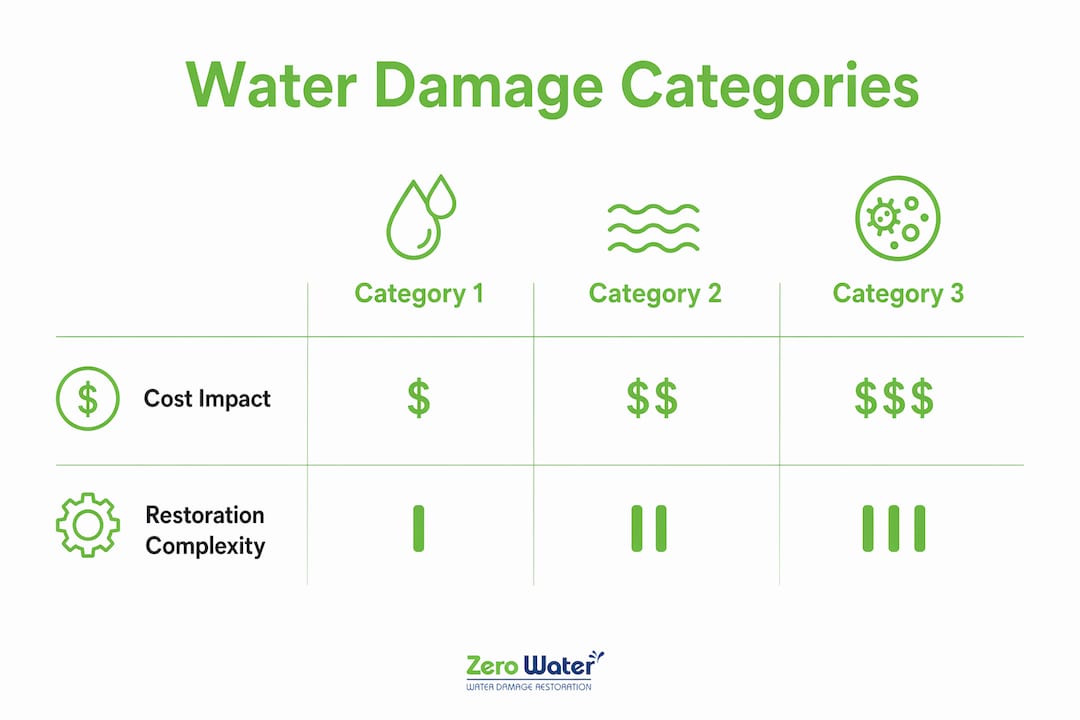
Restoration costs vary significantly by contamination level, and that gap is not trivial. A 500 square foot Category 1 loss costs roughly $1,500 to $2,500. The same area with Category 3 sewage damage can reach $12,500 or more. That difference matters enormously when your policy has a $10,000 coverage cap.
Category 3 damage also triggers the most insurance friction. Policies often treat sewage backup as a separate peril requiring a specific rider. Without that rider, the entire bill lands on you. Category 2 damage sits in a gray zone. Insurers sometimes dispute whether gray water qualifies for full remediation coverage, which can delay your claim and extend your out-of-pocket exposure.
What role does homeowner’s insurance play in restoration costs?
Insurance is the single biggest lever on your personal water damage repair expenses. It can cover the majority of a $5,000 loss or leave you holding most of a $20,000 bill, depending on how your policy is written.
Standard Illinois homeowner policies typically cover:
- Sudden and accidental water damage from burst pipes or appliance failures
- Water removal and structural drying
- Damaged personal property up to personal property limits
- Temporary housing if the home is uninhabitable
Standard policies typically exclude:
- Gradual leaks and flooding from external sources
- Sewer backup without a specific rider
- Mold remediation beyond sub-limit caps
- Flood damage, which requires a separate NFIP or private flood policy
Many policies cap mold remediation at $5,000 to $10,000. Extensive mold problems routinely cost more than that. The gap becomes your responsibility. Underinsurance compounds this risk. If your dwelling coverage reflects a home value from five years ago, reconstruction costs at current Illinois labor and material rates may exceed your limit.
Documentation quality also shapes your settlement. Restoration firms that use Xactimate software produce line-item estimates that match insurer expectations exactly. That alignment reduces disputes, speeds up claim processing, and keeps your out-of-pocket exposure as low as possible.
Pro Tip: Ask your restoration company directly whether they use Xactimate or a comparable industry-standard estimating tool. If they do not, your claim is more likely to face pushback from the adjuster.
How does timely action reduce your total restoration expenses?
Speed is the most underrated cost control tool in water damage recovery. Acting within the first 24 hours after water damage significantly lowers overall restoration costs by preventing structural saturation and mold growth. That window is not a guideline. It is the line between a drying job and a reconstruction project.
Here is what happens when you act fast versus when you wait:
- Hours 1–6: Water saturates surface materials. Professional extraction removes standing water and limits absorption into subfloors and wall cavities.
- Hours 6–24: Moisture migrates into structural framing. Industrial air movers and dehumidifiers begin drying before mold spores activate.
- Hours 24–48: Mold colonization begins. Remediation costs enter the equation, often adding thousands to the total bill.
- Beyond 48 hours: Structural damage accelerates. Drywall, insulation, and framing may require full replacement rather than drying alone.
Every 24 hours of delay roughly doubles restoration expenses due to mold colonization and escalating remediation complexity. That is not a figure to dismiss. A $3,000 drying job left unaddressed for two days can become a $9,000 remediation and reconstruction project.
Pro Tip: Do not run a box fan and a hardware store dehumidifier and assume the job is done. Consumer-grade drying equipment is ineffective for structural water damage. Only industrial air movers and dehumidifiers prevent mold growth after water intrusion.
Common hidden costs that inflate your water damage bill
Several cost drivers catch Illinois homeowners off guard. Knowing them in advance lets you ask better questions and avoid expensive surprises.
- Mold from incomplete drying: Using consumer-grade dehumidifiers instead of professional equipment leads to mold within 24–48 hours. Mitigation costs can jump from $1,500 to $5,000–$10,000 or more when mold takes hold.
- Code upgrade requirements: Illinois building codes may require upgrades when walls or electrical systems are opened during restoration. Your insurer pays for like-for-like replacement, not code upgrades. The difference is your cost.
- Material upgrades: If you choose better flooring or fixtures than what was damaged, you pay the difference between the original material value and the upgrade cost.
- Claim disputes from poor documentation: Contractors who do not document damage thoroughly give insurers grounds to reduce or deny portions of your claim. That gap becomes your bill.
- Policy sub-limit surprises: Homeowners often underestimate the impact of sub-limits on mold and sewage backup coverage until they receive a partial settlement.
- Secondary damage exclusions: If you delay repairs and secondary damage occurs, insurers may argue the additional damage resulted from neglect rather than the original event, and deny that portion of the claim.
Working with a restoration contractor experienced in insurance documentation is the most direct way to close these gaps. Firms experienced in claims can produce settlements $2,000 to $5,000 higher than homeowners achieve on their own, simply by ensuring full replacement coverage is documented correctly.
Key Takeaways
Out-of-pocket water restoration costs are determined by your deductible, your policy’s exclusions, the water damage category, and how quickly you call a professional.
| Point | Details |
|---|---|
| Deductibles drive baseline costs | Illinois homeowners typically pay $500–$2,500 out of pocket before insurance coverage begins. |
| Water category changes the price | Category 3 sewage damage costs $7–$25+ per sq ft versus $3–$5 for clean water losses. |
| Speed cuts total expenses | Acting within 24 hours prevents mold and can keep a $3,000 job from becoming a $9,000 project. |
| Policy exclusions create gaps | Gradual leaks, flooding, and mold sub-limits often leave homeowners paying far more than expected. |
| Documentation quality affects settlements | Contractors using Xactimate produce estimates that reduce claim disputes and maximize coverage. |
What I’ve learned after years of watching Illinois homeowners handle water damage
The homeowners who come out of water damage incidents in the best financial shape share one trait. They called a professional within hours, not days. The ones who waited, who tried to dry things themselves, or who assumed their insurance would cover everything without reading their policy, consistently faced the largest out-of-pocket bills.
The most common mistake I see is treating water damage like a plumbing problem rather than a structural emergency. A burst pipe is fixed in an hour. The water it released into your walls, subfloor, and insulation takes days to address properly. Skipping that step does not save money. It guarantees a mold remediation bill on top of everything else.
Review your insurance claim process before you need it. Know your deductible. Know whether you have a sewer backup rider. Know your mold sub-limit. These are not details you want to discover at 11 PM with water coming through your ceiling. The homeowners who understand their policy before a loss happen to be the ones who pay the least when one does.
— Jim
How Zerowaterrestoration helps Illinois homeowners control restoration costs
Illinois homeowners dealing with water damage have enough to manage without also fighting their insurance company. Zerowaterrestoration handles the full restoration process from water extraction through reconstruction, and works directly with insurance adjusters to document every detail of your loss.
The team uses industry-standard documentation tools to align your claim with insurer expectations, reducing disputes and keeping your personal expenses as low as possible. Zerowaterrestoration serves Barrington, Lake Zurich, Streamwood, and communities throughout the northwest suburbs of Chicago. Whether you need water damage restoration in Barrington or a full assessment anywhere in the Chicagoland area, the team is available 24/7. Call (847) 515-7000 or visit zerowaterrestoration.com for a free inspection and estimate.
FAQ
What is the average out-of-pocket cost for water restoration in Illinois?
Most homeowners pay their deductible ($500–$2,500) plus any costs beyond their coverage limit. Total restoration bills average around $3,850 nationally, though major losses can exceed $25,000.
Does homeowner’s insurance cover all water damage restoration costs?
Standard policies cover sudden and accidental damage but exclude gradual leaks, external flooding, and often cap mold remediation at $5,000–$10,000. Flood damage requires a separate flood insurance policy.
How does water damage category affect what I pay out of pocket?
Category 1 clean water damage costs $3–$5 per square foot, while Category 3 sewage damage runs $7–$25 or more. Higher categories also face more insurance scrutiny, increasing the risk of partial claim denials.
Why does waiting to call a restoration company increase my costs?
Every 24 hours of delay roughly doubles restoration expenses because mold colonization begins within 24–48 hours. What starts as a drying job becomes a full remediation and reconstruction project.
What is Xactimate and why does it matter for my insurance claim?
Xactimate is industry-standard estimating software that produces line-item restoration scopes matching insurer expectations. Contractors who use it reduce claim disputes and help homeowners recover more of their costs through insurance.