
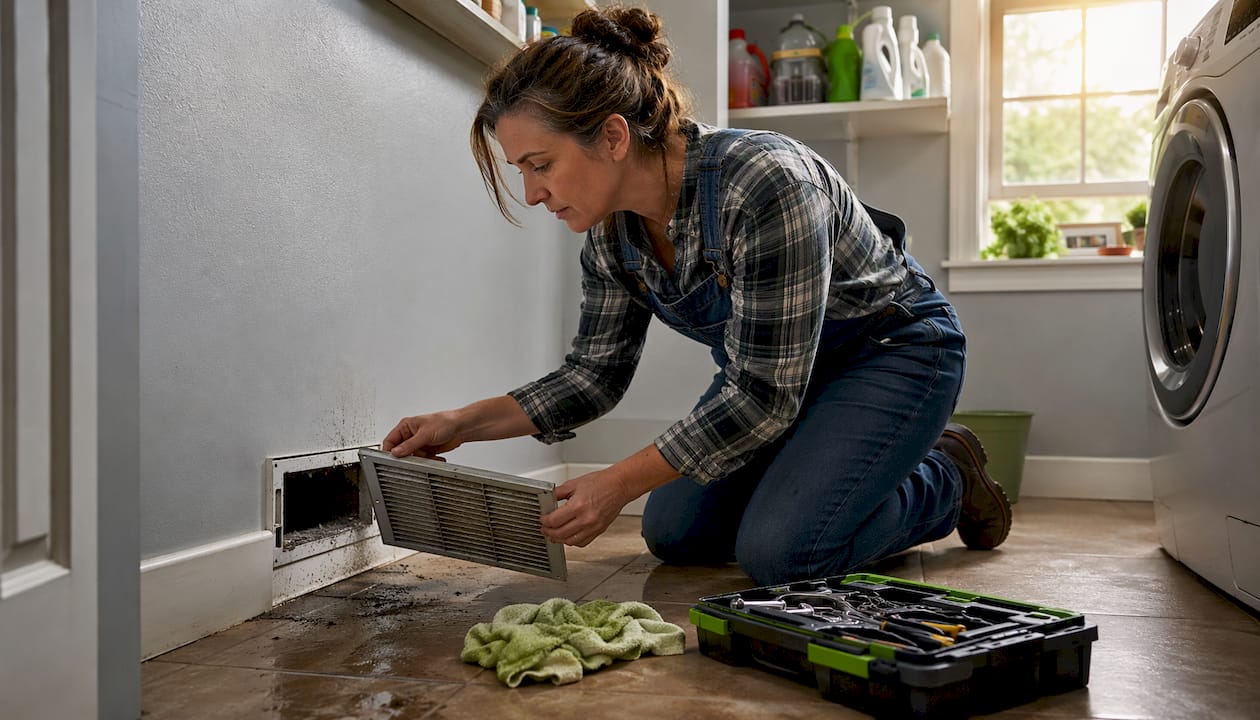
Ductwork water damage is moisture or standing water inside your HVAC ducting that corrodes metal, destroys insulation, and circulates mold spores through every room in your home. If you just found water in or near your ducts, do these three things right now:
- Shut off your HVAC system at the thermostat and breaker. Running the system spreads contamination fast.
- Stop the water source. Shut off the supply valve, clear the condensate drain, or call a plumber — whatever applies.
- Document everything. Take timestamped photos and video of the water, stains, and any damaged materials before touching anything.
For any event involving sewage, floodwater, visible mold, or water inside the air handler itself, call an emergency restoration contractor immediately. These are Category 2 or 3 water events that require professional containment, not a shop vac and a fan.
Pro Tip: Do not run the system to “test” whether the ducts dried out. Running a wet system creates a high-humidity environment that accelerates mold growth and blows spores into every room.
Table of Contents
- What causes water to get into ductwork?
- How can you tell your ducts have water damage?
- Why ductwork water damage is more serious than it looks
- What to do the moment you find water in your ducts
- What professional duct remediation actually involves
- When can you handle it yourself, and when do you need a pro?
- What does ductwork water damage cost, and will insurance cover it?
- How to prevent ductwork water damage going forward
- Key Takeaways
- The part most homeowners get wrong
- Zerowaterrestoration handles duct water damage in the northwest Chicago suburbs
- Useful sources and standards
What causes water to get into ductwork?
Water finds its way into ducts through several distinct paths, and knowing which one applies to your home points you toward the right fix.
- Condensation on uninsulated duct surfaces. When warm, humid air contacts cold duct walls in attics or crawlspaces, moisture condenses on the exterior and eventually works inward. Oversized HVAC units that short-cycle compound this by never running long enough to dehumidify the air properly.
- Clogged or cracked condensate drain lines. A blocked drain pan overflows into the air handler and down into connected duct runs. This is one of the most common causes in older systems.
- Plumbing leaks and burst pipes. A slow drip from a supply line above a ceiling can saturate duct insulation for weeks before anyone notices. A burst pipe is faster and more obvious, but the damage to nearby ducts can be just as severe.
- Flash flooding and external water intrusion. Ground-level and below-grade duct runs pick up contaminated floodwater through floor registers. This is almost always a Category 3 event.
- Poor airflow and oversized equipment. An HVAC unit too large for the space short-cycles, raises indoor humidity, and creates chronic condensation inside duct runs. Addressing duct sweating and prevention often starts with a load calculation to confirm the unit is correctly sized.
How can you tell your ducts have water damage?
Early signs are subtle. Most homeowners miss them until visible mold or a ceiling stain forces the issue.
- Musty or “wet dog” odor that appears only when the system runs
- Water stains or rust rings around supply registers
- Dripping or sloshing sounds from inside duct runs
- Sagging sections of flexible ductwork
- Noticeably weaker airflow in one or more rooms
- Sudden spike in allergy or respiratory symptoms among household members
Signs of water-damaged ductwork often show up at the registers first. Pull a vent grille and shine a flashlight inside. Rust, standing water, or a visible dark ring on the duct lining are all red flags.
For attic and crawlspace runs, check for sagging insulation wrap and soft spots on the duct exterior. If you have access to the air handler, look at the drain pan. A full or discolored pan means the condensate line is partially or fully blocked.
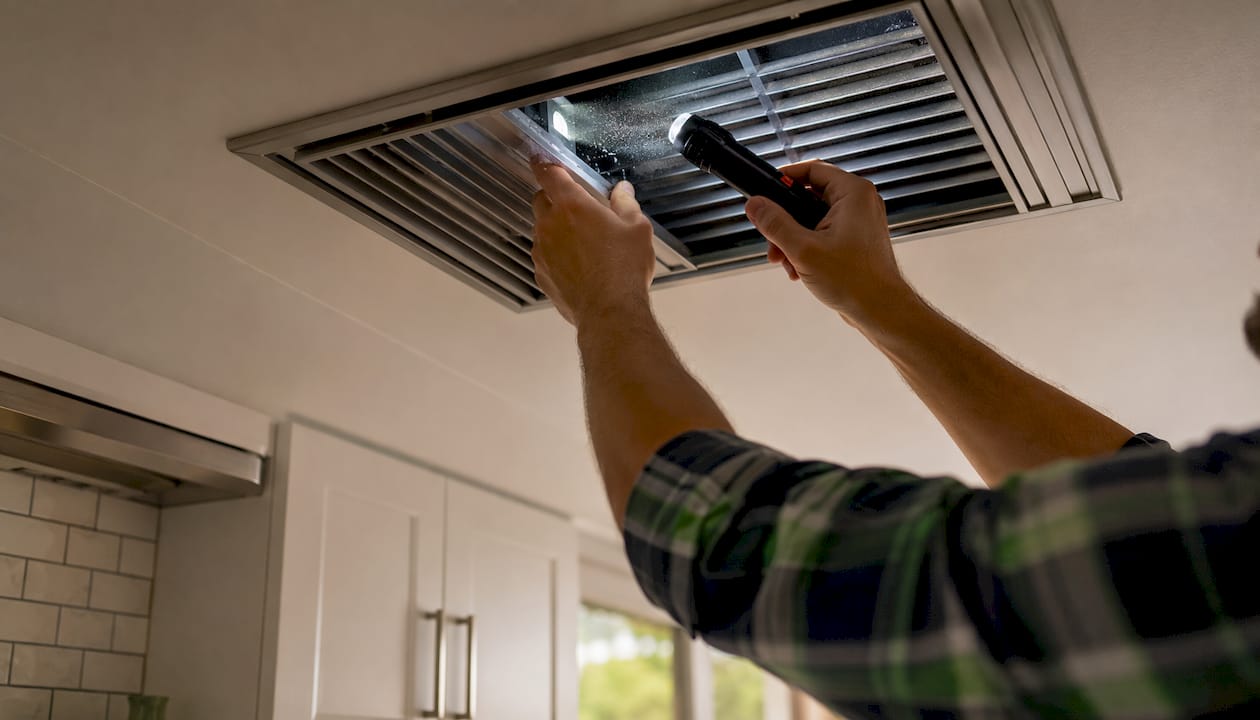
Pro Tip: Never remove a vent grille and then run the system to see what happens. If contaminated water is present, that airflow will push it directly into your living space.
Why ductwork water damage is more serious than it looks
The hidden risks of water damage inside ductwork go well beyond a stained ceiling tile.
- Mold and indoor air quality. Mold can begin growing within 24–48 hours of moisture exposure, with visible colonies appearing within 48–72 hours. Once established inside a duct system, spores circulate every time the system runs.
- HVAC performance loss. Wet insulation loses its R-value. Corroded metal restricts airflow. Both outcomes force the system to work harder, raising energy bills.
- Structural damage. Water that pools in duct bellies or soaks into surrounding building materials causes rot, ceiling damage, and attic deterioration over time.
- Escalating repair costs. Ignoring moisture beyond a short initial period increases the likelihood of needing a full duct overhaul rather than localized repair.
The 48-hour window is the planning threshold that separates a manageable repair from a major replacement project.
What to do the moment you find water in your ducts
Speed matters more here than almost anywhere else in home repair.
- Cut power to the HVAC system at the thermostat and the circuit breaker. Do not skip this step.
- Stop the water source — shut the supply valve, clear the drain line, or call a plumber for a burst pipe.
- Remove standing water near equipment only if it is safe to do so and the water is clean. Do not wade into floodwater near electrical panels.
- Document before you touch anything. Timestamped photos and video of the source, affected ducts, and any displaced materials are what your insurance adjuster will want to see. Careful documentation of pre- and post-conditions, plus contractor moisture logs, consistently improves claim outcomes.
- Close supply and return registers in affected zones if you can do so without disturbing contaminated material.
Call a restoration contractor immediately if you see any of these:
- Sewage or floodwater involved
- Visible mold at or near registers
- Water inside the air handler or plenum
- Electrical components exposed to moisture
- More than 48 hours have passed since the event began
What professional duct remediation actually involves
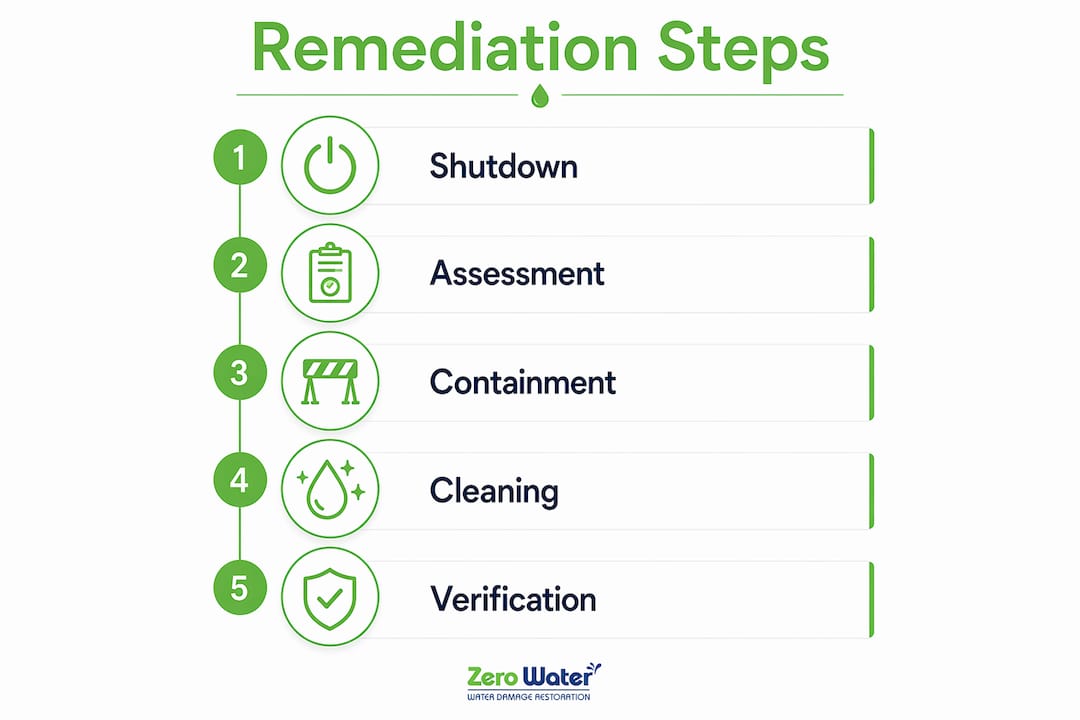
Professional post-water remediation is not the same as routine duct cleaning. The professional remediation process follows a structured protocol:
- System shutdown and safety assessment. Confirm power is off; identify water category (1, 2, or 3).
- HD camera inspection and moisture mapping. Technicians run a camera through accessible runs and use moisture meters to locate hidden pockets. Water commonly pools in the low points or “bellies” of flexible ducting — spots a visual inspection alone will miss.
- Containment with HEPA-filtered negative pressure. Disturbing Category 2 or 3 contamination without negative-pressure containment aerosolizes pathogens and worsens indoor air quality. Proper containment is non-negotiable.
- Specialized extraction and cleaning. HEPA vacuums and agitation tools remove debris, biological material, and residual moisture.
- Antimicrobial treatment. Applied to all affected interior surfaces after cleaning.
- Wet insulation replacement. Insulation that absorbed water cannot be dried effectively and must be removed and replaced.
- Post-cleaning verification. Moisture readings and clearance testing confirm the system is dry and safe before it is restarted.
Ask any contractor for IICRC-aligned procedures, category-based handling documentation, clearance criteria, and proof of equipment (HEPA vacuums, negative-pressure units). A contractor who cannot answer those questions clearly is not the right contractor.
Pro Tip: Request camera footage and moisture meter logs in writing before work begins. These records serve double duty: they verify the remediation was done correctly, and they become your insurance documentation.
When can you handle it yourself, and when do you need a pro?
Some tasks are safe for a homeowner. Most are not.
DIY-appropriate (clean water only, no mold, no contamination):
- Visual inspection of accessible registers and vent grilles
- Photographing and documenting damage
- Stopping a small, clean-water leak at its source
- Changing filters and improving ventilation in unaffected zones
Always hire a professional when:
- Any sign of microbial growth is present
- The water source is Category 2 (gray water) or Category 3 (black water/sewage/flood)
- Water reached the air handler, plenum, or electrical components
- Standing water is visible inside duct bellies
- More than 48 hours have passed with visible moisture and no drying
Flexible ductwork that has sagged, wet duct insulation, and any sewer or floodwater contact are automatic professional-remediation situations. There is no DIY path through those scenarios that ends well.
What does ductwork water damage cost, and will insurance cover it?
Coverage basics: Homeowners insurance covers sudden and accidental HVAC damage — a burst pipe that floods the air handler, for example. It typically excludes long-term neglect, wear and tear, and flood events. Flood damage requires a separate flood insurance policy. Sewer backup usually needs its own endorsement. Insurers generally pay for drying and restoration of damaged areas, not for replacing the failed component that caused the leak.
| Service | Typical Cost Range | Notes |
|---|---|---|
| Video/camera inspection | — | Often credited toward remediation |
| Basic duct cleaning (no contamination) | — | Routine maintenance pricing |
| Localized repair and cleaning | $400–$1,500 | Common range for contained events |
| Wet insulation replacement | — | Varies by linear footage and access |
| Full duct replacement | — | Larger homes or extensive contamination |
Claim documentation checklist:
- Timestamped photos and video of the source and affected areas
- Contractor scope of work and moisture meter logs
- Timeline of events (when you discovered it, what you did first)
- Pre- and post-remediation reports from the contractor
Illinois homeowners can find a step-by-step walkthrough of the insurance claim process specific to their state.
How to prevent ductwork water damage going forward
Most duct moisture problems are preventable with a few targeted maintenance steps.
- Insulate attic and crawlspace duct runs. Bare metal in unconditioned spaces sweats. Proper insulation wrap eliminates the temperature differential that causes condensation.
- Install and maintain a condensate float switch. This shuts the system off automatically if the drain pan fills, preventing overflow into the air handler.
- Clean condensate drain lines annually. A simple flush with diluted bleach keeps algae and debris from blocking the line.
- Seal duct joints with mastic or metal tape. Leaky joints let humid air in and conditioned air out, both of which contribute to moisture problems.
- Set a humidistat. Keeping indoor relative humidity between 30–50% reduces condensation risk throughout the system.
- Schedule annual HVAC maintenance. A technician will catch a cracked drain pan, a partially blocked line, or a sagging flex run before it becomes a water event.
- Confirm correct equipment sizing. An oversized unit that short-cycles is one of the most overlooked ductwork damage causes. A Manual J load calculation confirms whether your system is the right size for your home.
Pro Tip: When installing or replacing flex duct, make sure runs are supported every 4–5 feet with no sags. A belly in a flex run is a water trap waiting to happen.
Key Takeaways
Ductwork water damage requires immediate system shutdown, source control, and professional remediation within 48 hours to prevent mold colonization and avoid full duct replacement.
| Point | Details |
|---|---|
| 48-hour mold window | Mold can begin growing soon after moisture exposure; act quickly to keep repairs localized. |
| Shut down first | Turn off the HVAC at the thermostat and breaker the moment you suspect wet ducts. |
| Category determines response | Category 2 or 3 water (gray, sewage, flood) always requires professional containment, not DIY cleaning. |
| Document for insurance | Timestamped photos, moisture logs, and contractor reports are what adjusters need to approve a claim. |
| Zerowaterrestoration | Zerowaterrestoration provides 24/7 emergency duct remediation, mold remediation, and insurance coordination for northwest Chicago suburbs homeowners. |
The part most homeowners get wrong
The conventional wisdom says “dry it out fast and you’ll be fine.” That is half right and half dangerous. Speed matters, but the method matters just as much.
The most common mistake is running the HVAC system to accelerate drying. It feels logical. It is the opposite of helpful. A wet duct system turned back on becomes a forced-air mold distribution system. Spores that would have stayed localized in one flex run end up in every bedroom in the house within hours.
The second mistake is treating a Category 2 or 3 event like a Category 1 cleanup. Gray water from a backed-up condensate line is not the same as a clean supply-line drip. Floodwater through floor registers is not the same as either. The water category determines the containment protocol, and skipping containment on a contaminated event is how a $1,500 repair becomes a $6,000 remediation with mold testing on top.
Documentation is the third area where homeowners consistently leave money on the table. Insurance adjusters work from evidence. A contractor who hands you a verbal summary and a one-page invoice is not giving you what you need to file a strong claim. Insist on camera footage, moisture meter logs with readings at multiple points, and a written clearance report. Those three documents are the difference between a covered claim and a disputed one.
Fast response and thorough documentation are not separate priorities. They are the same priority.
Zerowaterrestoration handles duct water damage in the northwest Chicago suburbs
When water gets into your ductwork, the clock starts immediately. Zerowaterrestoration responds 24/7 to water damage emergencies throughout Schaumburg, Arlington Heights, Palatine, Barrington, Lake Zurich, Streamwood, and the surrounding northwest suburbs. The team handles the full scope: water extraction, HEPA-filtered duct remediation, mold remediation, and complete reconstruction when structural repairs are needed. They also work directly with your insurance provider, managing documentation, adjuster communication, and scope of work so your out-of-pocket costs stay as low as possible.
If you have found water in or near your ducts, do not wait to see whether it dries on its own. Call Zerowaterrestoration at (847) 515-7000 or request an emergency assessment at zerowaterrestoration.com/water-damage-restoration-in-barrington. Free inspection, no obligation.
Useful sources and standards
The claims in this article are grounded in primary standards and agency guidance. The table below identifies the key references and what each one validates.
| Source | What it validates |
|---|---|
| IICRC Standard | Water damage category framework (Category 1/2/3), containment protocols, and remediation thresholds |
| EPA Mold Resources | Health risks of indoor mold, recommended humidity ranges, and when professional remediation is required |
| FEMA Flood Insurance Guidance | Distinction between standard homeowners coverage and flood insurance; what flood policies cover |
| ASHRAE Standard | Indoor humidity targets (30–50% RH) and ventilation requirements that reduce condensation risk |
| InspectApedia — Wet and Corroded Ducts | 48-hour mold germination timeline and full-replacement thresholds for delayed remediation |
| LegalClarity — Sudden and Accidental Discharge | Insurance coverage rules for sudden vs. gradual water damage events |
This article is general information for homeowners, not legal, medical, or insurance advice. Confirm current coverage terms with your insurer and consult a licensed restoration contractor for your specific situation.