
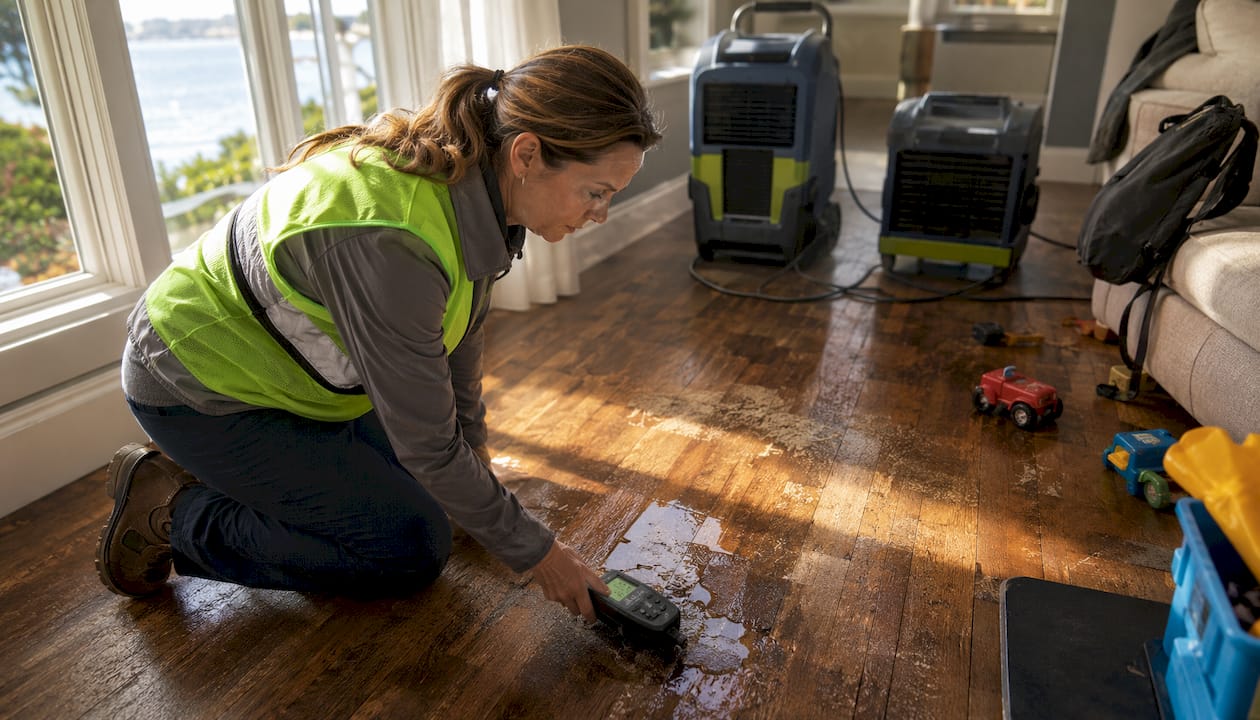
Quick water removal is the single most effective thing you can do after a flood or leak: it prevents mold colonization, protects your home’s structure, eliminates electrical hazards, and keeps repair costs from spiraling. The EPA and CDC both advise drying water-damaged materials promptly to significantly reduce the risk of mold growth. Miss that window, and you’re no longer dealing with a drying job — you’re dealing with remediation, demolition, and potentially a health crisis. Zerowaterrestoration operates 24/7 across the northwest Chicago suburbs precisely because that window doesn’t care what time it is.
The four consequences fast action prevents:
- Mold colonization — spores germinate on wet drywall, wood, and carpet within 24–48 hours
- Structural damage — wood framing swells and rots, subfloors buckle, fasteners corrode
- Electrical and personal-safety hazards — standing water near panels and outlets creates electrocution risk
- Escalating repair costs — every hour of delay expands demolition scope and remediation complexity
The 24–48 hour rule: EPA guidance states that in most cases, mold will not grow if wet or damp materials are dried within 24–48 hours. Beyond that window, assume mold is present and plan for professional remediation.
Table of Contents
- 1. Why the 24–48 hour window is your real deadline for mold prevention
- 2. How water damages your home’s structure — and when it becomes permanent
- 3. Electrical hazards and immediate safety steps you need to take first
- 4. Why the type of water determines how urgent cleanup really is
- 5. How fast action cuts your repair costs — and what delays actually cost you
- 6. What professional water damage restoration actually looks like, step by step
- 7. When to call a professional and how to pick the right restoration company
- 8. How Zerowaterrestoration responds when water damage happens
- Key Takeaways
- The real cost of waiting — a perspective on why speed defines the outcome
- Zerowaterrestoration is available now for emergency water removal
- Authoritative sources and further reading
1. Why the 24–48 hour window is your real deadline for mold prevention
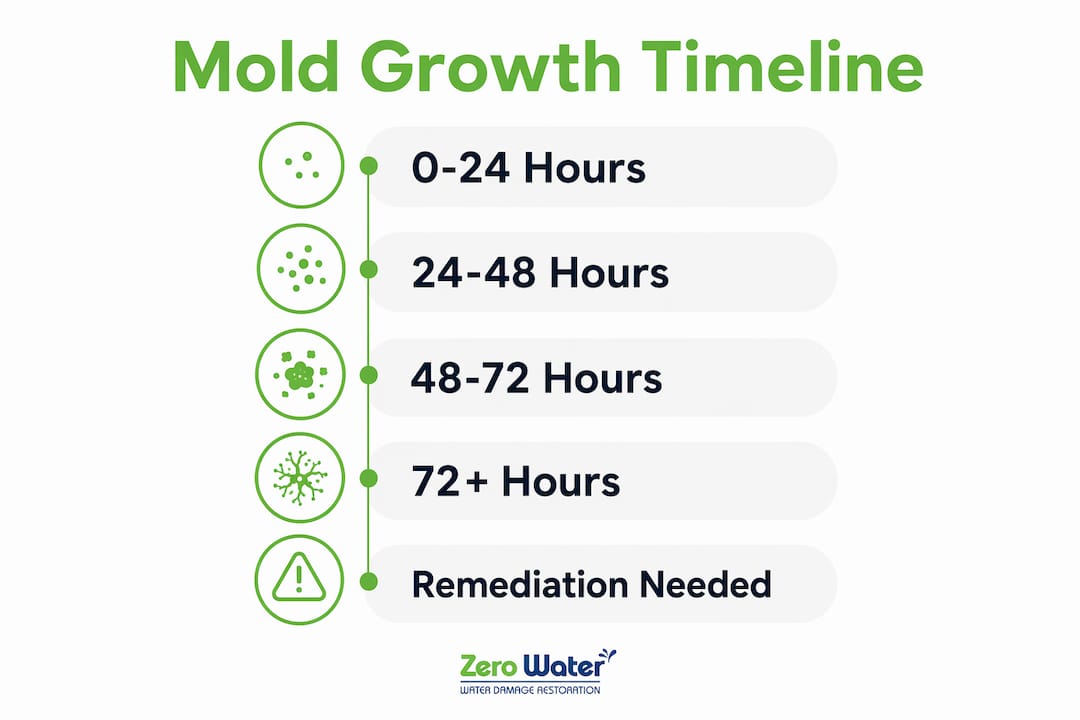
Mold doesn’t wait for you to finish cleaning up. Spores are present in virtually every indoor environment, and all they need to germinate is a wet organic surface and a little time. EPA guidance is direct: dry wet materials within 24–48 hours and mold growth is unlikely. Let them stay wet beyond that, and colonization begins — at which point drying alone is no longer enough.
Here’s what the timeline looks like in practice:
| Hours after water event | What’s happening |
|---|---|
| — | Spores present but not yet germinating; drying is still sufficient |
| A couple of days after water exposure | Germination begins on wet drywall, wood, and carpet; drying becomes urgent |
| Within several days | Visible mold growth likely on porous surfaces; remediation now required |
| — | Extensive colonization; containment, material removal, and professional disposal needed |
Once mold establishes, the scope of work changes entirely. Remediation requires containment barriers, removal of contaminated materials, and professional disposal — costs and timelines that dwarf a simple drying job. The CDC’s homeowner guide puts it plainly: if your home was flooded and you couldn’t dry it within 24–48 hours, assume mold growth and plan for cleanup and remediation.
Two signs that drying alone may not be enough: a persistent musty odor (even without visible growth) and visible discoloration on drywall or ceiling tiles. Either one means mold has likely started, and cleaning the surface without addressing the moisture source will only bring it back.
Pro Tip: “Dry to the touch” is not the same as “dry to a safe moisture content.” Professionals use moisture meters and hygrometers to verify that structural materials have returned to baseline readings for the region and material type. A wall that feels dry on the surface can still hold enough subsurface moisture to sustain mold growth for weeks.
2. How water damages your home’s structure — and when it becomes permanent
Get water out fast and most structural materials can be saved. Leave it sitting, and the repair scope shifts from drying to replacement — a difference that can mean tens of thousands of dollars.
The materials most at risk:
- Wood framing and subfloor: Wood absorbs water quickly, swells, and loses structural integrity. Prolonged exposure leads to rot, which is irreversible without replacement.
- Drywall: Gypsum board delaminates and crumbles when wet. It also provides an ideal surface for mold. Once saturated, it almost always needs to come out.
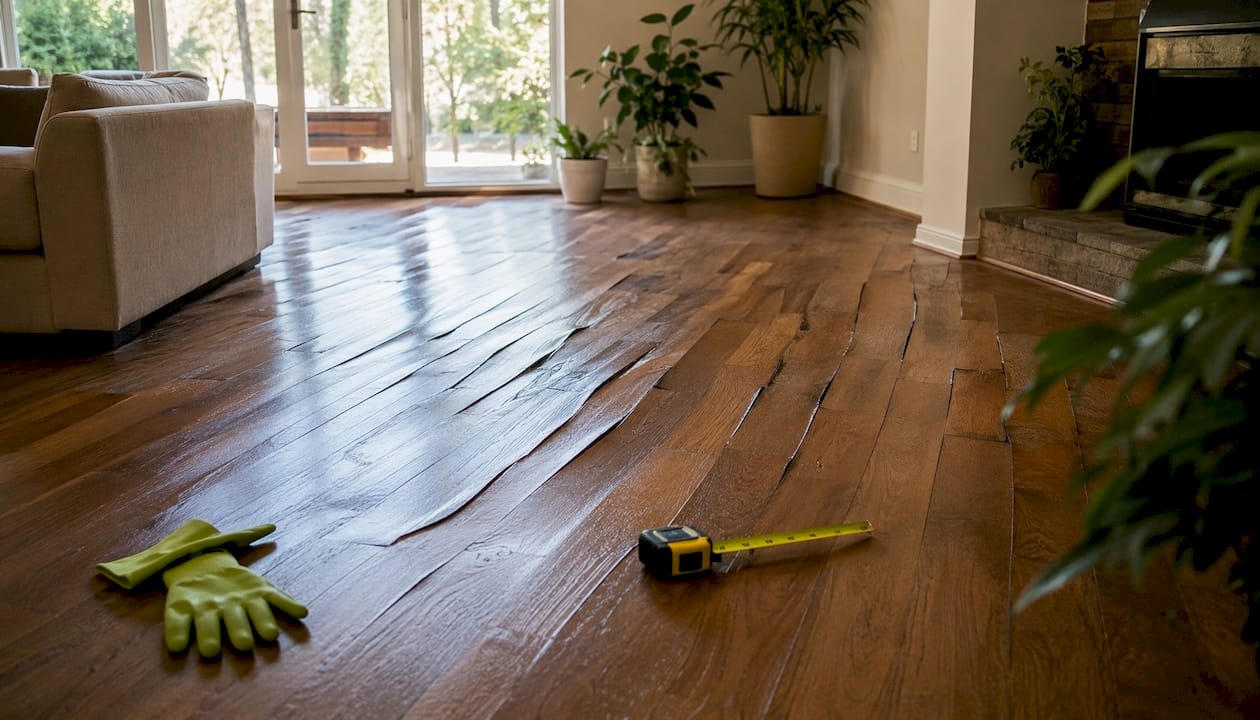
- Hardwood and laminate flooring: Buckling and cupping begin within hours. Hardwood can sometimes be saved with careful drying; laminate rarely can.
- Fasteners and metal components: Screws, nails, and metal brackets corrode under sustained moisture, weakening connections throughout the framing.
- Insulation: Fiberglass batts lose their R-value when wet and trap moisture against framing. Foam insulation is more resistant but still requires inspection.
The damage timeline matters here. Water sitting for about a day warps flooring and softens drywall. After several days, subfloor panels begin to swell and separate. After a week, wood framing can show early rot, and the structural repair cost climbs sharply. Industrial drying equipment — the kind restoration professionals bring — can preserve framing and finishes that would otherwise require full replacement.
Pro Tip: Sagging floors, doors that suddenly won’t close, and persistent musty odors after apparent drying are all signs that structural damage may have already occurred. Any of these warrants a professional inspection, not just a second pass with a fan.
3. Electrical hazards and immediate safety steps you need to take first
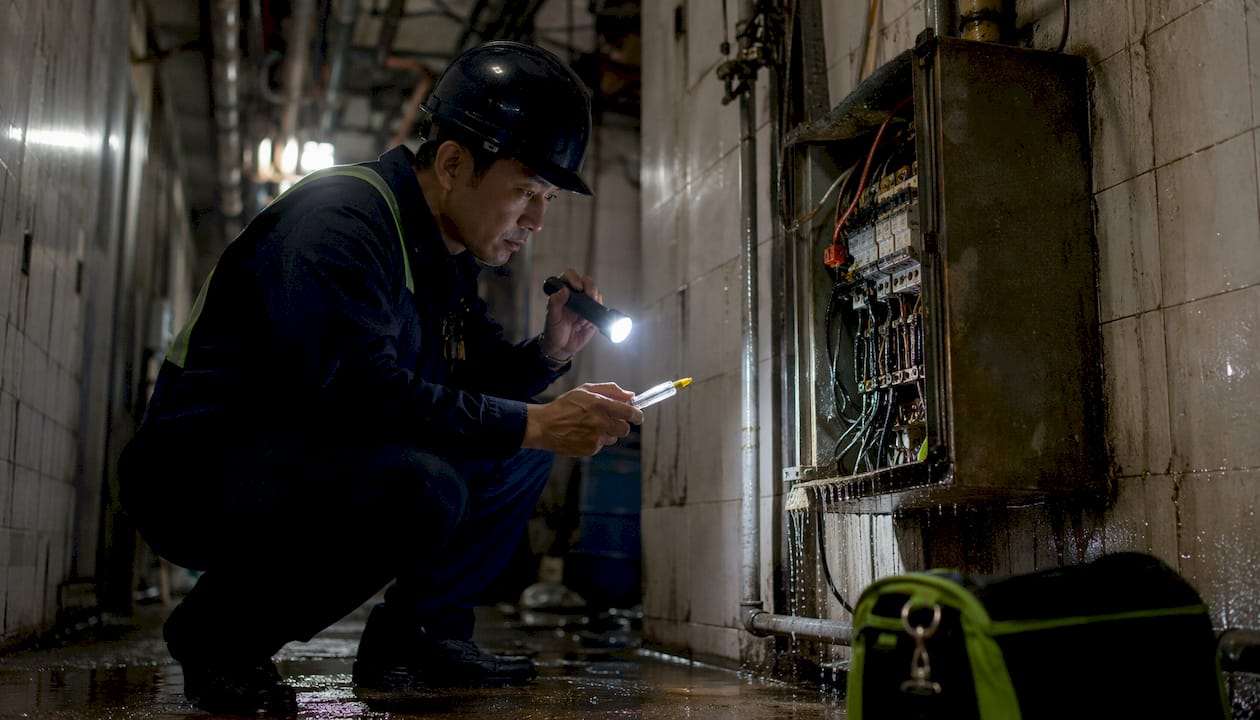
Before you touch anything, address the electrical risk. Water and electricity in the same space create immediate electrocution and fire hazards — and the danger isn’t always obvious. Water can travel along wiring, pool inside wall cavities near outlets, and reach panels without being visible at the source.
Immediate safety checklist:
- Shut off power at the main breaker only if you can reach the panel without standing in water or walking through a flooded area. If you can’t get there safely, call your utility company or a licensed electrician.
- Do not use any electrical devices while standing in or near standing water — this includes sump pumps, shop vacs, and fans.
- Assume all outlets in affected areas are compromised until an electrician clears them.
- Do not restart HVAC or appliances that were flooded. CDC guidance is explicit: flooded HVAC systems must be inspected and cleaned by a professional before reuse, because restarting a contaminated system spreads mold and contaminants throughout the house.
- Call a licensed electrician before restoring power to any flooded area, even after water is removed.
HVAC systems deserve special attention. A flooded air handler or ductwork can distribute mold spores, bacteria, and chemical contaminants to every room in the house the moment it’s switched back on. That’s a problem that’s far harder and more expensive to fix than the original flood.
Pro Tip: If you need to document damage for insurance before power is restored, use a battery-powered flashlight and your phone camera. Photograph every affected room, every damaged item, and every visible water line before moving or removing anything. That documentation is your claim.
4. Why the type of water determines how urgent cleanup really is
Not all water damage is the same, and the source of the water determines whether you can manage cleanup yourself or whether you need professionals in hazmat gear.
The three categories restoration professionals use:
- Category 1 (clean water): Comes from a supply line, clean rain, or an appliance with no contaminants. Lowest health risk; DIY drying is possible if started immediately.
- Category 2 (gray water): Contains biological or chemical contaminants — dishwasher overflow, washing machine discharge, toilet overflow without feces. Requires protective equipment and proper disposal of saturated materials.
- Category 3 (black water): Sewage backups, floodwater from rivers or storm drains, or any water that has contacted fecal matter or industrial waste. Highly hazardous.
Floodwater frequently carries bacteria, viruses, and parasites from sewage and industrial runoff. You cannot tell by looking at it. Any water that entered your home from outside during a storm or flood event should be treated as Category 3 until proven otherwise.
Safety steps for gray or black water exposure:
- Evacuate the affected area and limit re-entry until professionals assess it
- Do not use fans to accelerate drying before the water source is classified — using fans on contaminated water can aerosolize pathogens and spread them through the HVAC system
- Wear N-95 respirators, nitrile gloves, and eye protection if you must enter
- Discard all porous materials (carpet, drywall, upholstered furniture) that contacted black water — they cannot be safely cleaned
- Have HVAC inspected by a professional before restarting
Health risk callout: The EPA’s flood cleanup guidance warns that failure to remove contaminated materials and control moisture can create serious long-term health risks. Wet materials become breeding grounds for microorganisms that affect indoor air quality long after the visible water is gone.
5. How fast action cuts your repair costs — and what delays actually cost you
The financial case for speed is straightforward: the longer water sits, the more materials need to come out, and the more expensive the job gets. A burst pipe caught in two hours is a drying job. The same pipe discovered two days later is a demolition and remediation project.
| Response scenario | Typical scope | Primary cost drivers |
|---|---|---|
| Extraction within about a day | Drying, dehumidification, monitoring | Equipment rental or service fee; minimal material loss |
| Extraction within a couple of days | Partial demo of saturated drywall/flooring | Material replacement, labor for demo and reinstall |
| Extraction delayed beyond 48 hours | Full remediation likely required | Mold containment, material disposal, reconstruction |
The main cost drivers in a delayed response:
- Material replacement — drywall, flooring, insulation, and cabinetry that could have been dried must now be removed and replaced
- Mold remediation — containment, HEPA filtration, antimicrobial treatment, and professional disposal add significant cost
- Structural repairs — rotted framing or subfloor requires carpentry and sometimes engineering review
- Extended project timeline — what could have been a 3-day drying job becomes a multi-week reconstruction
Professional drying with industrial equipment is often cost-effective compared with replacement after prolonged exposure. The service fee for a professional extraction and drying crew is almost always less than the cost of replacing the materials they save.
For insurance purposes, document everything before extraction begins: photos, video, written notes on water levels and affected areas. Ask your restoration company how they handle insurance claims coordination — a company that works directly with adjusters can significantly reduce your out-of-pocket costs.
The typical professional water removal project runs one to several days for extraction and initial drying, with full drying and repairs taking days to weeks depending on the extent of damage. See the restoration timeline guide for a detailed breakdown by damage category.
6. What professional water damage restoration actually looks like, step by step
Professional restoration follows a repeatable sequence: inspect, extract, dry, verify, restore. Each phase builds on the last, and skipping or rushing any one of them creates problems that show up later — usually as mold, odor, or structural failure.
The standard phases:
- Inspection and triage — Technicians assess the source, water category, and extent of damage using moisture meters and thermal imaging. This determines the drying plan and whether contamination protocols apply.
- Water extraction — Industrial wet vacuums and truck-mounted extractors remove standing water from floors, carpets, and wall cavities. This step is where speed matters most.
- Structural drying — High-velocity axial and centrifugal air movers accelerate evaporation from structural materials. LGR (low-grain refrigerant) dehumidifiers pull moisture from the air and prevent re-absorption into walls and floors.
- Moisture monitoring — Technicians take daily readings with moisture meters and hygrometers, comparing results to regional baselines for each material type. Drying is not complete until readings return to acceptable levels.
- Cleaning and disinfection — Affected surfaces are cleaned with appropriate antimicrobial agents. For Category 2 or 3 water, this step involves containment and PPE.
- Repairs and reconstruction — Damaged drywall, flooring, and structural components are replaced. A full-service company handles this in-house rather than handing you off to a separate contractor.
The equipment list matters. Consumer-grade box fans and dehumidifiers from a hardware store move far less air volume and remove far less moisture per hour than professional equipment. An LGR dehumidifier can remove many times the moisture of a residential unit. That difference is what makes professional water extraction worth the cost when structural materials are at stake.
One thing worth understanding: moisture control is the fundamental requirement for preventing mold recurrence. Cleaning visible mold without fixing the moisture source will produce the same result again within weeks. A professional restoration job addresses both.
For a deeper look at what pros bring to a job site, the water extraction equipment guide breaks down each equipment type and what it’s designed to do.
7. When to call a professional and how to pick the right restoration company
DIY drying is reasonable for a small, clean-water spill caught immediately — a few gallons from a supply line, dried within hours with fans and a dehumidifier. Call a professional for anything beyond that.
Call a pro immediately if:
- There is standing water anywhere in the home
- The water source is gray or black (sewage, floodwater, appliance discharge)
- Drying cannot begin within 24 hours for any reason
- Structural materials (subfloor, framing, drywall) are saturated
- You smell mold or see discoloration
- The affected area exceeds roughly 10 square feet
Questions to ask before hiring a restoration company:
- Are you available 24/7 for emergency response?
- Do you hold IICRC certification? (The Institute of Inspection, Cleaning and Restoration Certification sets the industry standard for training and procedures.)
- What equipment will you bring, and how do you verify drying is complete?
- Can you provide a written scope of work and estimate before starting?
- Do you work directly with insurance adjusters, and how do you handle documentation?
- Do you handle reconstruction in-house, or will I need a separate contractor?
Red flags to avoid:
- No written estimate before work begins
- Pressure to sign contracts immediately without a proper inspection
- No moisture verification process (“we’ll dry it out and check back in a few days”)
- Inability to explain their water category classification process
- No references or verifiable certifications
On the insurance side: photograph everything before extraction, get written authorization for emergency work from your insurer, and ask the restoration company how they work with your insurance provider. A company experienced in claims coordination can document damage in the format adjusters expect, which speeds up approval and reduces disputes. For a full checklist of what to look for, the guide on selecting a restoration firm covers the key criteria in detail.
If you’re a property manager handling multiple units, the commercial water damage guide addresses the specific decision rules and documentation requirements for multi-unit properties.
For emergency plumbing issues that precede or accompany water damage, an emergency plumbing guide can help you address the source before the restoration crew arrives.
8. How Zerowaterrestoration responds when water damage happens
Zerowaterrestoration offers 24/7 emergency water extraction, professional drying with industrial equipment, mold remediation, full reconstruction, and direct insurance support — all under one roof, with crews available across the northwest Chicago suburbs.
Core services and what they deliver:
- Emergency extraction (24/7): Rapid response limits how far water spreads and how much material absorbs it. Getting equipment on-site within the first few hours is the single biggest factor in keeping costs down.
- Structural drying with professional equipment: Industrial air movers and LGR dehumidifiers dry framing, subfloors, and wall cavities to verified moisture levels — not just “dry to the touch.”
- Moisture verification: Technicians use moisture meters throughout the drying process to confirm materials have returned to safe levels before closing walls or reinstalling flooring.
- Mold remediation: When drying didn’t happen fast enough, or when mold is already present, Zerowaterrestoration handles containment, removal, and antimicrobial treatment. See the mold remediation service page for details on the process.
- Reconstruction: From drywall replacement to full room rebuilds, the team sees the job through to completion rather than handing off to a separate contractor.
- Insurance coordination: Zerowaterrestoration works directly with insurance adjusters, manages documentation, and communicates on your behalf — reducing out-of-pocket costs and the administrative burden on you.
With over 10 years in business and a service area covering Schaumburg, Arlington Heights, Palatine, Hoffman Estates, Rolling Meadows, Mount Prospect, Elk Grove Village, Barrington, Bartlett, Lake Zurich, Streamwood, and surrounding communities, Zerowaterrestoration has handled the full range of water damage scenarios the Chicagoland area produces: burst pipes in January, storm flooding in spring, and roof leaks that go undetected for weeks. The Illinois water damage restoration process guide explains what to expect from first call to final inspection.
Key Takeaways
Acting within the 24–48 hour window is the most important decision you will make after water damage: it determines whether you face a drying job or a full remediation and reconstruction project.
| Point | Details |
|---|---|
| Dry promptly | EPA and CDC guidance confirms mold colonization is unlikely if materials are dried within the recommended timeframe. |
| Call pros for standing or contaminated water | Gray and black water require professional remediation; DIY drying is only appropriate for small, clean-water spills caught immediately. |
| Document before you extract | Photograph every affected area and item before moving anything — this documentation drives your insurance claim. |
| Prioritize electrical safety first | Shut off power only if access is dry and safe; never use electrical equipment while standing in water. |
| Verify dryness with instruments | Visual checks are unreliable; moisture meters confirm when structural materials are actually safe. |
| Zerowaterrestoration | Available 24/7 across the northwest Chicago suburbs for emergency extraction, drying, mold remediation, and insurance coordination. |
The real cost of waiting — a perspective on why speed defines the outcome
Water damage is one of those situations where the gap between what people think is happening and what’s actually happening inside the walls is enormous. A homeowner sees a wet floor and thinks: “I’ll get some fans going and check on it tomorrow.” What’s actually happening is that drywall is wicking moisture upward, the subfloor is swelling at the seams, and mold spores that were dormant an hour ago are finding exactly the conditions they need to germinate.
The 24–48 hour rule isn’t a conservative guideline — it’s a hard biological threshold. Once mold colonizes porous material, drying alone is insufficient; removal of affected materials is necessary. This transition significantly increases the scope and cost of remediation.
What I find most underappreciated is the moisture verification piece. People assume that if the surface feels dry and the smell is gone, the job is done. Professionals know that subsurface moisture in framing and subfloor can persist for weeks after the surface appears dry — and that’s exactly where mold establishes its deepest growth. A moisture meter reading is the only honest answer to “is it actually dry?”
The other thing worth saying plainly: the insurance process rewards documentation and speed. A restoration company that arrives fast, photographs everything, and communicates directly with your adjuster will almost always produce a better claims outcome than a homeowner managing it alone while also trying to dry out their basement. That’s not a sales pitch — it’s just how the process works.
Zerowaterrestoration is available now for emergency water removal
When water is sitting in your home right now, the clock is already running. Zerowaterrestoration dispatches 24/7 to emergencies across the northwest Chicago suburbs — no waiting until business hours, no scheduling delays.
The team arrives with truck-mounted extractors, industrial air movers, LGR dehumidifiers, and moisture meters — the equipment that actually preserves structural materials instead of just moving air around. From the first call through final reconstruction, Zerowaterrestoration handles extraction, drying, mold remediation, and direct insurance coordination so you’re not managing adjusters while managing a disaster.
Service area includes Schaumburg, Arlington Heights, Palatine, Hoffman Estates, Rolling Meadows, Mount Prospect, Elk Grove Village, Barrington, Bartlett, Lake Zurich, Streamwood, and surrounding communities. For water damage restoration in Barrington or anywhere across the northwest suburbs, call (847) 515-7000 or visit zerowaterrestoration.com for a free inspection and estimate.
Authoritative sources and further reading
The guidance in this article draws on primary public health and environmental sources. For health-related cleanup decisions, follow EPA and CDC instructions directly and consult a qualified professional for your specific situation.
- Homeowner’s and Renter’s Guide to Mold Cleanup After Disasters (CDC) — Practical step-by-step cleanup guidance for homeowners after flooding, including the 24–48 hour drying rule and when to assume mold growth.
- Mold Remediation in Schools and Commercial Buildings, Chapter 4 (EPA) — Covers drying timelines, equipment use, water categories, and the risks of improper fan use during contaminated-water events.
- A Brief Guide to Mold, Moisture, and Your Home (EPA) — Explains why moisture control is the foundation of mold prevention and why cleaning mold without fixing the source causes recurrence.
- Flood Cleanup to Protect Indoor Air and Your Health (EPA) — Addresses health risks from contaminated materials, indoor air quality after flooding, and the importance of professional cleanup for serious events.
- Safety After Natural Disasters (CDC) — Covers floodwater contamination risks, HVAC inspection requirements, and personal safety during and after flood events.
- Zerowaterrestoration — Water Damage Restoration Services — Local emergency restoration services for the northwest Chicago suburbs, including extraction, drying, mold remediation, and insurance coordination.