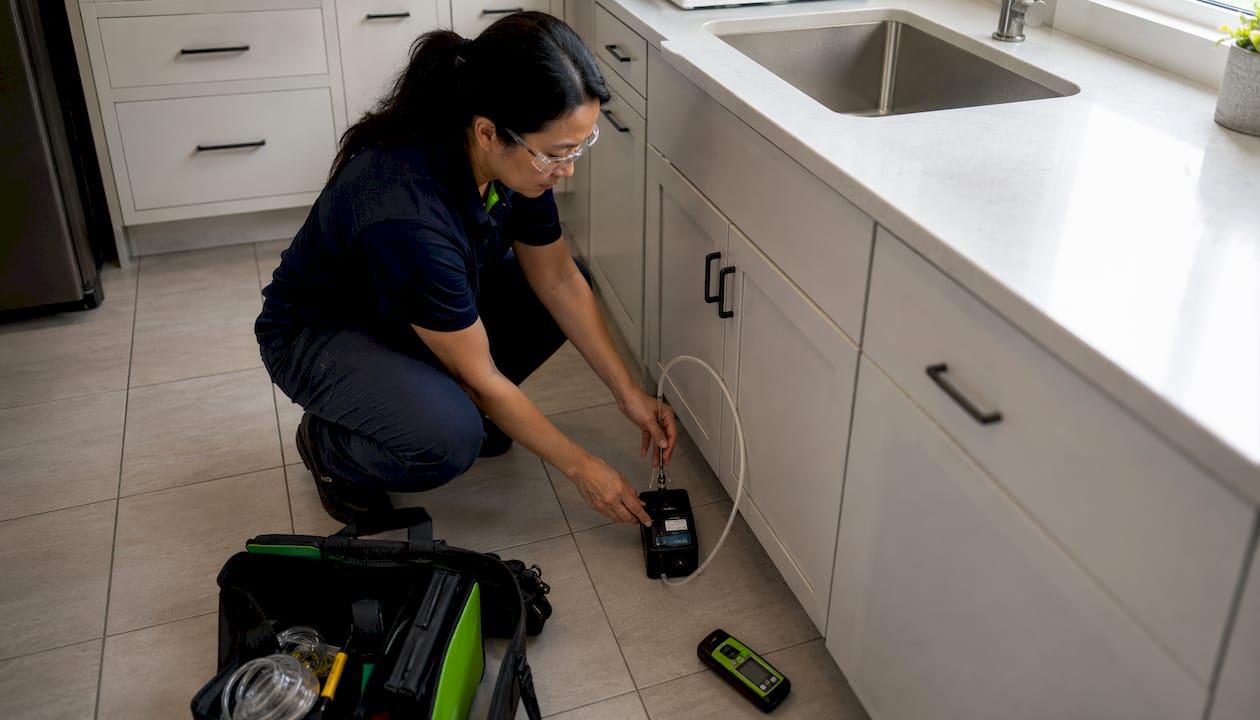
Post-restoration mold testing is the only reliable way to confirm that mold remediation actually worked. Without it, you are trusting the word of the contractor who did the work, which creates an obvious conflict of interest. A proper clearance test combines visual inspection, moisture measurement, and air sampling to verify that visible mold is gone, moisture sources are resolved, and indoor spore counts match outdoor ambient levels.
The core benefits of post-restoration mold testing include:
- Health protection: Confirms that airborne mold spores are no longer elevated, reducing allergy and respiratory risks for occupants
- Structural safety: Verifies that building materials like drywall and wood framing are dry and free of active mold growth
- Hidden problem detection: Identifies residual moisture or mold that visual cleanup alone may have missed
- Insurance documentation: Provides a third-party clearance report that insurers require or strongly prefer for claim reimbursement
- Real estate protection: Gives sellers a defensible disclosure record and buyers confidence in the property’s condition
- Long-term cost savings: Catching incomplete remediation early costs far less than re-remediating months later
- Peace of mind: Lets you re-occupy the property knowing the job was done right, verified by someone with no stake in the outcome
Independent testing by a qualified Indoor Environmental Professional (IEP) is the standard the industry recognizes. The IICRC S520 specifically calls for third-party verification separate from the remediation contractor to produce results that are credible for insurance, legal, and real estate purposes.
Table of Contents
- 1. How post-restoration mold testing protects structural integrity and occupant health
- 2. How mold testing supports insurance claims and real estate transactions
- 3. Why independent professional mold testing is essential after remediation
- 4. What to do if post-remediation testing detects mold or moisture problems
- 5. How post-restoration mold testing delivers peace of mind and long-term cost savings
- 6. What Zerowaterrestoration recommends about post-remediation mold testing
- 7. When should you schedule post-restoration mold testing?
- 8. What methods and types of mold testing are used post-restoration?
- 9. How to read your mold test results
- Zerowaterrestoration is ready to help you verify your home is safe
- Key Takeaways
1. How post-restoration mold testing protects structural integrity and occupant health
Mold does not just look bad. Molds gradually destroy the materials they colonize, breaking down wood framing, drywall, and insulation over time. A clearance test that confirms dryness and visual cleanliness is the checkpoint that stops that decay before it compounds.
A thorough post-remediation clearance covers three assessments:
- Visual inspection: No visible mold, mold-damaged materials, or musty odors anywhere in the remediated area
- Moisture measurement: Building materials like wood and drywall must read below established dry-standard thresholds
- Air sampling: Indoor spore counts compared to outdoor levels to confirm the fungal ecology has returned to normal
The health side is equally direct. Building occupants exposed to mold can experience headaches, breathing difficulties, skin irritation, allergic reactions, and worsening asthma symptoms. Clearance testing confirms those risks are gone before anyone moves back in. That is not a precaution you can skip and make up for later.
Pro Tip: Ask your IEP to collect an outdoor control sample at the same time as indoor air samples. Without that comparison, the indoor numbers have no meaningful baseline.

2. How mold testing supports insurance claims and real estate transactions
Insurance adjusters and real estate attorneys both want the same thing: a paper trail they can trust. An independent clearance report provides exactly that, and it carries weight precisely because it comes from someone who was not paid to do the remediation.
Key documentation benefits include:
- Insurance claims: Many insurers require third-party testing documentation before closing a mold-related claim; a clearance report removes the adjuster’s ability to question whether the work was complete
- Seller disclosures: A documented clearance gives sellers a defensible record that mold was properly remediated, reducing exposure to future buyer claims
- Buyer confidence: Buyers and their inspectors can review the IEP’s report independently, which tends to move transactions forward rather than stall them
States including New York, Texas, Florida, and Maryland have licensing or disclosure laws that mandate third-party mold testing after remediation. Even in states without explicit requirements, the documentation protects you in any future dispute about the property’s condition.

3. Why independent professional mold testing is essential after remediation
The conflict of interest problem is straightforward. A remediation contractor who tests their own work has a financial incentive to pass the job. That does not mean every contractor would manipulate results, but it does mean the results carry less credibility with insurers, attorneys, and future buyers.
The IICRC S520 standard is explicit on this point: post-remediation verification should be performed by an IEP who is independent of the remediator. That separation is what makes the clearance report legally acceptable and credible for insurance purposes.
What qualifies an IEP:
- Specific knowledge, training, and certification in fungal ecology assessment
- Experience designing sampling protocols and interpreting results correctly
- No financial relationship with the remediation contractor on the same project
The EPA also notes that sampling for mold should be conducted by professionals with specific experience in designing protocols and interpreting results, with analysis following methods recommended by the American Industrial Hygiene Association (AIHA) or the American Conference of Governmental Industrial Hygienists (ACGIH). Hiring someone without that background risks misleading results that give you false confidence.
4. What to do if post-remediation testing detects mold or moisture problems
A failed clearance test is not a disaster. It is the system working correctly, catching a problem before you close up walls or move furniture back in. The key is responding methodically rather than rushing to retest.
Steps to take after a failed result:
- Fix the moisture source first. Without resolving the moisture source, mold will return regardless of how thorough the cleaning was. This is non-negotiable before any re-remediation begins.
- Require a corrective scope of work from the remediation contractor that addresses the specific findings in the IEP’s report, not a generic re-clean.
- Withhold final payment until a new clearance test passes. Most remediation contracts allow for this, and it is your strongest leverage.
- Allow adequate drying time before retesting. Retesting too soon after additional work can produce misleading readings if materials have not fully dried.
- Document everything in writing, including the failed report, the corrective work performed, and the passing clearance that follows.
Engaging a qualified remediation specialist for follow-up work, rather than the lowest available bidder, matters here. Incomplete corrections just push the problem forward.
5. How post-restoration mold testing delivers peace of mind and long-term cost savings
The cost of independent post-remediation mold testing is generally between $300 and $600.
Clearance testing protects your investment in several concrete ways:
- Prevents re-remediation costs by catching incomplete work before reconstruction seals it in
- Reduces liability exposure for property managers who need to demonstrate due diligence to tenants or regulators
- Supports future resale by giving you a dated, professional clearance report to include in disclosures
- Reduces health-related costs by confirming that occupants are not being exposed to elevated spore levels
The post-restoration testing advantages extend beyond the immediate project. A documented clearance becomes part of the property’s maintenance record, useful for any future water damage claim, refinancing appraisal, or sale negotiation. Skipping it to save a few hundred dollars is a trade-off that rarely holds up over time.
6. What Zerowaterrestoration recommends about post-remediation mold testing
Zerowaterrestoration has been handling water damage and mold remediation across the northwest suburbs of Chicago for over a decade. In that time, the team has worked through enough insurance claims and post-remediation disputes to know exactly where things go wrong when clearance testing is skipped or done by the wrong party.
The team at Zerowaterrestoration works directly with insurance adjusters throughout Chicagoland, managing documentation and communicating with carriers so homeowners are not left navigating that process alone. Their experience with mold remediation services includes coordinating the timing of independent clearance testing to fit the project schedule, so testing happens at the right point in the process rather than as an afterthought.
For homeowners dealing with water damage that led to mold, understanding how restoration prevents mold after flooding is the first step. Clearance testing is how you confirm that prevention worked.
7. When should you schedule post-restoration mold testing?
Timing matters more than most homeowners realize. Testing too early, before materials have fully dried or before all remediation work is complete, produces results that do not reflect the actual final condition of the space.
The right sequence:
- All remediation work, including removal of mold-damaged materials and cleaning of affected surfaces, must be fully complete.
- Containment barriers should still be in place at the time of testing to reflect actual remediated conditions.
- The area must have returned to normal temperature and humidity levels, typically after the drying equipment has been removed and the space has stabilized.
- The EPA recommends revisiting the site shortly after remediation to confirm no signs of water damage or mold growth have returned before final occupancy.
For most residential projects, testing occurs within a few days of remediation completion. Larger commercial projects or those involving significant structural drying may require a longer stabilization period. Your IEP can advise on the specific timing based on the materials involved and the moisture readings at project close.
8. What methods and types of mold testing are used post-restoration?
Post-remediation testing is not a single test. It is a combination of methods, and air sampling alone is insufficient because it captures only a moment in time and can miss residual contamination that a visual or moisture check would catch.
The three primary methods used in a clearance inspection:
Visual and olfactory inspection is the most important component. An IEP looks for visible mold, mold-damaged materials, dust accumulation in the remediated area, and any musty or moldy odors. No amount of clean air sampling overrides a visual finding of active mold.
Moisture measurement uses a calibrated moisture meter to confirm that wood framing, drywall, and other building materials have dried to acceptable levels. Elevated moisture readings indicate that conditions still favor mold growth, even if nothing is visible yet.
Air sampling collects spore counts from the remediated area and compares them to an outdoor control sample taken at the same time. The goal is not to hit a specific number. No federal or EPA-approved numeric threshold exists for indoor mold spores. Instead, the IEP evaluates whether the types and concentrations of spores indoors are comparable to what is found in outdoor ambient air, confirming the space has returned to normal fungal ecology.
Surface sampling, using tape lifts or swabs, may also be used when a specific surface needs to be confirmed clean after remediation.
9. How to read your mold test results
Most homeowners receive a clearance report and are not sure what passing actually means. The answer is less about specific numbers and more about relative comparison.
A passing clearance means:
- No visible mold or mold-damaged materials anywhere in the remediated area
- Moisture readings in building materials fall below dry-standard thresholds for the material type
- Indoor air samples show spore types and concentrations that are consistent with the outdoor control sample collected at the same time
A failing result does not always mean the remediation was done poorly. Sometimes outdoor spore counts spike due to weather, which can temporarily affect indoor readings. An experienced IEP accounts for this by evaluating the qualitative relationship between indoor and outdoor samples, not just raw counts.
What you should receive in writing: the IEP’s sampling methodology, laboratory results with species identification, outdoor control data, moisture readings by location, and a clear pass or fail determination with the reasoning behind it. If the report does not include all of these elements, ask for clarification before accepting it as a final clearance.
Zerowaterrestoration is ready to help you verify your home is safe
After mold remediation, the last thing you want is uncertainty about whether the job was truly finished. Zerowaterrestoration handles the full scope of water damage and mold remediation for homeowners across the northwest suburbs of Chicago, from Schaumburg and Arlington Heights to Barrington, Lake Zurich, and Streamwood. The team coordinates independent clearance testing as part of every mold project, works directly with your insurance carrier to manage documentation, and does not hand the property back until the work meets the standard it should.
If you are dealing with water damage or mold in the Chicagoland area, get a free inspection and estimate by calling (847) 515-7000 or visiting zerowaterrestoration.com. For Illinois homeowners navigating the full restoration process, the water damage restoration guide covers what to expect from start to finish.
Key Takeaways
Post-restoration mold testing is the only objective way to confirm that remediation was complete, moisture is resolved, and the property is safe to re-occupy.
| Point | Details |
|---|---|
| Independent testing is required | IICRC S520 calls for a third-party IEP separate from the remediation contractor to produce credible clearance results. |
| Three methods, not one | A valid clearance combines visual inspection, moisture measurement, and air sampling compared to outdoor control levels. |
| No federal spore threshold exists | Clearance decisions rely on comparing indoor and outdoor fungal ecology, not hitting a specific spore count. |
| Typical cost for independent clearance testing | Independent post-remediation mold testing generally costs $300–$600, a minimal investment compared to the expense of incomplete remediation or future repairs. |
| Zerowaterrestoration coordinates clearance | The team manages independent testing, insurance documentation, and full mold remediation for Chicagoland homeowners. |