
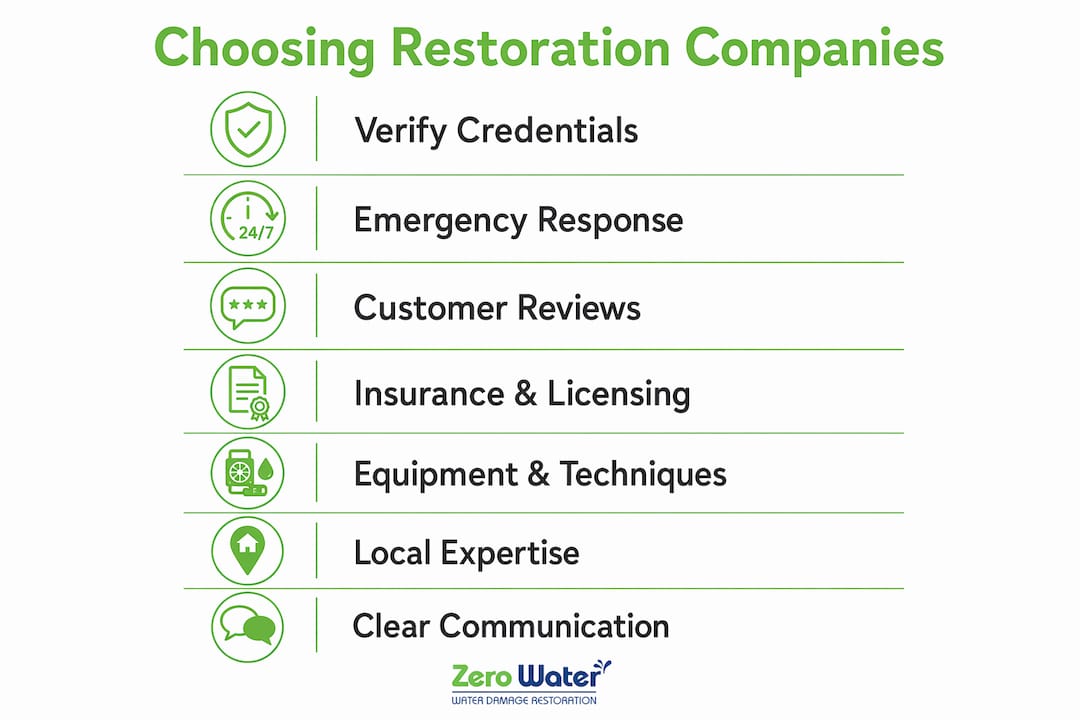
When water, fire, or mold damage hits your property, the company you call determines whether your home gets properly restored or whether you spend the next year dealing with hidden mold, failed insurance claims, and shoddy repairs. The right choice comes down to a short list of non-negotiables:
- IICRC Certified Firm status (company-level, not just individual technicians)
- Technician credentials: Water Restoration Technician (WRT), Fire and Smoke Restoration Technician (FSRT), Applied Microbial Remediation Technician (AMRT)
- Verified state licensing and adequate general liability insurance
- Emergency availability around the clock with a contractual response window, not just a marketing claim
- Documented customer reviews and verifiable references
- Professional-grade equipment and adherence to IICRC S500 and S520 standards
- Local expertise and established insurer relationships
- Transparent estimates, written contracts, and clear communication practices
Skipping any one of these checks creates real exposure, both to your property and to your insurance claim.
1. How to choose a certified restoration company by verifying credentials
The IICRC (Institute of Inspection, Cleaning and Restoration Certification) publishes the standards that govern professional restoration work. The organization offers multiple individual certifications covering every restoration discipline, but the credential that matters most at the company level is IICRC Certified Firm status.
Here is a distinction most homeowners miss: a technician’s WRT, FSRT, or AMRT credential is personal. It travels with that person if they leave the company. A Certified Firm credential belongs to the business itself, and it requires the company to maintain certified staff, carry general liability insurance, sign the IICRC Code of Ethics, and submit to a formal complaint-resolution process. If a contractor says they are “trained to IICRC standards” but cannot produce a firm number, that is a red flag.
Key certifications and what they cover:
- WRT (Water Restoration Technician): water damage, structural drying, sewer backflows, mold prevention
- FSRT (Fire and Smoke Restoration Technician): scoping, mitigation, deodorization, and documentation of fire and smoke damage
- AMRT (Applied Microbial Remediation Technician): mold and microbial contamination remediation
- MRS (Mold Remediation Specialist): advanced mold credential requiring at least one year of verified field experience
Verify any company’s firm status for free at the IICRC Global Locator. If they do not appear with an active status, they are not a Certified Firm, regardless of what their website says.
2. Does the company guarantee a fast emergency response?
Water damage compounds fast. Mold can begin developing within 24–48 hours of a moisture event, so the gap between your call and a crew arriving on-site directly affects how much damage you ultimately face.
Professional restoration companies should guarantee emergency response with a defined on-site arrival window, not just a general promise of 24/7 availability. The phrase “available 24/7” is marketing. A written commitment to a specific arrival window is a contractual obligation.
Questions to ask before you sign anything:
- What is your guaranteed on-site arrival time after an emergency call?
- Do you have crews on call overnight and on weekends, or do you use an answering service?
- How do you handle simultaneous emergencies in the same area?
- Will the same crew handle mitigation and reconstruction, or do you subcontract?
Pro Tip: Ask for the emergency response guarantee in writing before you hire. If a company hesitates or says it “depends on the situation,” that tells you everything you need to know about how they will perform at 2 AM on a Sunday.
3. What do customer reviews actually tell you?
A company’s reputation is the closest thing to a preview of your own experience. Look beyond the star rating and read for patterns: how does the company respond to negative reviews? Do complaints mention the same issues repeatedly? Are positive reviews specific about the crew, the timeline, and the outcome?
Where to look:
- Google Business Profile (most reliable volume of reviews)
- Better Business Bureau (BBB) for complaint history and resolution
- Nextdoor and local Facebook groups for neighborhood-level feedback
- Your insurance adjuster or agent, who often has a vetted vendor list
Red flags worth taking seriously: no verifiable online presence, a pattern of unresolved complaints about billing disputes, or reviews that mention the company disappeared after the initial mitigation without completing the job. A company with a strong track record on restoration company selection will welcome reference requests and provide them quickly.
4. Is the company properly insured and licensed?
Hiring an uninsured or unlicensed contractor is one of the fastest ways to turn a bad situation into a catastrophic one. If a worker is injured on your property and the company carries no liability insurance, you may be exposed. If the work causes additional damage, you have no financial backstop.
Before signing any authorization form, confirm:
- General liability insurance: ask for a certificate of insurance naming you as an additional insured for the duration of the project
- Workers’ compensation coverage: protects you if a crew member is injured on-site
- State contractor license: verify the license number through your state’s contractor licensing board
- Mold-specific licensing: mold remediation requires a separate state-mandated license in many states, distinct from a general contractor license. Relying on a general contractor license alone for mold work is a real risk
Certified firms are required to carry adequate liability insurance as a condition of maintaining their IICRC status, which gives you one more reason to prioritize firm certification over individual technician credentials alone.
5. What equipment and techniques should a qualified company use?
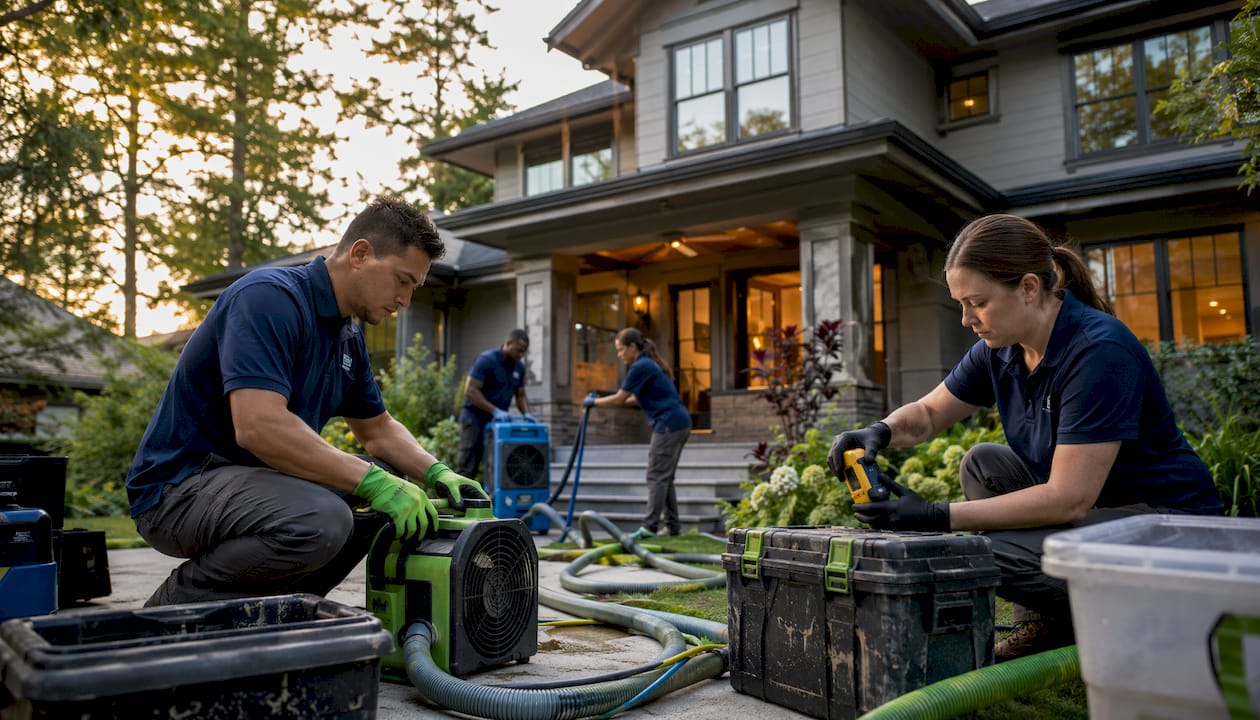
The difference between a company that dries your home and one that actually restores it often comes down to equipment. Professional-grade tools produce measurable, documentable results. Consumer-grade or inadequate equipment leaves moisture behind, which leads to mold and structural damage weeks later.
Standard equipment for a qualified restoration firm:
- Truck-mounted or portable water extractors for rapid water removal
- Industrial dehumidifiers calibrated to the affected space
- Air movers positioned to maximize evaporation rates
- Thermal imaging cameras to locate hidden moisture behind walls and under floors
- Air scrubbers and HEPA filtration for mold and smoke remediation
- Moisture meters and psychrometric logging equipment to document drying progress against IICRC S500 standards
Ask the company whether they will provide psychrometric logs and moisture readings throughout the project. Demanding that documentation is the benchmark for confirming restoration meets professional standards and prevents secondary damage. If a company cannot explain what psychrometric data is, that is a problem.
6. Why does local expertise matter for restoration work?
A local restoration company brings knowledge that a national call center simply cannot replicate. They understand the regional building codes that affect how walls and floors are constructed, the climate patterns that drive specific moisture and mold risks, and the local insurance adjusters they have worked with before.
For homeowners in the Chicago suburbs, for example, freeze-thaw cycles create specific pipe-burst patterns that a locally experienced crew recognizes immediately. That familiarity speeds up the assessment and reduces the chance of missed damage. Local water damage companies also tend to have established relationships with regional insurance carriers, which smooths the claims process considerably.
Questions to assess local knowledge:
- How long have you operated in this specific area?
- Are you familiar with the building codes and permit requirements in my municipality?
- Have you worked with my insurance carrier before?
7. Are the estimates, contracts, and communication practices clear?
Restoration projects can run for days or weeks, involve multiple trades, and generate significant insurance documentation. A company that communicates poorly at the estimate stage will communicate poorly throughout the project.
Before work begins, get clarity on:
- Scope of work: what is included, what is excluded, and what triggers a change order
- Written estimate: itemized, not a single lump sum
- Project manager credentials: who is your point of contact, and what are their certifications
- Update frequency: how often will you receive progress reports
- Dispute escalation: what is the written process if work does not meet the agreed standard
Certified firms are required to follow documented procedures, and that discipline shows up in how they communicate. Moisture readings, project progress logs, and clearance testing are all part of how professional firms advocate for their clients during the insurance claim process.
8. Why IICRC Certified Firm status changes your insurance outcome
Insurance adjusters are trained to look for IICRC Certified Firm credentials when reviewing restoration claims. A certified firm’s documentation follows the S500 (water damage) and S520 (mold remediation) consensus standards, which means the claim file arrives organized, complete, and aligned with what the carrier expects. That translates directly to faster claim approvals and fewer disputes over scope.
The firm-level credential also provides something individual technician certifications cannot: a formal complaint-resolution pathway through the IICRC. If a job goes wrong, you have a structured escalation process. With an uncertified contractor, your only recourse is civil litigation.
Pro Tip: Before hiring, ask for the company’s IICRC Certified Firm number and verify it yourself at the IICRC Global Locator. The search takes under a minute. If the firm number does not appear with an active status, walk away.
Industry experts view IICRC certification as a critical risk management tool that ensures accountability, insurance coverage, and ethical operation safeguards unavailable from uncertified companies. For storm-related damage that involves both roofing and interior water intrusion, coordinating with contractors who understand insurance documentation from the start prevents gaps in your claim.
9. What does restoration typically cost, and what drives the price?
Restoration costs vary widely based on damage type, affected square footage, materials involved, and how quickly mitigation begins. Water damage restoration for a single room runs far less than a whole-floor flood with contaminated water. Mold remediation pricing depends on the extent of growth and whether structural materials need replacement.
Factors that influence the final cost:
- Damage category: clean water (Category 1) costs less to remediate than sewage backup (Category 3)
- Affected area size: more square footage means more equipment, more labor, and longer drying time
- Material type: hardwood floors and plaster walls cost more to restore than vinyl and drywall
- Response speed: the faster mitigation begins, the less secondary damage accumulates, and the lower the total cost
- Insurance coverage: your deductible, policy limits, and the company’s ability to document to carrier standards all affect your out-of-pocket exposure
Get at least two written, itemized estimates before authorizing work. A reputable company will provide one without pressure.
10. How long does a restoration project take?
Timeline depends heavily on damage type and severity. A straightforward water extraction and structural drying job in a single room usually takes several days for the drying phase alone, followed by any needed reconstruction. A larger loss involving multiple rooms, contaminated water, or mold remediation can run several weeks.
General benchmarks:
- Water extraction: completed within hours of arrival
- Structural drying: typically 3–5 days, confirmed by moisture meter readings
- Mold remediation: several days depending on scope, plus clearance testing
- Reconstruction: varies by scope, from days to several weeks
The restoration project phases follow a defined sequence, and a qualified company will walk you through the expected timeline at the estimate stage. Ask for a written schedule with milestones, not just a verbal estimate.
11. What warranties and guarantees should a restoration company offer?
A reputable restoration company stands behind its work with a written warranty. The scope varies, but at minimum you should expect a workmanship guarantee covering the quality of repairs and a mold-free guarantee for any remediated areas, provided the underlying moisture source has been corrected.
Ask specifically:
- What does the warranty cover, and for how long?
- Does the guarantee apply if the same area experiences a new moisture event?
- Is the warranty transferable if you sell the property?
- What is the process for filing a warranty claim?
Written guarantees protect you and signal that the company is confident in its own work. A contractor who resists putting a guarantee in writing is telling you something.
Key Takeaways
Choosing a certified restoration company requires verified IICRC Certified Firm status, documented insurance and licensing, and a written emergency response commitment before any work begins.
| Point | Details |
|---|---|
| IICRC Certified Firm status | Verify the firm number on the IICRC Global Locator; firm certification covers insurance, ethics, and complaint resolution at the company level. |
| Technician credentials | Confirm WRT, FSRT, or AMRT certifications match the damage type; individual credentials travel with the technician, not the firm. |
| Insurance and licensing | Require a certificate of general liability insurance and verify the state contractor license; mold work requires a separate state-mandated license in many states. |
| Written emergency response | Get the guaranteed arrival window in writing before hiring; verbal “24/7 availability” claims carry no contractual weight. |
| Zerowaterrestoration | Zerowaterrestoration serves the Chicagoland northwest suburbs with 24/7 emergency response, full-scope restoration, and direct insurance coordination. |
Zerowaterrestoration: local, certified, and ready when it matters
When you have done the research and know what a qualified restoration company looks like, the next step is finding one that actually fits your situation.
Zerowaterrestoration is a locally owned restoration company based in Schaumburg, Illinois, with over 10 years serving homeowners across the northwest suburbs, including Barrington, Lake Zurich, Streamwood, Arlington Heights, and Palatine. The team is available 24/7 for emergency response and handles the full scope of work: water extraction, structural drying, mold remediation, and complete reconstruction. What sets Zerowaterrestoration apart from a generic call-center dispatch is the direct insurance coordination. The team works with your adjuster, manages the documentation, and keeps your out-of-pocket costs as low as your policy allows. For homeowners in the Chicagoland area dealing with water damage restoration, call (847) 515-7000 or visit zerowaterrestoration.com for a free inspection and estimate.