
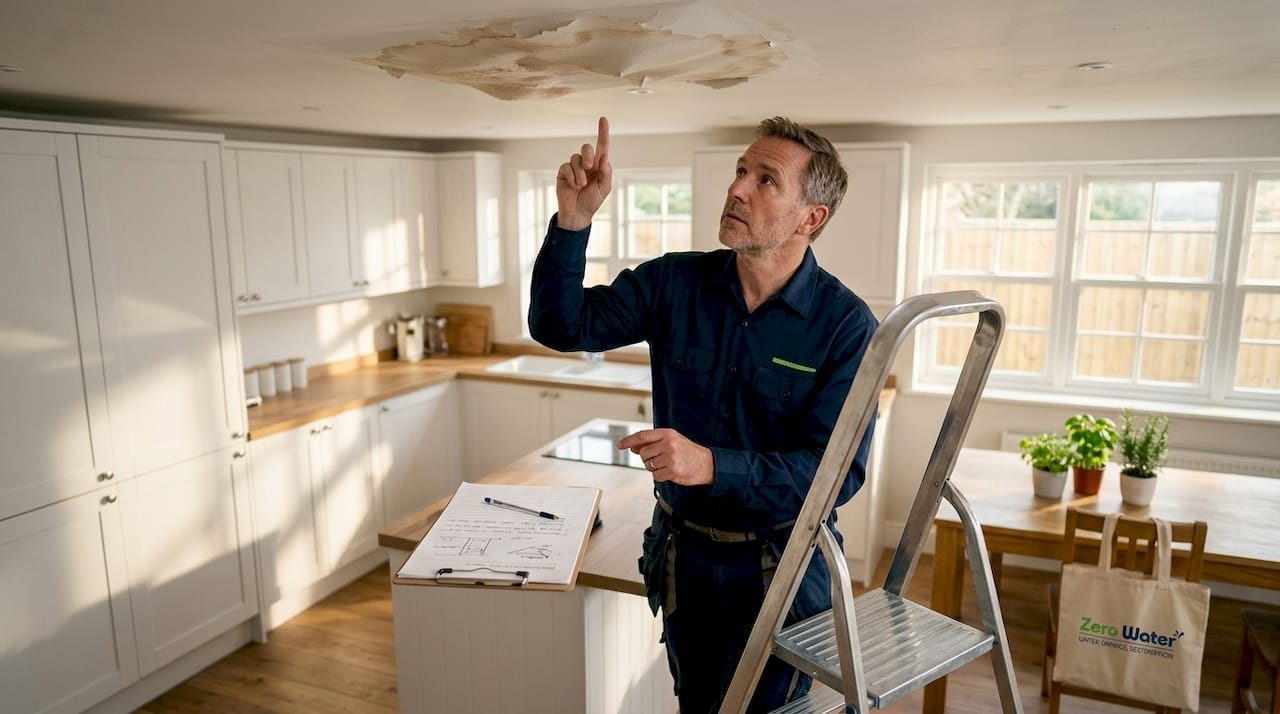
Water damaged ceilings collapse because absorbed moisture dramatically increases their weight, destroys the structural integrity of gypsum and plaster, and causes fasteners to pull free from the framing above. This process, known in the restoration industry as “wet ceiling failure,” moves faster than most homeowners expect. A standard 4×8 sheet of drywall weighs roughly 52 pounds when dry. Saturated drywall can exceed 200 pounds, which is four times the load those screws and nails were designed to hold. Understanding why water damaged ceilings collapse is not just useful knowledge. It is the difference between catching a problem early and standing under a ceiling that is about to come down.
Why water damaged ceilings collapse: the core mechanics
The physics behind ceiling collapse are straightforward. Drywall is a gypsum core sandwiched between two layers of paper facing. That paper facing gives the panel its tensile strength and holds the screws in place. When water saturates the panel, the gypsum core softens into a paste-like consistency and the paper facing delaminates, meaning it peels away from the core. Once that happens, screw heads no longer grip the panel. They pull through.
Plaster ceilings fail through a different but equally dangerous process. Plaster relies on tensile strength to stay rigid. Moisture causes it to lose that strength, leading to cracking, bowing, and eventually chunks breaking free. Unlike drywall, plaster is heavier to begin with, so the falling debris carries more force.
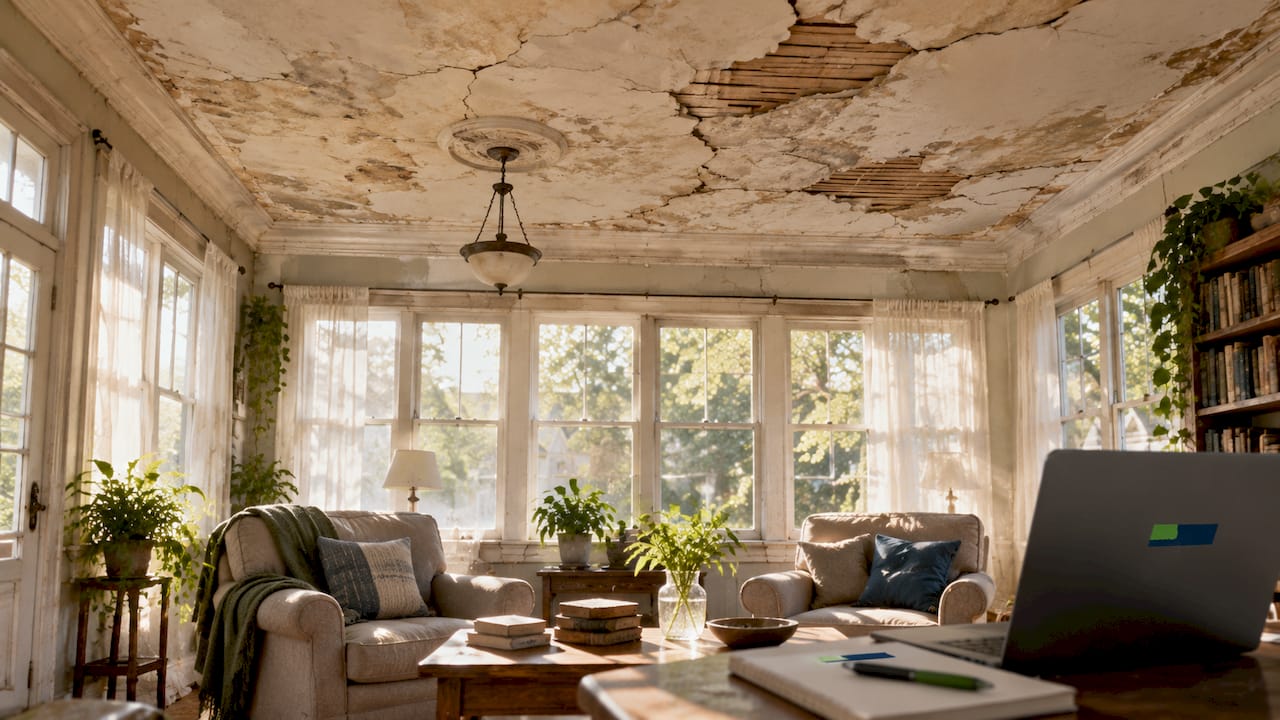
The fasteners holding your ceiling up were engineered for a specific load. A dry drywall panel sits well within that range. A fully soaked panel blows past it entirely. This is why sagging or bowing surfaces are not cosmetic issues. They are signs that the fastener system is already failing.
Pro Tip: If you press gently on a ceiling area and it feels soft or spongy, stop immediately. That texture means the gypsum core has already lost its integrity. Do not apply more pressure.
What are the warning signs a ceiling is about to fall?
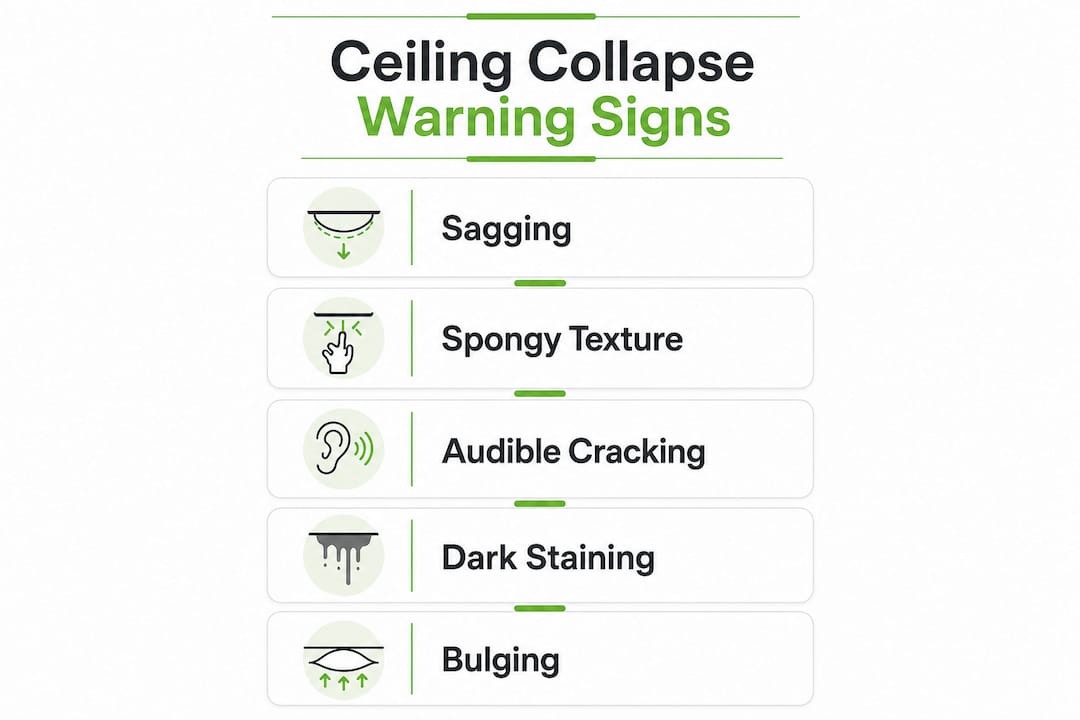
Recognizing the signs of a failing ceiling gives you time to act before a collapse occurs. The warning signals follow a predictable sequence, and each one represents a more advanced stage of structural failure.
- Sagging or bulging sections. Any visible deformation in the ceiling plane means water has pooled above and the panel is bending under the added weight. Sagging drywall commonly develops within 48–72 hours of an unresolved water source. That window closes fast.
- Soft or spongy texture when touched. A ceiling that gives under light pressure has a compromised gypsum core. This is a structural emergency, not a cosmetic defect.
- Bubbling, peeling, or blistering paint. Paint bubbles form when moisture collects between the paint film and the drywall surface. This is often the first visible sign of water intrusion above.
- Cracking or popping sounds. Audible popping or cracking from the ceiling indicates fasteners pulling free or framing members shifting under moisture stress. This is an immediate evacuation signal.
- Active dripping or wet spots. Visible moisture penetration points confirm that water is still entering the assembly. The damage is ongoing.
- Mold growth or dark staining. Mold can develop within 24–48 hours of moisture exposure in ceiling materials. Visible mold means the moisture has been present long enough to create a secondary health hazard alongside the structural risk.
Pro Tip: Dark staining that appears in a ring pattern, sometimes called a “tide mark,” shows where water has dried and left mineral deposits behind. Multiple rings mean the leak has happened more than once.
The combination of sagging, audible cracking, and a spongy texture represents imminent collapse conditions. If you observe all three together, clear the room and call a professional immediately.
Where does the water come from? Common sources of ceiling damage
Water reaches your ceiling through several distinct pathways, and identifying the source is the first step toward stopping the damage.
Roof and attic failures
Roof leaks are the most common cause of ceiling water damage in Chicagoland homes. Damaged shingles, failed flashing around chimneys and vents, and ice dams in winter all allow water to enter the attic. The critical detail most homeowners miss: water travels along rafters and sheathing before it ever drips through the ceiling. The wet spot on your ceiling may be several feet away from the actual roof penetration. Moisture also accumulates in attic insulation, which then transfers that moisture to the ceiling framing below, causing rot over time. If you notice signs your roof needs repair, address them before they become a ceiling emergency.
Plumbing and appliance leaks
Burst pipes, failed wax rings under toilets, and slow drain leaks above a ceiling are all direct causes of ceiling saturation. A bathroom on the second floor leaking into the first-floor ceiling is one of the most common scenarios Zerowaterrestoration responds to in the northwest suburbs. HVAC condensation line clogs are another frequent culprit. When a condensate drain line backs up, water overflows the drip pan and soaks directly into the ceiling assembly below the air handler.
Appliance and fixture failures
Dishwashers, refrigerators with ice makers, and washing machines all carry supply lines that can fail. A slow leak behind a refrigerator can go unnoticed for weeks while it saturates the subfloor and migrates to the ceiling of the room below. Kitchen and bathroom exhaust fans that vent improperly can also push humid air into the attic, where it condenses on cold framing and insulation.
| Water source | How it reaches the ceiling | Key risk factor |
|---|---|---|
| Roof leak | Travels along rafters before dripping | Entry point may be far from wet spot |
| Burst pipe | Direct saturation from above | Rapid, high-volume flooding |
| HVAC condensate overflow | Overflows drip pan onto ceiling below | Often slow and undetected |
| Appliance supply line | Migrates through subfloor to ceiling below | Weeks of hidden damage possible |
| Ice dam | Backs up under shingles into attic | Seasonal, concentrated in winter |
How to prevent ceiling collapse and respond safely
Preventing ceiling collapse comes down to speed and the right sequence of actions. Every hour of delay after a water intrusion event increases the structural risk.
-
Locate and stop the water source first. Shut off the water supply valve if a plumbing leak is involved. For roof leaks, place buckets and call a roofer immediately. Knowing how to stop a roof leak fast can limit the volume of water reaching your ceiling assembly.
-
Do not touch, poke, or puncture a sagging ceiling. This is the most common and most dangerous mistake homeowners make. A sagging section is holding pooled water above it. Puncturing it releases that water suddenly and can trigger a full panel collapse.
-
Cut power to affected circuits immediately. Water near electrical fixtures poses a serious shock risk. Shut off the breaker for any room where the ceiling is wet or sagging before you do anything else.
-
Call a water damage restoration professional without delay. Professional drying must begin within 24–48 hours to prevent mold growth and limit structural damage. Zerowaterrestoration responds 24/7 throughout Schaumburg, Arlington Heights, Palatine, and the surrounding northwest suburbs.
-
Do not attempt to patch or paint over damaged drywall. Patching masks failure without restoring integrity. A sagging ceiling section does not regain strength after drying. The compromised material must be cut out and replaced entirely.
-
Get a structural evaluation for any cracked or sagging ceiling. Small water stains under 3 square feet may be manageable with careful monitoring, but sagging always requires professional assessment. There is no safe DIY threshold for a ceiling that has lost its shape.
-
Address mold risk as part of the repair. Ceiling assemblies that have been wet for more than 24 hours carry mold risk. Professional mold prevention after a leak is not optional. It protects both the structure and the air quality in your home.
Pro Tip: Take photos and video of all visible damage before any cleanup begins. This documentation is critical for your insurance claim and helps restoration professionals assess the full scope of the damage.
Key Takeaways
Water damaged ceilings collapse because saturation multiplies panel weight, destroys gypsum integrity, and causes fasteners to fail, making any sagging or soft ceiling a structural emergency requiring immediate professional response.
| Point | Details |
|---|---|
| Weight is the primary collapse driver | Saturated drywall can exceed 200 lbs, overwhelming fasteners designed for a 52-lb dry panel. |
| Sagging appears fast | Visible sagging can develop within 48–72 hours of an unresolved water source. |
| Mold adds a second hazard | Mold growth begins within 24–48 hours, creating health risks alongside structural failure. |
| Patching does not fix it | Compromised drywall must be replaced, not patched. Patching masks the hazard without restoring strength. |
| Electrical safety comes first | Cut power to any circuit near a wet or sagging ceiling before entering the room. |
What I’ve learned after years of ceiling collapse calls
I’ve walked into a lot of homes where the homeowner waited too long. Not because they were careless. Because the ceiling looked like “just a stain” the day before it came down. That is the deceptive part of wet ceiling failure. The visible damage on the surface is almost always less severe than what is happening inside the assembly.
The mistake I see most often is the patch-and-paint approach. A homeowner notices a brown ring, dries it out with a fan, and rolls on a coat of stain-blocking primer. The ceiling looks fine for a few weeks. Then the paper facing, which never re-bonded to the softened gypsum core, finally gives way. Sometimes it happens at 2 AM. Sometimes it happens while someone is standing underneath it.
DIY patching over water-damaged drywall is not just ineffective. It is genuinely dangerous because it removes the visual warning signal. A patched ceiling looks safe. It is not.
The other thing I want homeowners to understand is that mold risk and structural risk arrive together. By the time you see mold growth after a ceiling leak, the moisture has been present long enough to compromise the framing, not just the drywall panel. Treating the surface without addressing the framing and insulation above is an incomplete repair.
Act the moment you see a stain, a bubble, or a soft spot. The cost of a professional assessment is a fraction of the cost of a collapse and the repairs that follow.
— Jim
Zerowaterrestoration is ready when your ceiling can’t wait
A sagging or water-stained ceiling is not a problem to monitor. It is a problem to solve today.

Zerowaterrestoration provides 24/7 emergency response throughout Schaumburg, Barrington, Arlington Heights, and the greater Chicagoland northwest suburbs. The team handles the full scope of water damage restoration in Barrington and surrounding communities, from water extraction and structural drying to mold remediation and complete ceiling reconstruction. Zerowaterrestoration also works directly with your insurance provider to manage documentation and keep your out-of-pocket costs as low as possible. Call (847) 515-7000 for a free inspection, or visit zerowaterrestoration.com.
FAQ
Why do water damaged ceilings collapse so suddenly?
Ceiling panels absorb water gradually, but fastener failure happens all at once. Once the paper facing delaminates and the gypsum core softens past a critical point, the screws pull through the panel simultaneously, causing sudden collapse.
How long does it take for a wet ceiling to become dangerous?
Sagging typically develops within 48–72 hours of an unresolved water source. Mold growth can begin within 24–48 hours, adding a health hazard to the structural risk.
Can a water damaged ceiling dry out and become safe again?
No. A sagging ceiling section does not regain structural integrity after drying. The gypsum core and fastener grip remain compromised, and the material must be removed and replaced rather than dried in place.
What should I do if my ceiling is bulging?
Clear the room, cut power to any electrical circuits in that area, and call a water damage restoration professional immediately. Do not press, poke, or puncture the bulging area, as this can trigger a sudden collapse and release pooled water.
Is a small water stain on the ceiling a serious problem?
Small stains under 3 square feet may indicate a minor or resolved leak, but any stain warrants investigation to confirm the source has stopped. Sagging, soft texture, or mold growth alongside a stain always requires professional assessment, regardless of size.